Kitchen sinks, decided by gauge, mount and material
Three specifications settle almost every kitchen sink question: how thick the steel is, how it meets the counter, and what it is made of. Get those right and brand barely matters.
Start here
Answer these and you have narrowed it down
How wide is the cabinet underneath?
A sink is sized by the cabinet, not the countertop. A 30-inch sink wants a 33-inch base; a 33-inch sink wants a 36-inch base. Measure inside the cabinet before anything else.
An existing drop-in cutout can usually take another drop-in, and converting to undermount means a new countertop or a fabricator. This is the most expensive question on the page.
Cast iron and fireclay chip; stainless dents and scratches; composite hides everything but dislikes thermal shock. Match the material to how you actually cook, not to the showroom.
Thin steel drums. Gauge is part of the answer and sound-deadening pads are most of it — and they are not the same thing, which is where the marketing gets slippery.
Kitchen sinks look like a style decision and behave like an engineering one. The three numbers that decide how a sink feels to live with are steel thickness, bowl depth, and how much of the basin is covered by sound-deadening material. None of them is the number on the front of the box, and two of them are frequently left off the listing entirely.
Gauge, in thousandths of an inch
Stainless steel sinks are sold by gauge, and gauge runs backwards: a lower number is thicker steel. 16-gauge stainless is about 0.0625 of an inch; 18-gauge is about 0.05. That is a difference of roughly twelve thousandths of an inch, which sounds like nothing and is in fact a 25% increase in thickness. It buys dent resistance under a dropped cast-iron pan and a basin that flexes less when you lean on it.
What it does *not* buy, on its own, is quiet. A bare 16-gauge basin still rings. The sound fix is undercoating and pads — and the useful spec is the percentage of the basin they cover, which good manufacturers publish and poor ones do not. Our 16 gauge vs 18 gauge page is the longest on this site because the market here is almost entirely brand blogs with a thickness to sell.
Mount type, and why it is really a countertop question
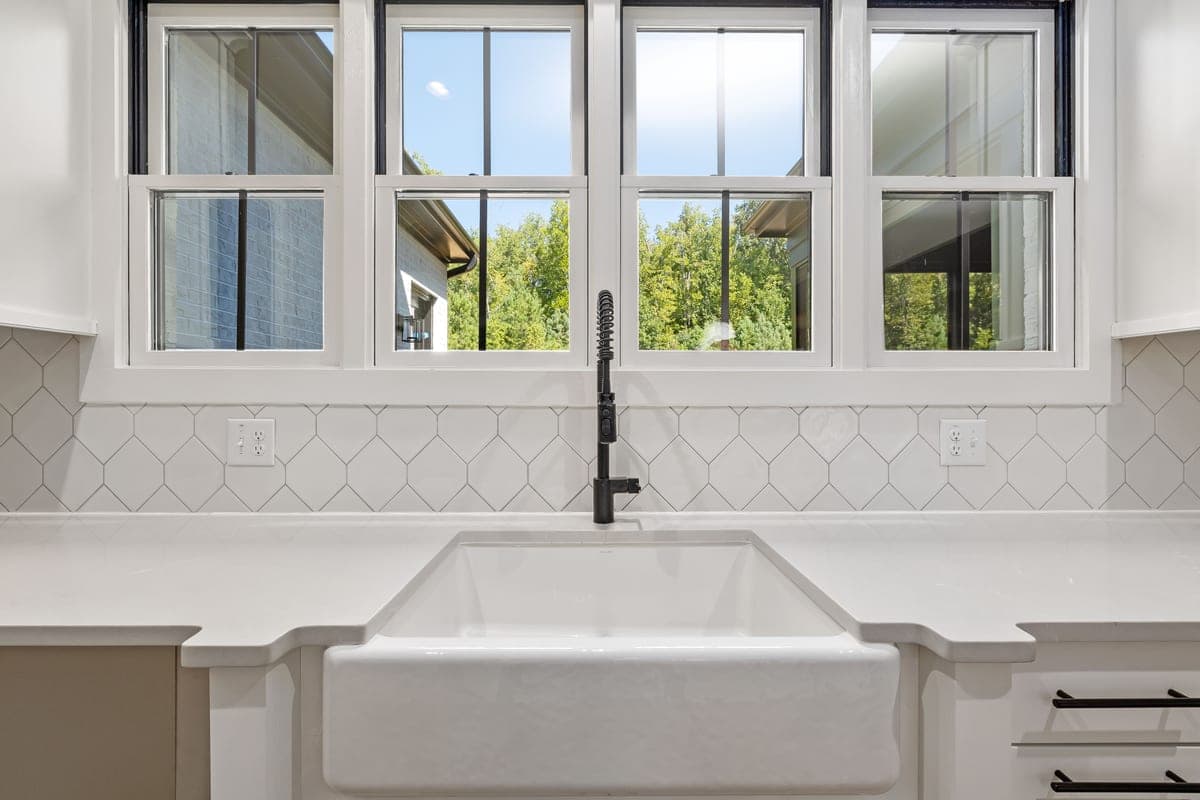
An undermount sink hangs beneath the counter, so crumbs sweep straight in and there is no rim to clean around. A drop-in (top-mount) sits in the cutout on its own flange, which means it does not depend on the countertop material for support and can be fitted by one person in an afternoon. A farmhouse or apron-front sink carries its weight on the cabinet rather than the counter, and its front face replaces the cabinet face.
The decision is usually made for you by what is already installed. Undermount needs a countertop that can carry it — stone, quartz, solid surface — and a polished cutout edge. Laminate normally cannot, without a specially built substrate. Butcher block can, with care about sealing. If your counter has an existing top-mount cutout and you want undermount, you are buying a countertop, not a sink.
Materials, honestly
What each kitchen sink material is actually good and bad at
Material
Strength
Weakness
Best for
Stainless steel
Takes abuse, takes heat, cheapest per inch of bowl
Shows scratches and water spots; rings unless damped
Households that put hot pans in the sink
Granite composite
Hides spots and scratches; quiet without pads
Thermal shock; light colors stain
Hard water and sinks you can see from the sofa
Fireclay
Non-porous glaze; lighter than cast iron
Chips on hard impact and cannot be spot-repaired
Farmhouse looks without a steel frame
Enameled cast iron
Resists chipping, cracking and heat
Heavy enough to need cabinet reinforcement
Period kitchens where weight is not a problem
Sources are on each material page. We publish no comparative lab data because none exists for residential sinks.
The honest summary: stainless is the default for a reason and composite is the upgrade that most people actually notice, because it removes the water-spot chore rather than adding a feature. Cast iron and fireclay are aesthetic choices with real installation consequences, and both are the wrong answer in a kitchen where pans get dropped.
Bowl configuration and depth
Single bowl or double bowl is a workflow question, and the trend toward single bowls is not fashion: a 30-inch single bowl takes a full sheet pan flat, and two 15-inch bowls take nothing larger than a dinner plate. The counter-argument is real too — a second bowl is where the drying rack lives, and it is where you put the thing you do not want to look at.
Depth follows the same logic. Ten inches is now common and it is genuinely better for hiding dishes and washing trays; it is also a longer reach for a shorter person and a tighter fit around a garbage disposal and a P-trap. If you are fitting a disposal, read our disposal sizing and fit page before choosing bowl depth, because the two constrain each other and the constraint is discovered under the cabinet at the worst moment.
Workstation sinks: the one genuine innovation
A workstation sink has an integrated ledge milled into the basin walls so a cutting board, colander or drying rack slides along it. In a small kitchen it converts the sink into prep counter, which is the best square-footage trade available under $600. It is also the one sink configuration where 16-gauge steel matters most, because accessories rest on the rim and transmit every bit of basin flex to your hands.
Buying guides
Ranked picks with a comparison table, per-pick reasoning from published specifications, and an honest note on who each one is wrong for.
16 gauge is thicker. Stainless steel gauge runs inversely to thickness: 16-gauge is about 0.0625 inches and 18-gauge about 0.05 inches, so 16-gauge is roughly 25% thicker. That buys dent resistance and less flex; quietness comes mainly from sound-deadening pads, not gauge.
What size sink fits a 36-inch cabinet?
A 33-inch sink is the standard fit for a 36-inch base cabinet, leaving room for the cabinet sides and the mounting hardware. As a rule, subtract three inches from the cabinet width to get the largest sink that will fit comfortably, and check the manufacturer's stated minimum cabinet size rather than assuming.
Can I put an undermount sink in a laminate countertop?
Usually not without a purpose-built substrate. Laminate's particleboard core is exposed at the cutout edge and will swell where water reaches it, and it is not designed to carry a sink's weight from below. Drop-in is the correct choice for laminate, and it is not a compromise — the flange covers the cut edge, which is exactly what laminate needs.
Do granite composite sinks stain?
Light-colored ones can, from turmeric, tea and tomato, and the fix is a mild abrasive cream rather than bleach. Dark colors hide staining almost completely. The more important limitation is thermal shock: composite does not want a pan straight off the burner, where stainless does not care.