Kitchen Sinks
Farmhouse sinks, and the cabinet work nobody mentions
An apron-front sink is a cabinet project as much as a sink purchase. One design detail decides whether it is a rough cut or a cabinetmaker's fit.
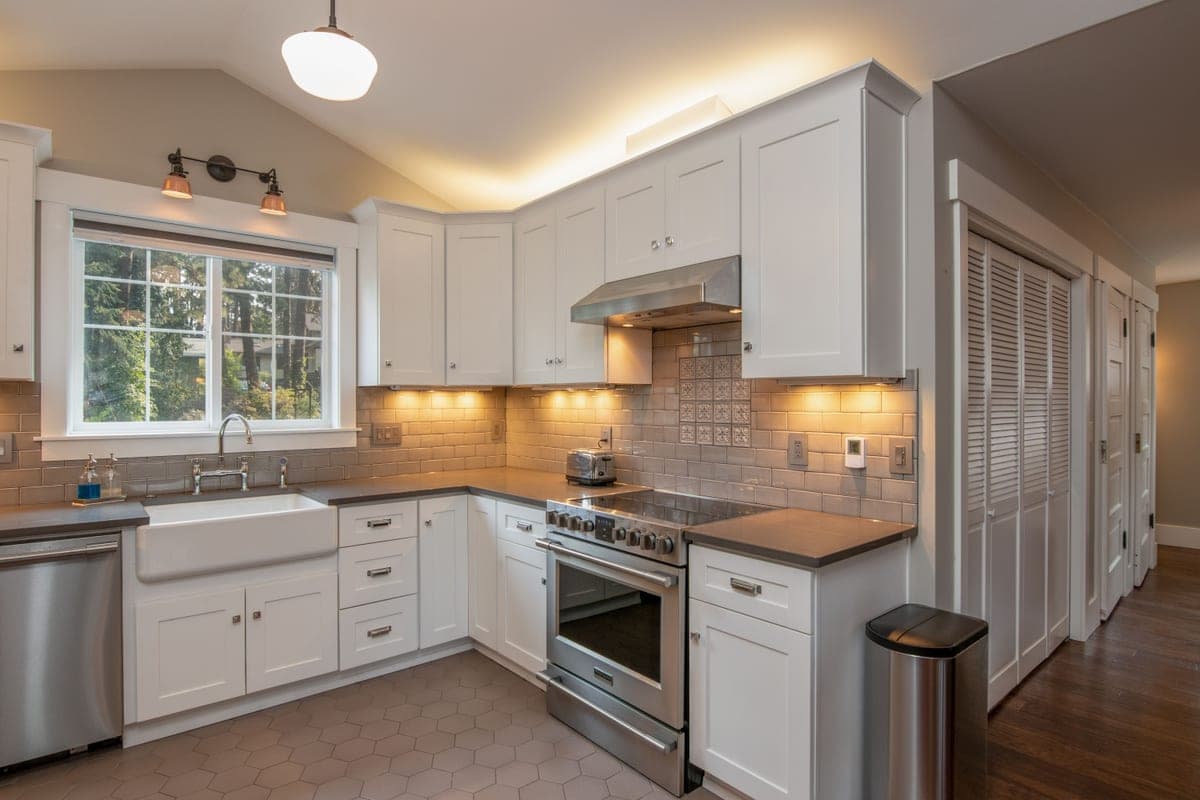
Disclosure: we earn a commission if you buy through the Amazon links on this page, at no extra cost to you. Commission never decides a verdict or a ranking position — read our editorial policy and affiliate disclosure.
How we assessed these: we compared published manufacturer specifications, read from each maker's own page or listing and linked at every figure. We have not installed or tested these products. Where a figure is not published, the page says so rather than estimating it.
Short answer
A farmhouse or apron-front sink carries its weight on the cabinet rather than the countertop, and its front face replaces the cabinet's front face. A 36-inch cabinet is the usual requirement for a 33 to 36-inch sink. The detail that decides difficulty is whether the sink is self-trimming: a self-trimming apron overhangs the cut, so a rough cabinet cut is enough.
Farmhouse sinks are bought for the look and installed as a carpentry job. The bowl is large, the front is exposed, and the sink sits forward of where a normal sink sits — all of which is why they feel generous to use and why the fitting is more involved than any other sink type.
Quick picks
Tap any row to jump to the full write-up. There are no scores here because we run no test lab — how picks are chosen is published in full on our methodology page.
| # | Product | Best for | Our read | Price |
|---|---|---|---|---|
| 1 | 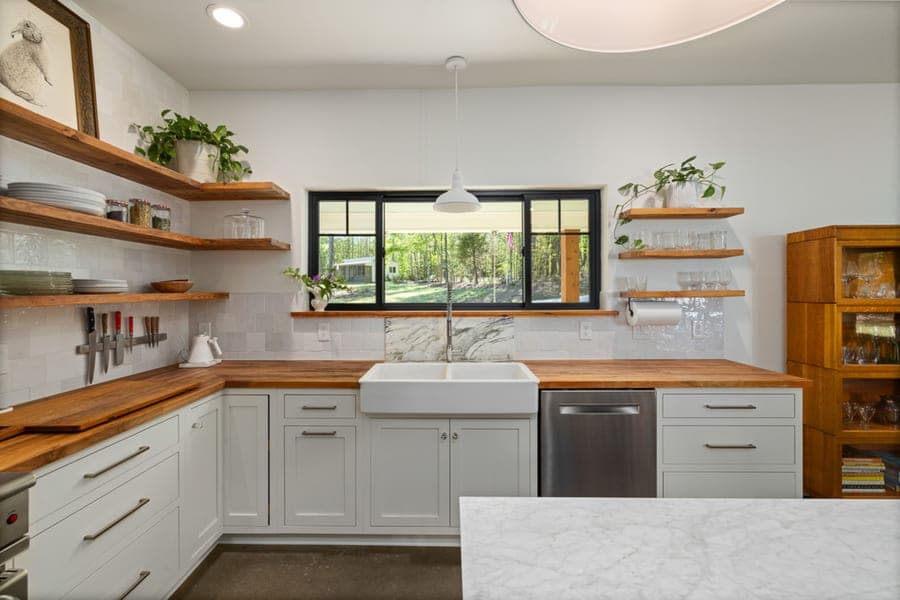 Kohler Whitehaven K-6489 Best farmhouse sink | Farmhouse looks without a custom cabinet | Self-trimming apron — a rough cut, not a precision fit | Check price on Amazon #ad Affiliate link · We publish no price; Amazon shows the current one |
| 2 | 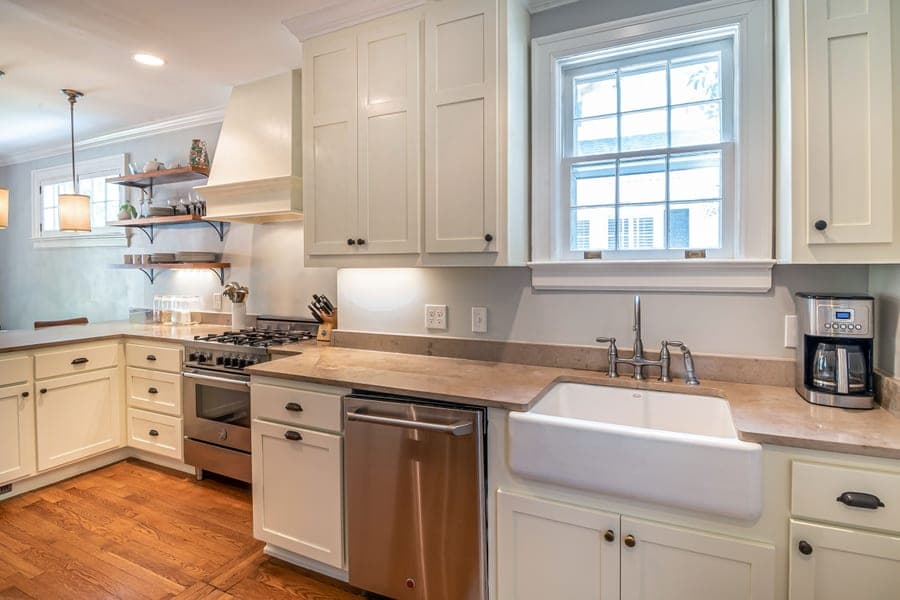 BOCCHI Classico 30-inch fireclay farmhouse sink Best fireclay farmhouse | Farmhouse style, lighter than cast iron | Lighter than cast iron, grid and strainer included | Check price on Amazon #ad Affiliate link · We publish no price; Amazon shows the current one |
| 3 |  Kohler Duostrainer K-8801 Best drain to pair | Replacing a failed sink drain | Brass basket strainer with tailpiece included | Check price on Amazon #ad Affiliate link · We publish no price; Amazon shows the current one |
The dimensions that matter
Farmhouse sinks are commonly 30, 33 or 36 inches wide, and the width quoted is the sink rather than the cabinet. The Kohler Whitehaven K-6489 is 35-11/16 inches wide by 21-9/16 deep front to back, with a basin of 30-3/4 by 18-1/16 and a 9-inch depth, and Kohler states a 36-inch minimum cabinet. Those are the numbers to design around, and they are published — treat any listing that does not publish them as incomplete.
Front-to-back depth matters more on an apron sink than elsewhere, because the sink projects forward: a 21-1/2-inch-deep sink in a 24-inch-deep counter leaves very little behind the bowl for the faucet. Check where your faucet will actually mount before you commit.
Self-trimming: the specification to look for
A traditional apron sink needs the cabinet face cut precisely to the sink's dimensions, because the sink sits inside the opening and any gap shows. A self-trimming design has a slight overhang on the apron that covers the cut, so the cabinet opening can be roughly sized. Kohler's Whitehaven range is built around that idea, and it is the single biggest difference between a weekend job and a call to a cabinetmaker.
Fireclay or cast iron
| Fireclay | Enameled cast iron | |
|---|---|---|
| Surface | Glaze fired onto clay, non-porous | Enamel fused to cast iron |
| Weight | Lighter | Heavy — plan cabinet reinforcement |
| Impact | Chips on a hard knock; not spot-repairable | More impact resistant, but enamel can still chip |
| Heat | Resists thermal shock well | Resists heat well |
| Dimensional consistency | Varies slightly batch to batch | Consistent, machine cast |
| Best for | Farmhouse looks with simpler support | Where weight is not a constraint |
Both have deeper treatments here: fireclay sinks and cast iron sinks. The short version is that fireclay is easier to install and slightly more fragile, and cast iron is the reverse.
Photograph shows the product category, not this specific unit. We do not republish manufacturer product photography.
1. Best farmhouse sink
Kohler Whitehaven K-6489
Kohler · Best for farmhouse looks without a custom cabinet
The enameled cast-iron farmhouse sink to buy, mainly for one structural reason: the self-trimming apron overhangs the cabinet face, so installation is a rough cut rather than a cabinetmaker's fit. That detail is the difference between a weekend job and a trade job. It is also heavy enough that the cabinet needs real support.
Published specifications
What works
- Self-trimming apron means a rough cabinet cut, not a precision one
- Enameled cast iron resists chipping, cracking and heat in a way composite does not
- The 2-degree slope and offset drain genuinely reduce standing water
- Kohler stocks matching drains and accessories, so the sink does not orphan
What does not
- Cast iron is heavy — the cabinet needs a proper support frame, and that is the real installation cost
- Enamel dulls under abrasive cleaners, and a dropped cast pan will chip it
- Kohler does not publish a unit weight on the range page, so plan support using your retailer's shipping weight
Skip it if
Skip it if you are installing alone, or over an existing base cabinet you cannot reinforce. Weight decides this one, not looks.
#ad Affiliate link · We publish no price; Amazon shows the current one
Raw specifications: Kohler’s own page for the Kohler Whitehaven K-6489.
Photograph shows the product category, not this specific unit. We do not republish manufacturer product photography.
2. Best fireclay farmhouse
BOCCHI Classico 30-inch fireclay farmhouse sink
BOCCHI · Best for farmhouse style, lighter than cast iron
Fireclay's argument against cast iron is the surface: the glaze is fired onto clay at very high temperature and is non-porous, rather than an enamel layer bonded to metal. This one ships with the bottom grid and strainer, and needs no flange extension for a disposal — a small detail that saves a trip to the store on install day.
Published specifications
What works
- Non-porous glaze, so staining is a cleaning problem rather than a permanent one
- Lighter than an equivalent enameled cast-iron sink, which simplifies cabinet support
- Grid and strainer in the box — the grid is what protects the glaze from dropped cast iron
- Takes a standard disposal flange without an extension kit
What does not
- Fireclay is a ceramic: a hard impact chips it, and a chip is not repairable the way a scratch in stainless is
- Hand-made dimensions vary slightly batch to batch, so cut the cabinet to the sink you received
- No independent lab publishes chip-resistance testing for fireclay sinks, so the material claims here are the manufacturer's
Skip it if
Skip it if your household is hard on a sink — dropped pots and ceramic do not mix. Choose 16-gauge stainless instead.
#ad Affiliate link · We publish no price; Amazon shows the current one
Photograph shows the product category, not this specific unit. We do not republish manufacturer product photography.
3. Best drain to pair
Kohler Duostrainer K-8801
Kohler · Best for replacing a failed sink drain
The permanent answer rather than the drop-in one: a full basket-strainer assembly with the tailpiece included, so it replaces the drain hardware instead of sitting in it. The basket both catches debris and holds water for soaking, which is the pair of jobs a silicone mesh screen cannot do.
Published specifications
What works
- Brass body rather than plated steel, which is what makes a drain assembly last
- Tailpiece included, so the install is one part rather than three
- The stopper seals well enough to soak a pan, which a mesh screen cannot
- Fits both 3-1/2" and 4" outlets, covering nearly every stainless sink
What does not
- It is a drain replacement, not an accessory — budget thirty minutes and plumber's putty
- Finish matching to a faucet is approximate across brands
- Overkill if your existing drain is sound and you only want to catch peelings
Skip it if
Skip it if your drain works and you only want to keep food out of the disposal. Buy the silicone screen and keep the difference.
#ad Affiliate link · We publish no price; Amazon shows the current one
Raw specifications: Kohler’s own page for the Kohler Duostrainer K-8801.
Drainboards, ledges and the variants
Farmhouse sinks with an integrated drainboard are genuinely useful and genuinely space-hungry: the drainboard occupies width that would otherwise be basin, so a 36-inch sink with a drainboard has the bowl of a 27-inch sink. Farmhouse sinks with a workstation ledge combine two good ideas, with the caveat that the ledge sits slightly forward of where your hands expect it because the whole sink does.
Double-bowl apron sinks exist and are the one configuration we would think hardest about, because a 33-inch apron sink split into two bowls gives you two small bowls in a sink that occupies a very large cabinet.
Faucet geometry with an apron sink
The front rim stands proud of the counter and the basin sits forward, which changes the faucet calculation twice: you need slightly more reach to get the stream over the center of the bowl, and a low-spout faucet may not clear the rim comfortably. This is the most common fitment surprise with apron sinks, and it is why we treat it as its own page: best faucet for a farmhouse sink.
What to take away
- Buy self-trimming if you can. It turns the cabinet work from a precision fit into a rough cut.
- The cabinet carries the weight, and the support frame has to hold the sink at exactly the right height.
- Check front-to-back depth against your counter, or the faucet will have nowhere to mount.
- Fireclay is lighter and chips more easily; cast iron is tougher and needs real reinforcement.
How we sourced this page
Every figure on this page came from one of the following. Where a manufacturer or an independent lab does not publish a number, we say so rather than estimate it.
Common questions
- What size cabinet do I need for a farmhouse sink?
- Usually a 36-inch base cabinet for a 33 to 36-inch apron sink — Kohler specifies a 36-inch minimum for the 35-11/16-inch Whitehaven. The cabinet also needs modification: the front face is cut away and a support frame built to hold the sink at the right height.
- Are farmhouse sinks hard to install?
- Harder than any other sink type, because it is cabinet work rather than countertop work. A self-trimming design makes the cut forgiving, which is the main thing to look for. The critical part is building the support at exactly the right height, since a quarter-inch error is permanently visible.
- What are farmhouse sink dimensions?
- Commonly 30, 33 or 36 inches wide and 20 to 22 inches front to back, with basins 9 to 10 inches deep. The Kohler Whitehaven K-6489, for example, is 35-11/16 by 21-9/16 by 9-5/8 inches overall with a 30-3/4 by 18-1/16 by 9-inch basin.
- Is fireclay or cast iron better for a farmhouse sink?
- Fireclay is lighter and simpler to support, with a non-porous glaze; cast iron is more impact-resistant but heavy enough to need a properly built frame. Neither is right for a household that drops pans, and both are excellent if you want the look.
More in Kitchen Sinks
Three specifications settle almost every kitchen sink question: how thick the steel is, how it meets the counter, and what it is made of. Get those right and brand barely matters.
Read next
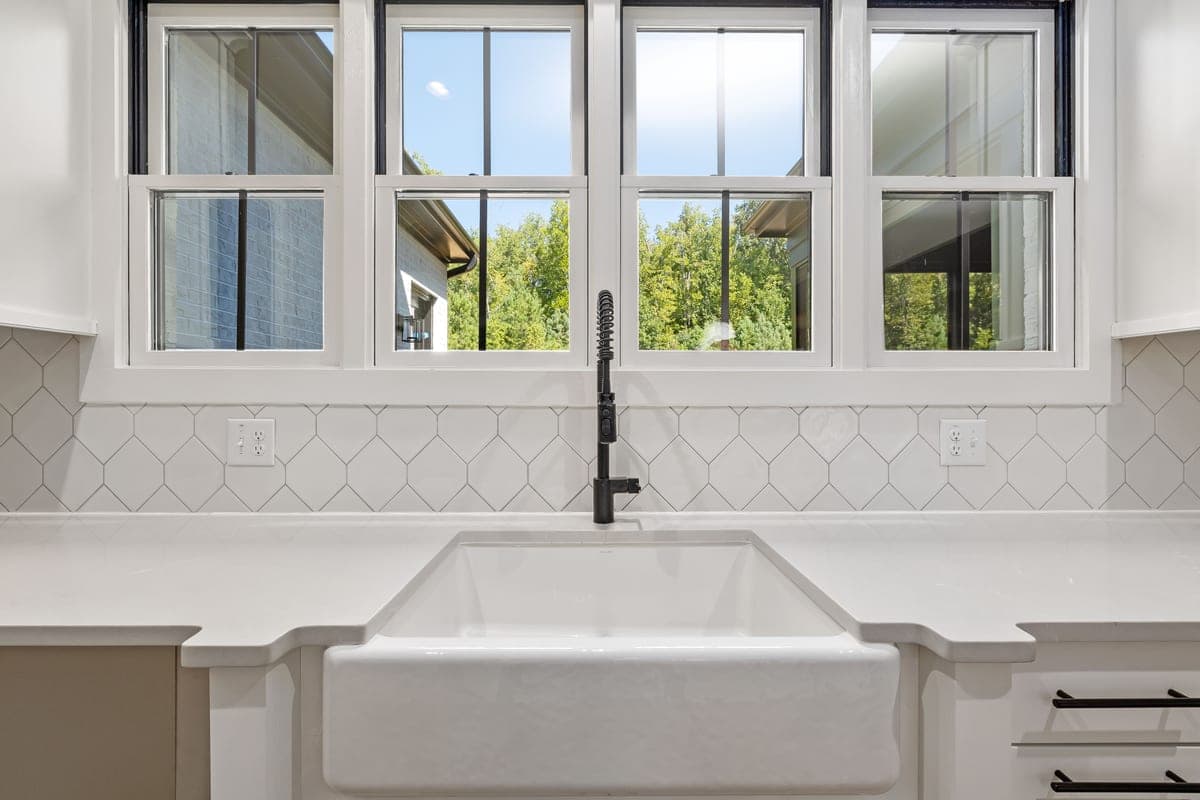
Guide
Fireclay sinks
How fireclay is made, what the glaze does, whether it chips, and how it stacks up against cast iron and stainless.

Guide
Cast iron sinks
What enameled cast iron is good at, the cabinet support it demands, and whether refinishing an old one is ever worth it.
Head to head
Drop-in vs undermount
A pros and cons table, what each countertop material can take, and the real cost of converting from one to the other.
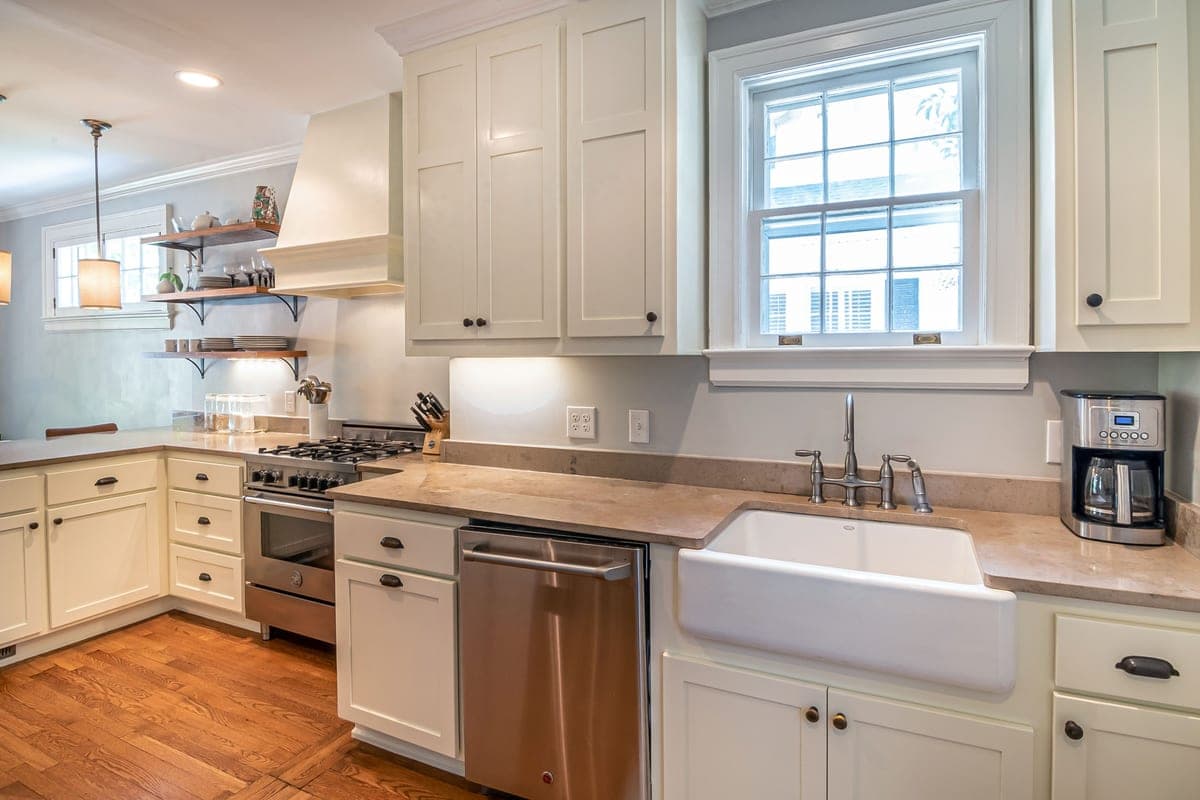
Best faucet for a farmhouse sink
Best faucet for a farmhouse sink
Why apron sinks change faucet geometry, the two measurements to take, and four faucets that suit the configuration.

Guide
Sink sizes and cabinet fit
The cabinet-to-sink arithmetic, the four measurements to take, and how a disposal changes the numbers.
Found something out of date, or a figure you can source better than we did? Tell us — corrections get read first. Our methodology explains how picks are made, and contact is one click away.