Kitchen Sinks
Farmhouse vs undermount sinks
Both sit below the counter and only one asks you to modify the cabinet. That single structural difference decides the cost, the install and whether it is a weekend job.
Disclosure: we earn a commission if you buy through the Amazon links on this page, at no extra cost to you. Commission never decides a verdict or a ranking position — read our editorial policy and affiliate disclosure.
How we assessed these: we compared published manufacturer specifications, read from each maker's own product page or specification sheet and linked at every figure. We have not tested these sinks and we do not own them. No independent laboratory publishes dent, chip or noise testing for residential kitchen sinks, so where a number would have to come from somewhere else, this page says so rather than estimating it.
Short answer
An undermount sink is fastened to the underside of the countertop and the cabinet is untouched. A farmhouse sink carries its own weight on a support frame inside the cabinet and its apron replaces part of the cabinet face, so the cabinet has to be cut and reinforced. If your counter is staying, undermount is the only one of the two you can fit; a farmhouse sink is a cabinet job.
The two mounts get compared as styles. They are not styles, they are two different structural relationships to your kitchen, and the comparison gets much simpler once that is clear. One hangs from the stone. The other sits on the woodwork.
Quick picks
Tap any row to jump to the full write-up. There are no scores here because we run no test lab — how picks are chosen is published in full on our methodology page.
| # | Product | Best for | Our read | Price |
|---|---|---|---|---|
| 1 | 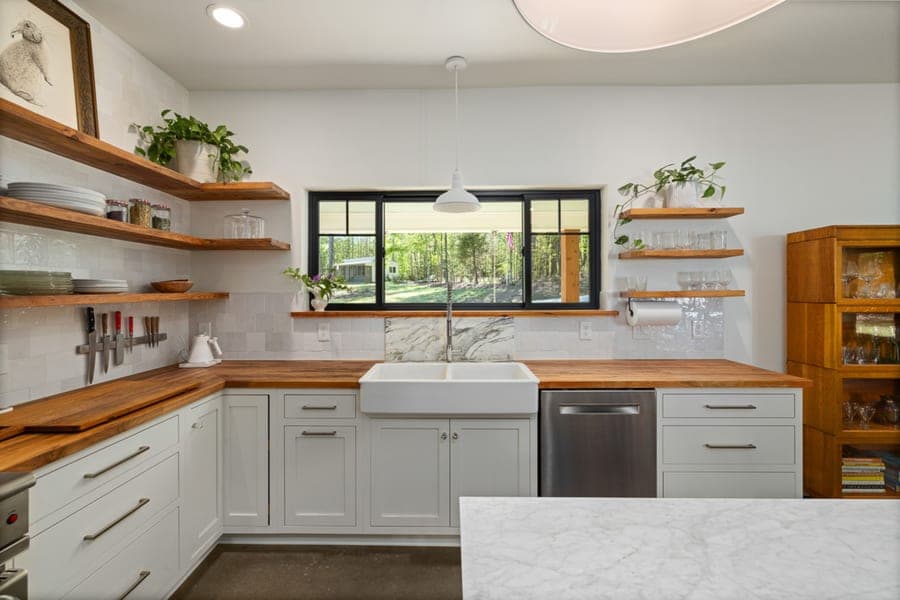 Kohler Whitehaven K-6489 Best farmhouse sink | Farmhouse looks without a custom cabinet | Self-trimming apron, so the cabinet cut is rough not precise | Check price on Amazon #ad Affiliate link · We publish no price; Amazon shows the current one |
| 2 | 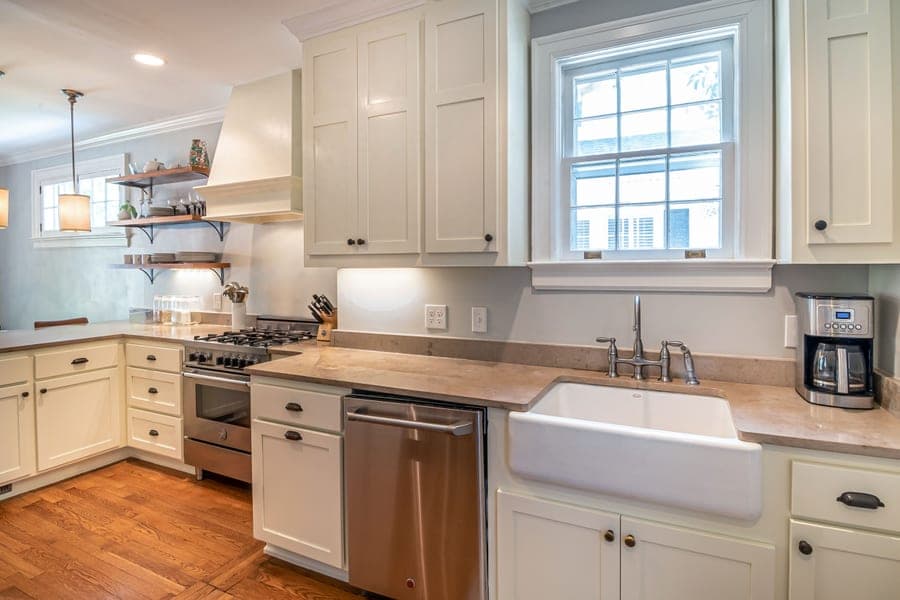 BOCCHI Classico 30-inch fireclay farmhouse sink Best lighter farmhouse | Farmhouse style, lighter than cast iron | Fireclay rather than cast iron, and a 33-inch cabinet | Check price on Amazon #ad Affiliate link · We publish no price; Amazon shows the current one |
| 3 | 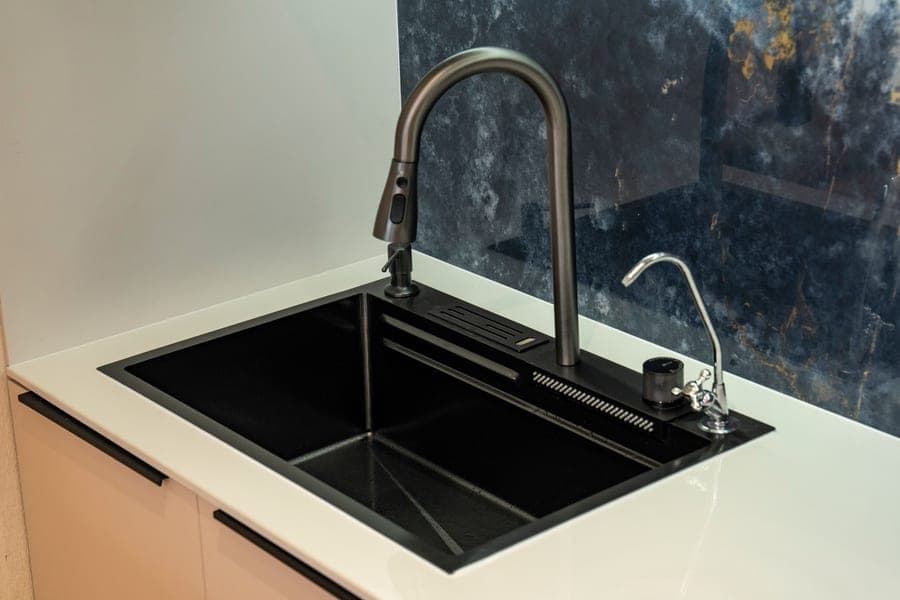 Kraus Kore KWU110-30 workstation sink Best undermount | Small kitchens that need counter space | No cabinet modification, and a prep ledge | Check price on Amazon #ad Affiliate link · We publish no price; Amazon shows the current one |
Difference one: what holds the sink up
An undermount sink is held by the countertop — clips, adhesive and the lip of the stone — which is why it is only practical under a rigid counter: granite, quartz, solid surface or a sealed wood top. The whole load goes into material that is already spanning the cabinet.
A farmhouse sink is held by the cabinet. A support frame or a shelf inside the base unit takes the weight, and the countertop is cut around the sink rather than carrying it. That is the reason an enameled cast-iron apron sink is an entirely different installation from a stainless undermount of the same size: the question is no longer how the stone is fixed but whether the base unit can carry a hundred-plus pounds of sink plus water.
Kohler does not publish a unit weight for the Whitehaven on its range page, which is worth knowing rather than guessing around — use your retailer's shipping weight to plan the frame. Fireclay is meaningfully lighter than cast iron for the same apron look, which is most of the reason the BOCCHI Classico is here.
Difference two: what has to be cut
For an undermount, the countertop is cut and polished to the sink's template and nothing else changes. For a farmhouse sink, the cabinet face frame is cut away to the apron's width and height, and the counter is cut to meet the apron's top edge.
This is where self-trimming matters. Kohler publishes the Whitehaven's apron as self-trimming: it overhangs the cabinet face, so the cut behind it does not have to be a precision fit because the sink covers it. A non-self-trimming farmhouse sink wants the cabinet opening finished to a line you will be looking at for twenty years, and that is cabinetmaker work. If you are weighing doing this yourself, that one specification is the difference.
| Question | Farmhouse (apron front) | Undermount |
|---|---|---|
| Carries the weight | A support frame inside the cabinet | The countertop |
| Cabinet modification | Face frame cut to the apron, frame added | None |
| Countertop needed | Rigid, cut to the apron's top edge | Rigid — granite, quartz, solid surface, sealed wood |
| Fits an existing counter | No, unless the counter is coming off too | Only if the existing cutout matches, which is rare |
| Faucet holes | In the counter or the wall, never the sink | In the counter, drilled to the faucet |
| Reach to the basin | Shorter — no counter lip in front of the bowl | Standard counter depth in front of the bowl |
| Typical materials | Fireclay, enameled cast iron, stainless | Stainless, granite composite |
| Weekend job | Only with a self-trimming apron and a reinforced cabinet | Yes, with a new countertop template |
Difference three: how it feels to use
This is the farmhouse sink's real, unmarketed advantage and the one nobody mentions: there is no countertop in front of the bowl. On an undermount you lean over two or three inches of stone to reach the basin. On an apron front you stand against the sink itself, which is noticeably easier on your back over a long wash-up and the reason these sinks persist in kitchens where people cook.
Against that, an undermount has the cleaning advantage both mounts are sold on: crumbs sweep straight off the counter into the bowl with no rim to catch them. A farmhouse sink shares that at the back and sides, and the apron face itself becomes a surface you wipe — a white one, usually, at shin height, in the busiest part of the room.
Photograph shows the product category, not this specific unit. We do not republish manufacturer product photography.
1. Best farmhouse sink
Kohler Whitehaven K-6489
Kohler · Best for farmhouse looks without a custom cabinet
The enameled cast-iron farmhouse sink to buy, mainly for one structural reason: the self-trimming apron overhangs the cabinet face, so installation is a rough cut rather than a cabinetmaker's fit. That detail is the difference between a weekend job and a trade job. It is also heavy enough that the cabinet needs real support.
Published specifications
What works
- Self-trimming apron means a rough cabinet cut, not a precision one
- Enameled cast iron resists chipping, cracking and heat in a way composite does not
- The 2-degree slope and offset drain genuinely reduce standing water
- Kohler stocks matching drains and accessories, so the sink does not orphan
What does not
- Cast iron is heavy — the cabinet needs a proper support frame, and that is the real installation cost
- Enamel dulls under abrasive cleaners, and a dropped cast pan will chip it
- Kohler does not publish a unit weight on the range page, so plan support using your retailer's shipping weight
Skip it if
Skip it if you are installing alone, or over an existing base cabinet you cannot reinforce. Weight decides this one, not looks.
#ad Affiliate link · We publish no price; Amazon shows the current one
Raw specifications: Kohler’s own page for the Kohler Whitehaven K-6489.
Photograph shows the product category, not this specific unit. We do not republish manufacturer product photography.
2. Best lighter farmhouse
BOCCHI Classico 30-inch fireclay farmhouse sink
BOCCHI · Best for farmhouse style, lighter than cast iron
Fireclay's argument against cast iron is the surface: the glaze is fired onto clay at very high temperature and is non-porous, rather than an enamel layer bonded to metal. This one ships with the bottom grid and strainer, and needs no flange extension for a disposal — a small detail that saves a trip to the store on install day.
Published specifications
What works
- Non-porous glaze, so staining is a cleaning problem rather than a permanent one
- Lighter than an equivalent enameled cast-iron sink, which simplifies cabinet support
- Grid and strainer in the box — the grid is what protects the glaze from dropped cast iron
- Takes a standard disposal flange without an extension kit
What does not
- Fireclay is a ceramic: a hard impact chips it, and a chip is not repairable the way a scratch in stainless is
- Hand-made dimensions vary slightly batch to batch, so cut the cabinet to the sink you received
- No independent lab publishes chip-resistance testing for fireclay sinks, so the material claims here are the manufacturer's
Skip it if
Skip it if your household is hard on a sink — dropped pots and ceramic do not mix. Choose 16-gauge stainless instead.
#ad Affiliate link · We publish no price; Amazon shows the current one
Photograph shows the product category, not this specific unit. We do not republish manufacturer product photography.
3. Best undermount
Kraus Kore KWU110-30 workstation sink
Kraus · Best for small kitchens that need counter space
The workstation sink we would buy, and the clearest case for 16-gauge steel anywhere in this category: a ledge sink is the one configuration where basin flex is genuinely audible, because accessories rest on the rim and transmit it. Ten inches deep, rear-offset drain, and the grid, mat, board and strainer are in the box rather than a $200 upsell.
Published specifications
- Overall size
- 30" x 19" source
- Bowl size
- 28" x 16" source
- Bowl depth
- 10" source
- Gauge
- 16-gauge stainless steel source
- Minimum cabinet
- 33" left to right, 24" front to back source
- Drain
- Rear offset, 3-1/2" opening source
- Sound damping
- NoiseDefend pads covering over 80% of the basin, plus undercoating source
- Warranty
- Kraus limited lifetime source
What works
- The integrated ledge turns a 30-inch sink into prep counter, the best single trade available in a small kitchen
- Rear-offset drain leaves usable cabinet space under the front of the sink
- Genuine 16-gauge with pads over 80% of the basin — gauge and damping do different jobs, and this sink has both
- A 3-1/2" drain opening takes a standard disposal flange with no adapter
What does not
- Needs a 33-inch cabinet for a 30-inch sink — measure before ordering
- A 10-inch deep bowl is a long reach for a shorter person
- The accessories are the reason to buy it and also the reason it costs more than a plain undermount
Skip it if
Skip it if your run of counter is already generous — you would be paying for prep space you do not need, and a plain 18-gauge undermount will serve.
#ad Affiliate link · We publish no price; Amazon shows the current one
Raw specifications: Kraus’s own page for the Kraus Kore KWU110-30 workstation sink.
Difference four: what happens when it chips
Stainless and composite undermount sinks fail gradually: scratches blend into a satin grain, and a composite's color runs through the body so a scratch shows nothing different underneath. Fireclay and enameled cast iron fail suddenly. The glaze on a fireclay sink is non-porous and hard, fired onto clay at temperatures up to 2000°F, and a sharp impact from a dropped cast-iron pan chips it — a chip that is not repairable the way a scratch in stainless is.
Which is why both farmhouse picks here ship with a bottom grid, and why fitting it is not optional. BOCCHI publishes a stainless bottom grid and strainer in the box with the Classico, and no flange extension needed for a disposal. Material by material, the detail is on fireclay vs cast iron sinks and cast iron sinks.
So which one should you fit?
- Counter staying, sink going: undermount, if the existing cutout can be re-templated — otherwise a drop-in. A farmhouse sink is not available to you without lifting the counter.
- Whole kitchen being replaced, and you cook a lot: farmhouse. The missing counter lip in front of the bowl is a daily improvement you will not notice until you go back.
- Doing the work yourself: undermount, or a farmhouse sink with a published self-trimming apron. Nothing else belongs in a first-time install.
- Small kitchen, counter space at a premium: undermount workstation. The ledge gives back more than the mount style costs.
- Hard water and a visible sink: a dark composite undermount hides limescale better than any white apron front will.
If the real question is whether to go under the counter at all — because the counter is staying and the budget is the sink — then drop-in vs undermount is the comparison to read instead. The honest answer there is that a modern dual-mount drop-in gets you most of the way for a fraction of the work.
What to take away
- An undermount hangs from the countertop. A farmhouse sink sits on a frame inside the cabinet and replaces part of the cabinet face.
- You cannot fit a farmhouse sink without taking the countertop off. An undermount only needs the counter re-templated.
- A self-trimming apron turns a cabinetmaker's fit into a rough cut — it is the single spec that decides whether a farmhouse sink is DIY.
- No counter lip in front of the bowl is the farmhouse sink's real advantage, and it is ergonomic rather than visual.
- Fireclay and enameled cast iron chip rather than scratch. Fit the bottom grid on day one.
- Fireclay is the lighter route to an apron front; cast iron is the tougher one.
How we sourced this page
Every figure on this page came from one of the following. Where a manufacturer or an independent lab does not publish a number, we say so rather than estimate it.
Common questions
- Is a farmhouse sink the same as an undermount sink?
- No. A farmhouse sink has an exposed apron front that replaces part of the cabinet face and carries its weight on a frame inside the cabinet. An undermount is fastened to the underside of the countertop and the cabinet is untouched. Some farmhouse sinks are undermounted to the counter as well, but the cabinet work is still required.
- Can I replace an undermount sink with a farmhouse sink?
- Not without removing the countertop. The cabinet face has to be cut for the apron and reinforced to carry the sink, and the counter has to be re-cut to meet the apron's top edge. If the counter is staying, your realistic options are another undermount or a drop-in.
- Are farmhouse sinks harder to install?
- Yes, and the gap is bigger than most people expect — it is cabinet joinery plus a support frame plus a countertop cut, rather than a countertop cut alone. A sink with a published self-trimming apron narrows it considerably, because the apron overhangs and hides the cut behind it.
- Do farmhouse sinks need special cabinets?
- They need a modified cabinet rather than a special one. The face frame is cut away to the apron's dimensions and a support frame or shelf is added inside to carry the weight. A standard 36-inch base unit can usually be adapted; a 33-inch one limits you to a 30-inch sink.
More in Kitchen Sinks
Three specifications settle almost every kitchen sink question: how thick the steel is, how it meets the counter, and what it is made of. Get those right and brand barely matters.
Read next
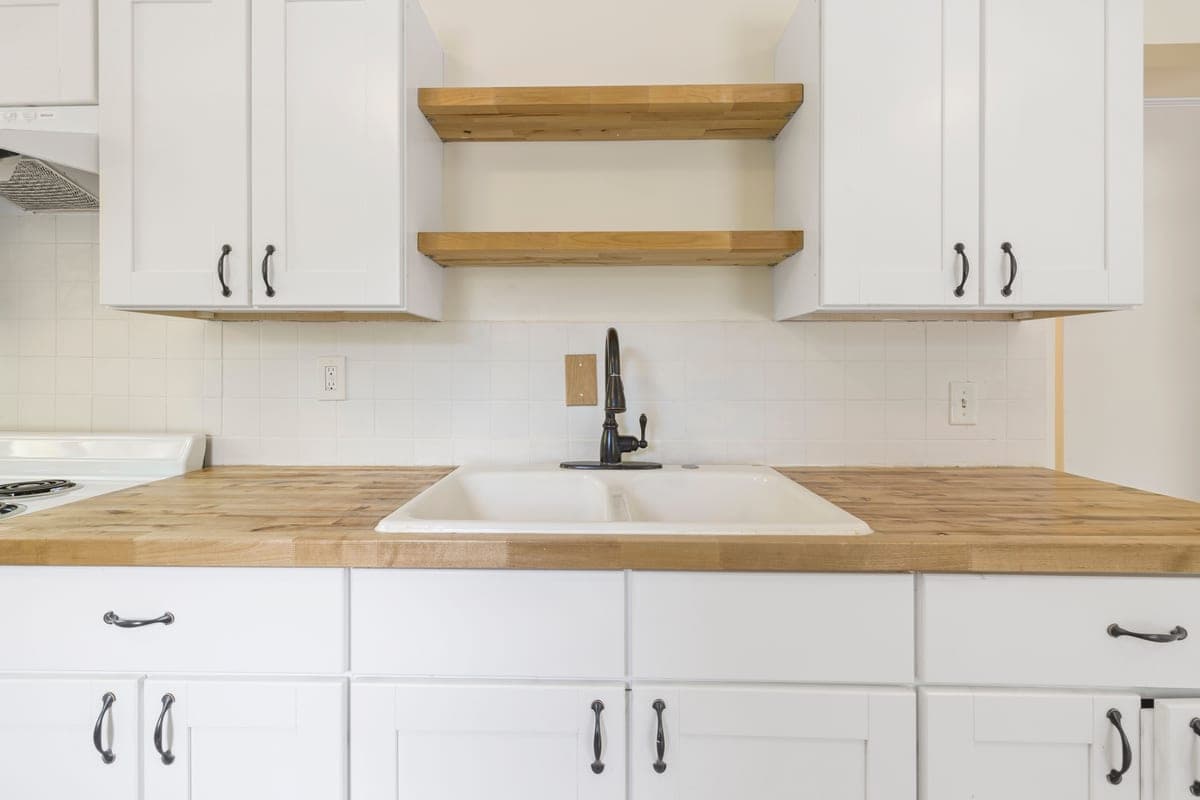
Head to head
Drop-in vs undermount
A pros and cons table, what each countertop material can take, and the real cost of converting from one to the other.
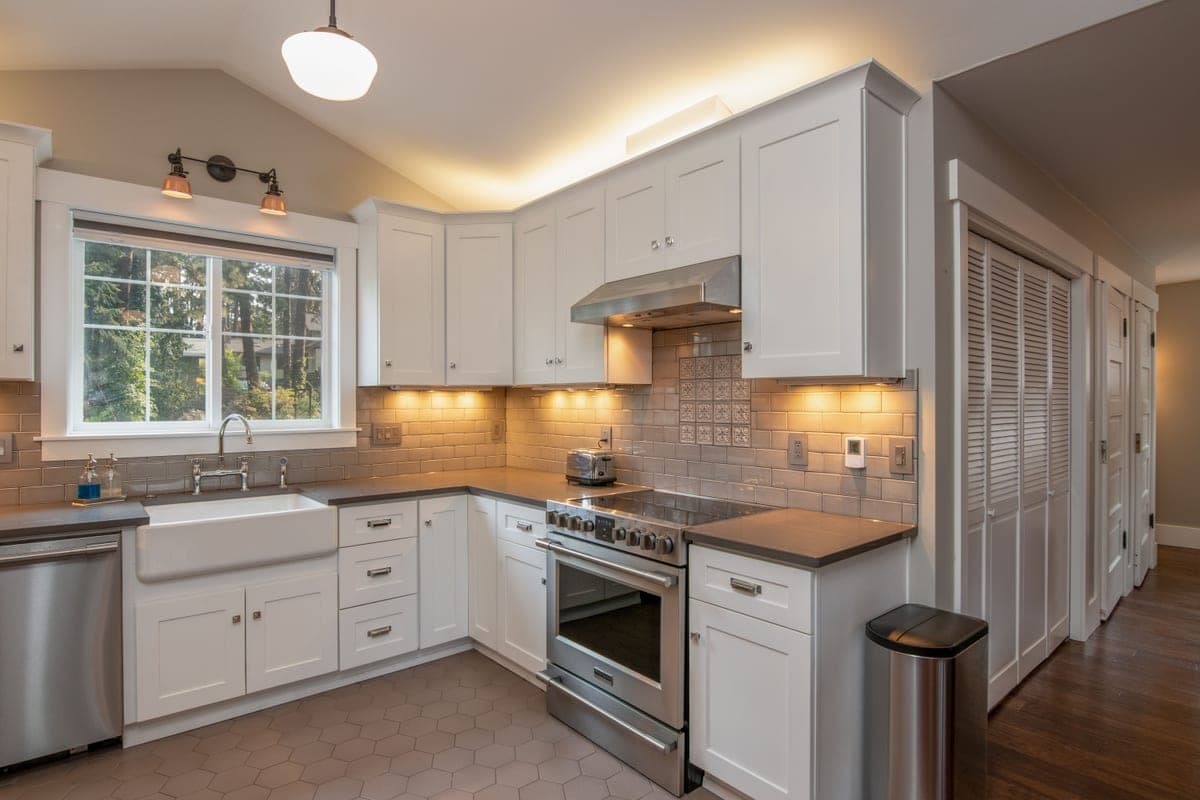
Best farmhouse sink
Farmhouse sinks
Apron-front dimensions, the cabinet modification involved, and why self-trimming is the detail that decides the difficulty.

Head to head
Fireclay vs cast iron
The same white farmhouse look from two different materials. What the substrate under the glaze changes about weight, chipping and installation.
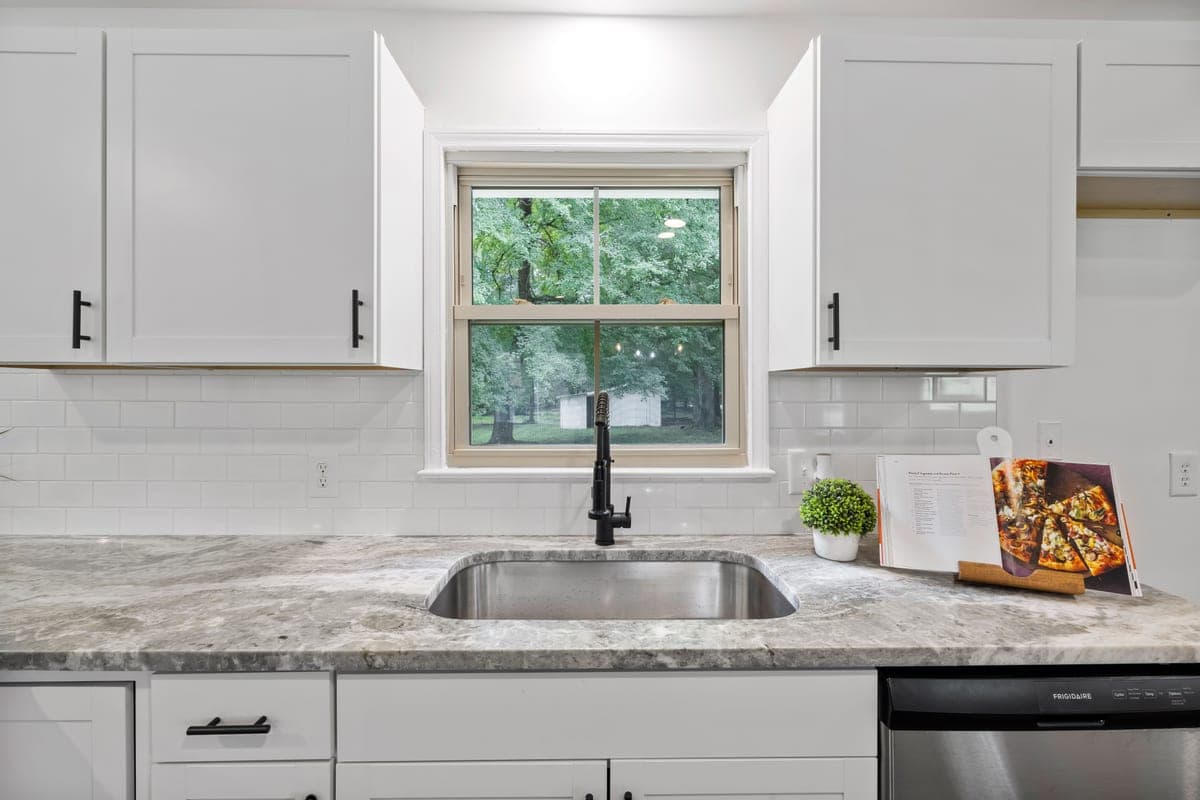
Best undermount sink
Best undermount sinks
Undermount picks by material, and the countertop question that decides whether an undermount sink is possible in your kitchen.
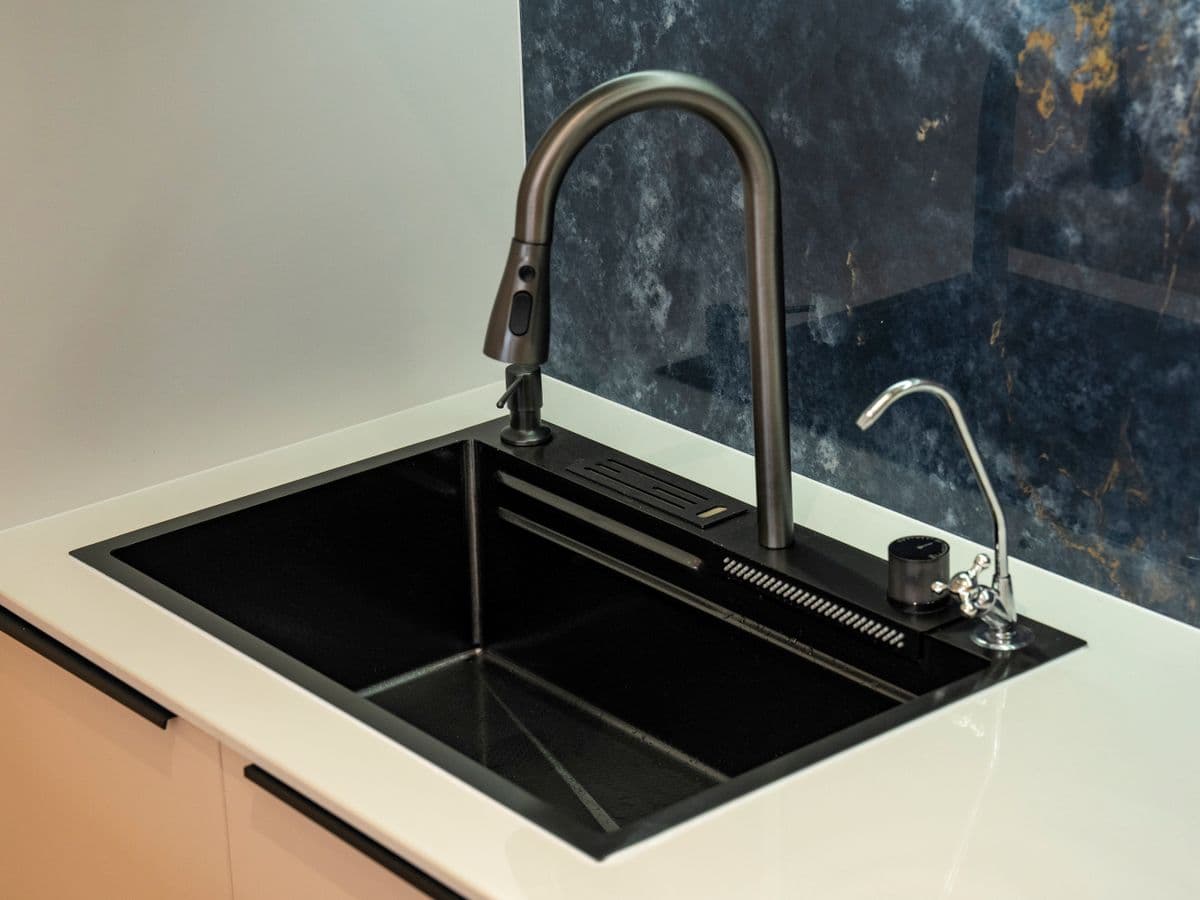
Best single bowl sink
Best single bowl sinks
Four single-bowl sinks compared on usable basin width, depth and the cabinet each one needs.

How to
Install an undermount sink
Bracing, sealing and clipping an undermount sink, with separate notes for quartz, granite, laminate and butcher block.
Found something out of date, or a figure you can source better than we did? Tell us — corrections get read first. Our methodology explains how picks are made, and contact is one click away.