Kitchen Sinks
The best sinks for butcher block countertops
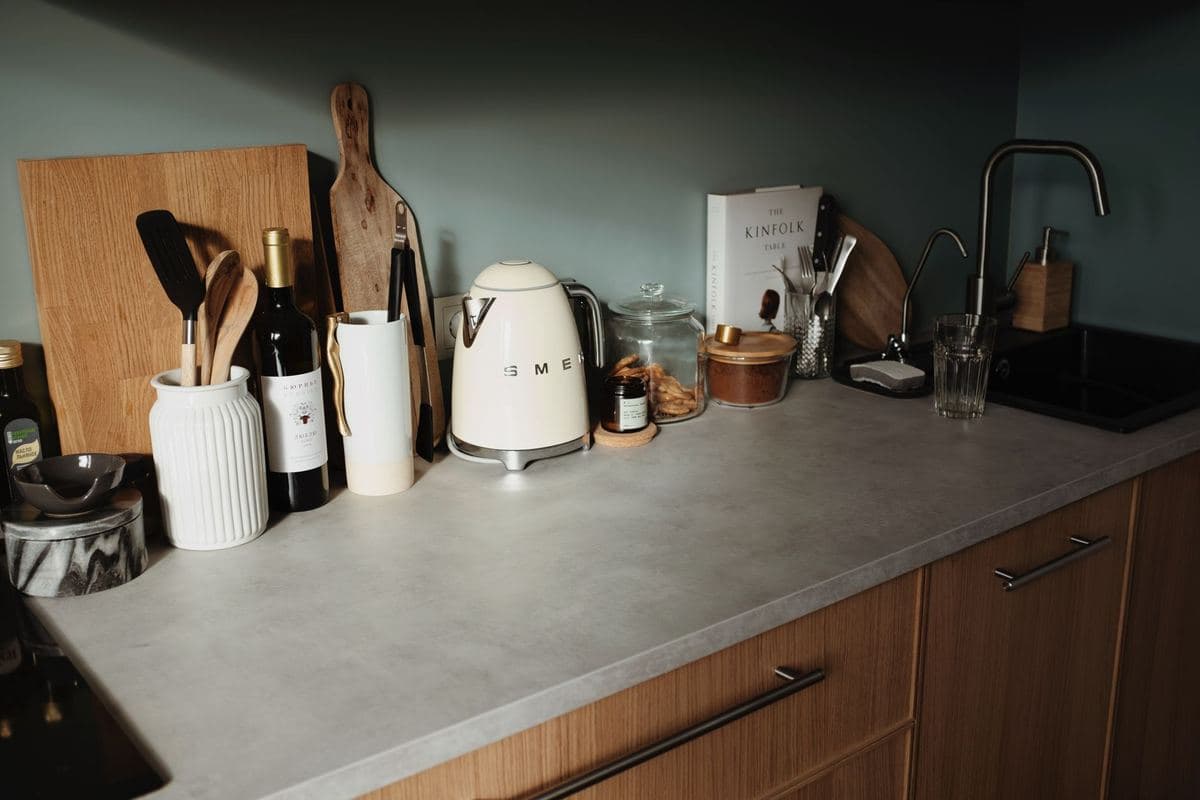
Choosing the sink is the easy half. The decision that matters is which mounting leaves bare wood sitting in water, because that is what destroys a butcher block top.
Disclosure: we earn a commission if you buy through the Amazon links on this page, at no extra cost to you. Commission never decides a verdict or a ranking position — read our editorial policy and affiliate disclosure.
How we assessed these: model dimensions, gauge, material and box contents here are each read from that manufacturer's own product page or specification sheet and linked at every figure. No sink manufacturer publishes mounting guidance specific to wood countertops and no independent laboratory publishes moisture testing of butcher block cutouts, so the mounting argument on this page is a description of geometry rather than a measurement, and sealing specifications are left to your countertop supplier rather than invented here.
Short answer
For a butcher block countertop, buy a drop-in sink — the Kraus Premier KTM100-33 is the one we would fit. A drop-in rim sits on top of the wood and covers the entire cut edge of the cutout, which is the part of a butcher block top most likely to fail. Undermounting into wood is possible and people do it, but it leaves the cut edge exposed to standing water and makes the sealing job permanent and unforgiving. The mounting decision matters more here than the sink's material does.
Butcher block is a beautiful counter and a demanding one, and the sink cutout is where it gets tested hardest. Wood moves with moisture: it swells when it takes water on and shrinks when it dries, and the freshly sawn edge around a sink cutout is the most absorbent surface on the whole countertop. Everything on this page follows from that one fact.
Quick picks
Tap any row to jump to the full write-up. There are no scores here because we run no test lab — how picks are chosen is published in full on our methodology page.
| # | Product | Best for | Our read | Price |
|---|---|---|---|---|
| 1 | 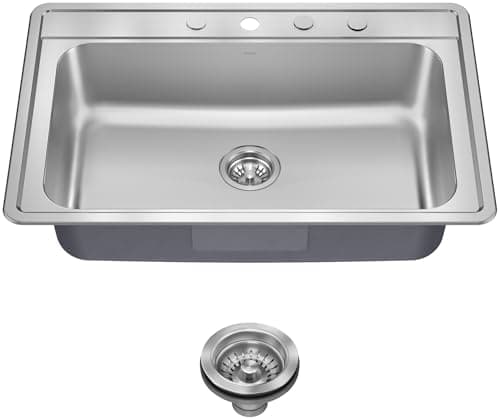 Kraus Premier KTM100-33 Best overall for wood | A like-for-like swap in an existing cutout | A drop-in rim that covers the cut edge completely | |
| 2 | 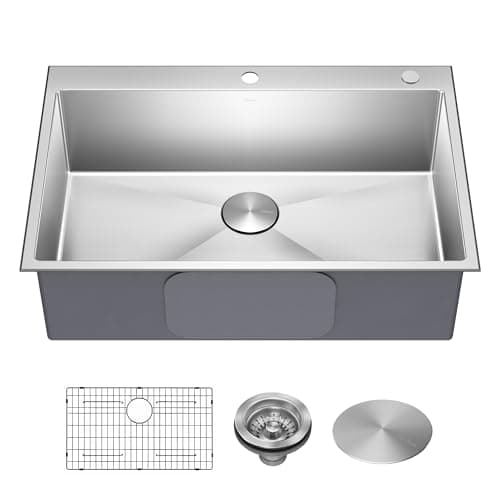 Kraus KHT300-33 drop-in sink Best dual mount | Replacing a sink without touching the counter | Drop in now, undermount later, with a template in the box | $544.98 · View on Amazon #ad Affiliate link · Price as of October 17, 2026 |
| 3 | 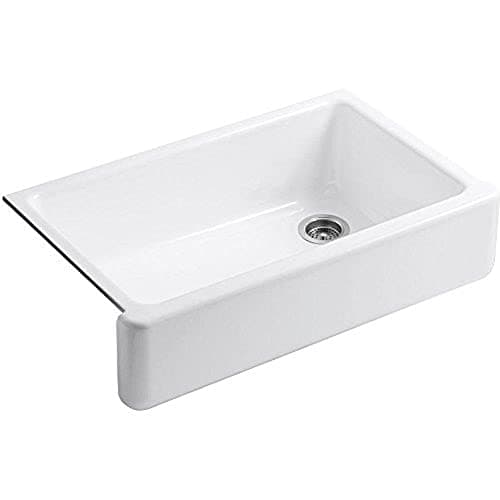 Kohler Whitehaven K-6489 Best apron front | Farmhouse looks without a custom cabinet | Self-trimming apron, so the front edge is covered | $1,266.86 · View on Amazon #ad Affiliate link · Price as of October 17, 2026 |
| 4 | 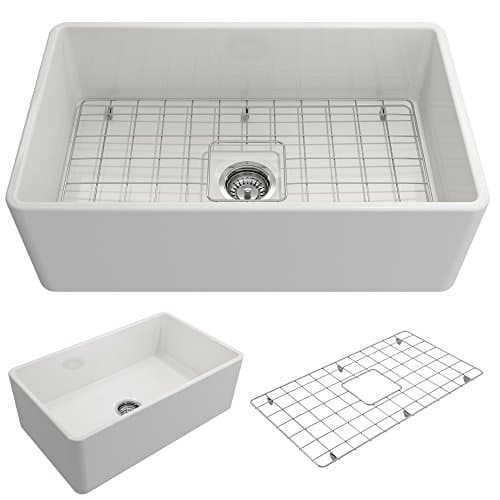 BOCCHI Classico 30-inch fireclay farmhouse sink Best fireclay apron | Farmhouse style, lighter than cast iron | Lighter than cast iron, 33 inch minimum cabinet | $515.45 · View on Amazon #ad Affiliate link · Price as of October 17, 2026 |
| 5 | 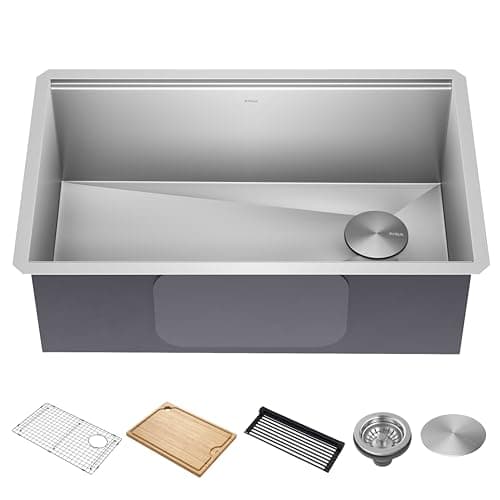 Kraus Kore KWU110-30 workstation sink Best undermount, if you commit | Small kitchens that need counter space | 16 gauge workstation; the sealing job is on you | $469.95 · View on Amazon #ad Affiliate link · Price as of October 17, 2026 |
The criteria, in the order they matter
We rank sinks for a wood counter on four things, and the first one outweighs the other three combined.
- How the mounting treats the cut edge. A rim sitting on top of the wood covers it. An undermount leaves it exposed and relies entirely on sealant and finish. This is the whole decision.
- Whether the sink is heavy enough to need support beyond the countertop. Undermounted sinks hang from the counter; a heavy one hanging from wood is a different proposition from the same sink hanging from quartz.
- Whether the maker publishes a cut-out template. On stone the fabricator cuts to the sink. On butcher block you are usually cutting it yourself, and a template in the box removes the measurement that goes wrong.
- What comes in the box. A bottom grid and a drain assembly are worth having anyway, and on a wood counter a grid also keeps pans off the base so you are not dropping things into a basin set in a material you cannot easily repair.
Why drop-in wins on a wood counter
A drop-in — also called top-mount or self-rimming — drops through the cutout from above and its rim rests on the countertop surface. That rim is the point. It overlaps the cut edge of the wood by a quarter inch or more all the way around, so water running off the counter toward the sink crosses metal, not sawn end grain.
The Kraus Premier KTM100-33 is the clearest example. Kraus publishes 33 x 22 x 8 inches overall with a 27-4/5 x 16 x 7-1/2 inch bowl, 18-gauge T-304 stainless, a rear-set drain and a 36-inch minimum cabinet. It is a drop-in and top-mount sink only — there is no undermount option to be tempted by — and the cut-out template is in the box, which removes the one measurement that goes wrong when you are cutting the hole yourself rather than handing the sink to a stone fabricator.
An 18-gauge sink of this size is also light enough for one person to lift in and out, which means you can re-seal the cutout in a few years without a second pair of hands. Kraus does not publish a weight for this model, so weigh the box rather than trusting a figure. Drop-in vs undermount covers the general argument; on butcher block it is much less of an argument than it is on stone.
The case for an apron front, which is better than both
An apron-front sink removes the front section of the problem entirely. The sink's own face becomes the front of the cabinet run, so there is no cut edge of countertop at the front of the bowl at all — the most splashed, most leaned-on, most-likely-to-fail inch of a butcher block cutout simply does not exist.
Kohler publishes the Whitehaven K-6489 at 35-11/16 x 21-9/16 x 9-5/8 inches overall with a 30-3/4 x 18-1/16 x 9 inch deep basin, enameled cast iron, a 36-inch minimum cabinet, a basin sloped 2 degrees toward an offset drain and a 1-1/2 inch drain connection. The relevant word in Kohler's own description is self-trimming: the apron is designed to cover the cut edges of the cabinet front, which is exactly the behavior you want where wood meets water.
The BOCCHI Classico 30 is the fireclay route to the same geometry. BOCCHI publishes fireclay fired at temperatures up to 2000°F, a non-porous glaze stated to resist stains, scratches and thermal shock, a 33-inch minimum cabinet, a stainless bottom grid and chrome strainer in the box, and no flange extension needed for a garbage disposal. BOCCHI's own argument for it is that it is lighter than an equivalent enameled cast-iron sink, which simplifies the cabinet support — a real consideration when the cabinet is also carrying a wood top.
| Mounting | Cut edge of the wood | Who carries the weight | Re-sealing later | Example here |
|---|---|---|---|---|
| Drop-in / top mount | Covered by the sink rim on all four sides | The countertop, through the rim | Lift the sink out and re-seal | Kraus Premier KTM100-33 |
| Dual mount | Covered if you drop it in; exposed if you undermount it | Depends which way you fit it | Easy if dropped in | Kraus KHT300-33 |
| Apron front | No cut edge at the front at all | The cabinet, not the counter | Front edge needs none | Kohler Whitehaven, BOCCHI Classico |
| Undermount | Exposed on all four sides, sealant only | The countertop, in tension | Means removing the sink | Kraus Kore KWU110-30 |
This table describes mounting geometry, not measurements. No sink manufacturer publishes guidance specific to wood countertops, and no independent laboratory publishes moisture testing of butcher block cutouts, so nothing here is presented as a tested figure. Model dimensions quoted elsewhere on this page all come from the makers' own pages, listed in the sources below.
The dual-mount hedge
If you want to keep the decision open, a dual-mount sink can be fitted either way. Kraus publishes the KHT300-33 at 33 x 22 x 10-5/8 inches overall with a 31 x 18 x 10 inch bowl, TRU16 gauge T304 stainless, two pre-drilled faucet holes, a rear-set drain, a 36-inch minimum cabinet, NoiseDefend pads on all sides plus an anti-condensation undercoating, cUPC certification to ASME A112.19.3 / CSA B45.4, and a bottom grid, drain assembly and decorative drain cover in the box.
On a butcher block top our advice is to use the drop-in option and treat the undermount capability as resale value for whoever replaces the counter with stone later. A 10-inch bowl in 16-gauge steel is also the quietest and most forgiving sink here, and the deeper bowl keeps more water below the level of the wood. 16 gauge vs 18 gauge explains what the thickness does and does not buy.
Product photograph supplied by Amazon for this listing, used under the Associates program.
1. Best overall for wood
Kraus Premier KTM100-33
Kraus · Best for a like-for-like swap in an existing cutout
The plain, serviceable drop-in, and the one most likely to be a direct swap for what is already in your counter: 33 by 22 inches, a bowl 7-1/2 inches deep, 18-gauge Type 304 steel. The shallow bowl is the point — it is the depth older cabinets and high trap arms were built around, and it is getting hard to buy now that every new sink is ten inches deep.
Published specifications
- Overall size
- 33" x 22" x 8" source
- Bowl size
- 27-4/5" x 16" x 7-1/2" deep source
- Gauge
- 18 gauge, T-304 stainless steel source
- Faucet holes
- Pre-drilled for a faucet; Kraus does not publish a hole count for this model source
- Mounting
- Drop-in / top mount, with a cut-out template in the box source
- Drain
- Rear-set source
- Minimum cabinet
- 36" source
- Sound damping
- NoiseDefend pads on all sides plus anti-condensation undercoating source
- Certification
- cUPC to ASME A112.19.3 / CSA B45.4, and MASS source
- Included
- Drain assembly with removable strainer, mounting hardware, cut-out template source
- Warranty
- Kraus limited lifetime source
What works
- A 7-1/2 inch bowl, which is the depth most older cabinets and shallow trap arms were built around
- A rear-set drain, so the trap sits at the back of the cabinet and leaves the front usable
- NoiseDefend pads on all sides rather than bottom pads only, which is unusual on an 18-gauge sink
- Drain assembly, strainer, hardware and a cut-out template are in the box, so the only extra part is the sealant
What does not
- 18-gauge flexes more than 16-gauge under a dropped pan, and the pads damp drumming rather than remove it
- Kraus does not publish a faucet-hole count for this model, so confirm the drilling matches your counter before ordering
- A 33-inch sink still needs a 36-inch cabinet, so it is not a swap for a 30-inch base unit
Skip it if
Skip it if you want a deep modern basin. At 7-1/2 inches the bowl will not take a sheet pan laid flat.
Raw specifications: Kraus’s own page for the Kraus Premier KTM100-33.
Product photograph supplied by Amazon for this listing, used under the Associates program.
2. Best dual mount
Kraus KHT300-33 drop-in sink
Kraus · Best for replacing a sink without touching the counter
The drop-in we would fit in most kitchens, because it is a 16-gauge sink sold as a dual-mount: the rim is finished to sit on the counter, and the same sink can be undermounted later if you ever replace the countertop. At 10 inches deep with a rear-set drain it behaves like a modern undermount while asking nothing of your existing counter.
Published specifications
- Overall size
- 33" x 22" x 10-5/8" deep source
- Bowl size
- 31" x 18" x 10" deep source
- Gauge
- TRU16 gauge T304 stainless steel source
- Mounting
- Dual mount — drop-in or undermount source
- Faucet holes
- Two pre-drilled, for a faucet and a soap dispenser source
- Drain
- Rear-set source
- Minimum cabinet
- 36" source
- Sound damping
- NoiseDefend pads on all sides plus anti-condensation undercoating source
- Certification
- cUPC to ASME A112.19.3 / CSA B45.4 source
- Included
- Bottom grid, drain assembly with removable strainer, decorative drain cover source
- Warranty
- Kraus limited lifetime source
What works
- 16-gauge steel in a drop-in, which is unusual — most top-mount sinks at this size are 18-gauge or thinner
- Dual mount means the sink survives a future countertop replacement instead of being thrown away with it
- A 10-inch bowl with a rear-set drain leaves usable cabinet space under the front of the sink
- Grid, drain and strainer are in the box, so the only extra part is the sealant
What does not
- A 33-inch sink still needs a 36-inch cabinet, so it is not a drop-in replacement for a 30-inch base unit
- A 10-inch bowl is a long reach for a shorter person, and a drop-in rim sits slightly higher than an undermount one
- Kraus publishes no unit weight for this model, so plan the lift by the shipping box rather than a figure
Skip it if
Skip it if your existing cutout is for a 30-inch sink. A drop-in can cover a slightly smaller hole, never a smaller cabinet.
#ad Affiliate link · Price as of October 17, 2026
Raw specifications: Kraus’s own page for the Kraus KHT300-33 drop-in sink.
Product photograph supplied by Amazon for this listing, used under the Associates program.
3. Best apron front
Kohler Whitehaven K-6489
Kohler · Best for farmhouse looks without a custom cabinet
The enameled cast-iron farmhouse sink to buy, mainly for one structural reason: the self-trimming apron overhangs the cabinet face, so installation is a rough cut rather than a cabinetmaker's fit. That detail is the difference between a weekend job and a trade job. It is also heavy enough that the cabinet needs real support.
Published specifications
What works
- Self-trimming apron means a rough cabinet cut, not a precision one
- Enameled cast iron resists chipping, cracking and heat in a way composite does not
- The 2-degree slope and offset drain genuinely reduce standing water
- Kohler stocks matching drains and accessories, so the sink does not orphan
What does not
- Cast iron is heavy — the cabinet needs a proper support frame, and that is the real installation cost
- Enamel dulls under abrasive cleaners, and a dropped cast pan will chip it
- Kohler does not publish a unit weight on the range page, so plan support using your retailer's shipping weight
Skip it if
Skip it if you are installing alone, or over an existing base cabinet you cannot reinforce. Weight decides this one, not looks.
#ad Affiliate link · Price as of October 17, 2026
Raw specifications: Kohler’s own page for the Kohler Whitehaven K-6489.
Product photograph supplied by Amazon for this listing, used under the Associates program.
4. Best fireclay apron
BOCCHI Classico 30-inch fireclay farmhouse sink
BOCCHI · Best for farmhouse style, lighter than cast iron
Fireclay's argument against cast iron is the surface: the glaze is fired onto clay at very high temperature and is non-porous, rather than an enamel layer bonded to metal. This one ships with the bottom grid and strainer, and needs no flange extension for a disposal — a small detail that saves a trip to the store on install day.
Published specifications
What works
- Non-porous glaze, so staining is a cleaning problem rather than a permanent one
- Lighter than an equivalent enameled cast-iron sink, which simplifies cabinet support
- Grid and strainer in the box — the grid is what protects the glaze from dropped cast iron
- Takes a standard disposal flange without an extension kit
What does not
- Fireclay is a ceramic: a hard impact chips it, and a chip is not repairable the way a scratch in stainless is
- Hand-made dimensions vary slightly batch to batch, so cut the cabinet to the sink you received
- No independent lab publishes chip-resistance testing for fireclay sinks, so the material claims here are the manufacturer's
Skip it if
Skip it if your household is hard on a sink — dropped pots and ceramic do not mix. Choose 16-gauge stainless instead.
#ad Affiliate link · Price as of October 17, 2026
Product photograph supplied by Amazon for this listing, used under the Associates program.
5. Best undermount, if you commit
Kraus Kore KWU110-30 workstation sink
Kraus · Best for small kitchens that need counter space
The workstation sink we would buy, and the clearest case for 16-gauge steel anywhere in this category: a ledge sink is the one configuration where basin flex is genuinely audible, because accessories rest on the rim and transmit it. Ten inches deep, rear-offset drain, and the grid, mat, board and strainer are in the box rather than a $200 upsell.
Published specifications
- Overall size
- 30" x 19" source
- Bowl size
- 28" x 16" source
- Bowl depth
- 10" source
- Gauge
- 16-gauge stainless steel source
- Minimum cabinet
- 33" left to right, 24" front to back source
- Drain
- Rear offset, 3-1/2" opening source
- Sound damping
- NoiseDefend pads covering over 80% of the basin, plus undercoating source
- Warranty
- Kraus limited lifetime source
What works
- The integrated ledge turns a 30-inch sink into prep counter, the best single trade available in a small kitchen
- Rear-offset drain leaves usable cabinet space under the front of the sink
- Genuine 16-gauge with pads over 80% of the basin — gauge and damping do different jobs, and this sink has both
- A 3-1/2" drain opening takes a standard disposal flange with no adapter
What does not
- Needs a 33-inch cabinet for a 30-inch sink — measure before ordering
- A 10-inch deep bowl is a long reach for a shorter person
- The accessories are the reason to buy it and also the reason it costs more than a plain undermount
Skip it if
Skip it if your run of counter is already generous — you would be paying for prep space you do not need, and a plain 18-gauge undermount will serve.
#ad Affiliate link · Price as of October 17, 2026
Raw specifications: Kraus’s own page for the Kraus Kore KWU110-30 workstation sink.
If you undermount anyway
Plenty of people undermount into butcher block and are happy with it, and the look is genuinely better — an uninterrupted wood surface running to the edge of the bowl. Be clear about what you are taking on. The cut edge is sealed rather than covered, the seal is the only thing between standing water and end grain, and inspecting or redoing it means taking the sink out.
If that is the route, the Kraus Kore KWU110-30 is the one we would pick: Kraus publishes 30 x 19 inches overall, a 28 x 16 inch bowl, 10 inches deep, 16-gauge stainless, a 33-inch minimum cabinet left to right and 24 inches front to back, a rear-offset 3-1/2 inch drain opening, NoiseDefend pads covering over 80% of the basin plus undercoating, and a grid, mat, cutting board and strainer in the box. The workstation ledge is a real asset on a wood counter because it moves cutting and draining off the timber and onto the sink. Are workstation sinks worth it weighs that properly.
What about the faucet holes?
On butcher block, every hole is another raw edge, and the faucet holes sit in the wettest zone of the counter. Two things follow. First, prefer a sink with its faucet holes already drilled in the deck rather than drilling the wood: the Kraus KHT300-33 and KHT302-33 each publish two pre-drilled holes for a faucet and a soap dispenser, which keeps the plumbing off the timber altogether.
Second, if holes do have to go in the wood, a single-hole faucet with a deck plate is the smallest intervention. Do you need a deck plate for a kitchen faucet covers when the plate helps, and faucet hole configurations has the standard sizes and the rules for drilling.
Living with it
- Wipe standing water at the sink edge. On stone this is cosmetic; on wood it is maintenance. It is the single habit that decides how the cutout looks in five years.
- Use the bottom grid. Three of the five sinks here include one. On a counter you cannot easily replace, keeping heavy pans off the base of the bowl is cheap insurance.
- Re-oil or re-seal on the countertop maker's schedule, and pay particular attention to the cutout edge and the area in front of the sink.
- Check the faucet base for slow weeps. A faucet that drips a few drops a day onto stone is nothing; onto butcher block it is a dark ring. Kitchen faucet leaking diagnosis covers finding it.
- Do not let a dishwasher vent steam at the cutout. Steam is water, and it goes where it likes.
Which one to buy
- Buy the Kraus Premier KTM100-33 for the straightforward right answer: a drop-in rim covering the cut edge, 18-gauge T-304, a cut-out template in the box, and light enough to lift out and re-seal later.
- Buy the Kraus KHT300-33 if you want 16-gauge steel and a 10-inch bowl and would rather keep the undermount option for a future counter — fit it as a drop-in for now.
- Buy the Kohler Whitehaven K-6489 if you want an apron front and the cabinet can carry enameled cast iron. The self-trimming apron is the best answer on this page to the wood-meets-water problem.
- Buy the BOCCHI Classico 30 for the same apron geometry in fireclay, lighter than cast iron, with the grid and strainer already in the box.
- Buy the Kraus Kore KWU110-30 only if you have decided to undermount, have proper support from below, and accept that the seal is the whole defense.
If you have not settled the format yet, how to choose a kitchen sink runs the whole decision in order, the best 33 inch kitchen sinks covers the size most of these are, and kitchen sink materials is the material-by-material version.
What to take away
- On butcher block the mounting matters more than the material, because wood swells with moisture.
- A drop-in rim covers the cut edge of the cutout. An undermount leaves it exposed to standing water.
- An apron front removes the front cut edge entirely - Kohler calls the Whitehaven apron self-trimming.
- A light sink you can lift out alone, like an 18-gauge drop-in, makes re-sealing the cutout a one-person job.
- Undermounting into wood needs support from below, specified with the countertop supplier.
- Prefer a sink with pre-drilled faucet holes so the plumbing never penetrates the timber.
How we sourced this page
Every figure on this page came from one of the following. Where a manufacturer or an independent lab does not publish a number, we say so rather than estimate it.
- Kraus Premier KTM100-33 drop-in / top-mount sink product page (published specifications)
- Kraus KHT300-33 drop-in / undermount single-bowl sink product page (published specifications)
- Kohler Whitehaven apron-front sink range (published specifications)
- BOCCHI Classico 30-inch fireclay farmhouse sink — manufacturer listing
- Kraus Kore KWU110-30 specification sheet (PDF)
- Kraus Kore KWU110-30 product page (published specifications)
Common questions
- Can you put an undermount sink in a butcher block countertop?
- Yes, and people do, but it is the demanding option. Undermounting leaves the sawn edge of the cutout exposed to water with only sealant and finish protecting it, and the sink needs support from below rather than hanging on adhesive. A drop-in rim covers that edge instead, which is why it is the conservative choice on wood.
- What kind of sink is best for a butcher block countertop?
- A drop-in, or an apron front. A drop-in rim overlaps and protects the cut edge of the wood; an apron front removes the front cut edge altogether. Both keep water off sawn end grain, which is the part of a butcher block top most likely to fail around a sink.
- Do you need to seal butcher block around a sink?
- Yes - including the underside and the full depth of the cut edge, before the sink goes in. Sink manufacturers publish no specification for this, so follow your countertop supplier's instructions for the finish they supplied. A drop-in rim forgives an imperfect job; an undermount relies on it completely.
- Will a butcher block countertop get ruined around the sink?
- Not if the cutout is sealed properly, the mounting covers or removes the cut edge, and standing water gets wiped rather than left. The failure mode is repeated wetting of bare end grain, which swells and then splits as it dries. Every recommendation on this page is aimed at that one mechanism.
More in Kitchen Sinks
Three specifications settle almost every kitchen sink question: how thick the steel is, how it meets the counter, and what it is made of. Get those right and brand barely matters.
Read next
Head to head
Drop-in vs undermount
A pros and cons table, what each countertop material can take, and the real cost of converting from one to the other.
Best drop-in sink
Best drop-in sinks
Four top-mount sinks chosen on gauge, bowl depth and cutout — plus the measurement that decides whether a new one drops into your existing hole.
Best farmhouse sink
Farmhouse sinks
Apron-front dimensions, the cabinet modification involved, and why self-trimming is the detail that decides the difficulty.
Best 33 inch sink
Best 33 inch sinks
Five 33-inch sinks compared on bowl size, depth, mounting and what comes in the box - starting with the cabinet width each one actually requires.
Guide
How to choose a sink
The six decisions in the order that actually works, each with the measurement that settles it — and what to do when two of them conflict.
Guide
Sink materials compared
Five materials compared on heat, impact, noise and repairability, with the honest failure mode of each one.
Found something out of date, or a figure you can source better than we did? Tell us — corrections get read first. Our methodology explains how picks are made, and contact is one click away.