Kitchen Sinks
Are workstation sinks worth it?
Yes in a small kitchen, and genuinely not in a large one. The deciding question is whether you are short of counter space or short of sink.
Disclosure: we earn a commission if you buy through the Amazon links on this page, at no extra cost to you. Commission never decides a verdict or a ranking position — read our editorial policy and affiliate disclosure.
How we assessed these: we compared published manufacturer specifications, read from each maker's own product page or specification sheet and linked at every figure. We have not tested these sinks and we do not own them. No independent laboratory publishes dent, chip or noise testing for residential kitchen sinks, so where a number would have to come from somewhere else, this page says so rather than estimating it.
Short answer
A workstation sink is worth it if counter space is the thing your kitchen is short of, and it is not worth it if you already have a generous run of counter. The ledge converts the sink opening into working surface — a board, a colander and a drying rack slide across it — so you are buying back roughly two square feet of counter in the one place a sink normally takes it away.
That is the whole case, and it is a good case in a small kitchen. The rest of this page is the two ways the purchase goes wrong: paying for prep space you do not need, and buying a sink with a rail but none of the engineering that makes a ledge sink work.
What a workstation sink actually is
An integrated ledge — a machined track stepped into the basin walls, usually front and back — that accessories sit in and slide along. A real workstation sink has the ledge formed as part of the bowl, so the accessories ride below the rim and inside the basin, over the water.
The accessories are the product: a cutting board that spans the bowl, a roll-up drying rack, a colander and a bottom grid. The Kraus Kore KWU110-30 ships the grid, mat, board and strainer in the box rather than as a separate order, and that matters commercially — bought individually, a board and a rack for a ledge sink is a meaningful fraction of the sink's price.
The case for: where the ledge earns its money
- A small kitchen. The Kore is a 30-inch sink needing a 33-inch cabinet, and its ledge gives back more usable surface than a 30-inch stretch of counter would.
- Prep that ends in the sink. Trimming vegetables over the board, sweeping the trimmings into the bowl, rinsing in a colander on the same ledge — the sequence happens in one place rather than three.
- Drying without a counter puddle. A roll-up rack across the bowl drains into the sink instead of onto the worktop.
- A deep bowl with somewhere to put things. Ten inches of depth is excellent for washing and poor for staging. The ledge is where the staging goes.
The case against, honestly
If your kitchen has a long uninterrupted run of counter beside the sink, a workstation sink is solving a problem you do not have, and a plain 18-gauge undermount of the same size will serve for less. Our own product note on the Kore says exactly that, and we are not going to soften it here.
Two smaller objections are worth naming. The accessories are part of the price whether or not you use them all — most households settle on the board and ignore the rest. And a ledge adds surfaces to clean: the track collects water and debris, and on a sink with a shallow or badly drained ledge it collects it where you cannot easily wipe.
The specs that separate a good one from a bad one
A ledge sink is the one configuration where gauge is genuinely audible rather than theoretical, because accessories rest on the rim and transmit basin flex straight into whatever is sitting on them. A board on a flexing 18-gauge bowl moves under a knife. Sixteen gauge is the right specification here, and both picks on this page are TRU16.
Damping coverage is the second one, for the same reason — Kraus publishes NoiseDefend pads over more than 80% of the Kore's basin plus undercoating. The third is drain position: a rear-offset drain keeps the trap at the back of the cabinet, which is what lets a deep workstation bowl coexist with a disposal and a bin. Gauge and damping do different jobs and a good ledge sink has both; the detail is on 16 gauge vs 18 gauge.
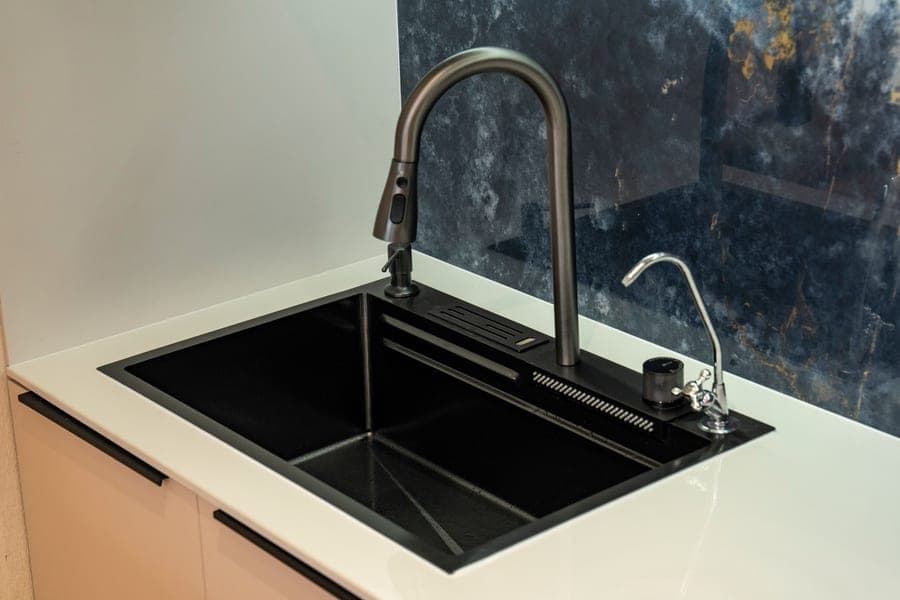
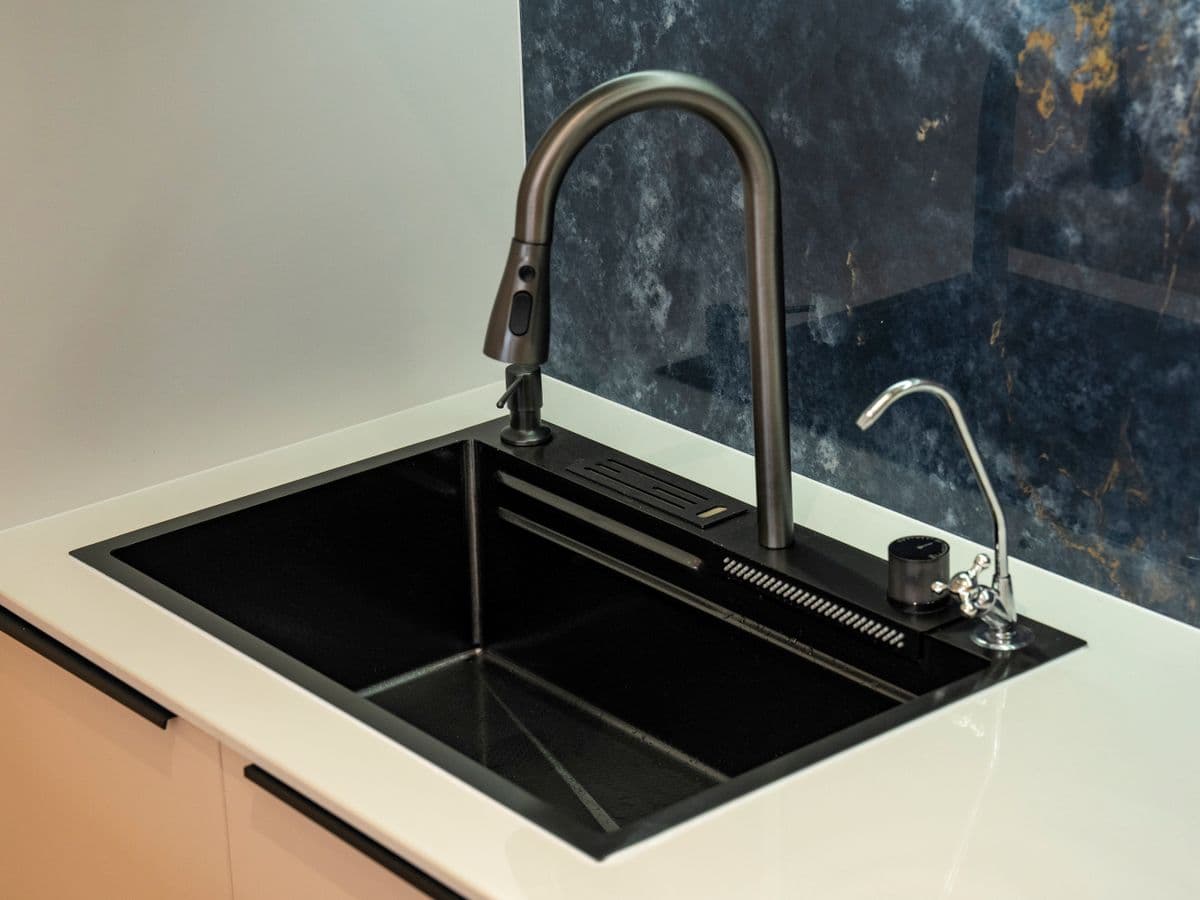
Photograph shows the product category, not this specific unit. We do not republish manufacturer product photography.
1. The workstation sink to buy
Kraus Kore KWU110-30 workstation sink
Kraus · Best for small kitchens that need counter space
The workstation sink we would buy, and the clearest case for 16-gauge steel anywhere in this category: a ledge sink is the one configuration where basin flex is genuinely audible, because accessories rest on the rim and transmit it. Ten inches deep, rear-offset drain, and the grid, mat, board and strainer are in the box rather than a $200 upsell.
Published specifications
- Overall size
- 30" x 19" source
- Bowl size
- 28" x 16" source
- Bowl depth
- 10" source
- Gauge
- 16-gauge stainless steel source
- Minimum cabinet
- 33" left to right, 24" front to back source
- Drain
- Rear offset, 3-1/2" opening source
- Sound damping
- NoiseDefend pads covering over 80% of the basin, plus undercoating source
- Warranty
- Kraus limited lifetime source
What works
- The integrated ledge turns a 30-inch sink into prep counter, the best single trade available in a small kitchen
- Rear-offset drain leaves usable cabinet space under the front of the sink
- Genuine 16-gauge with pads over 80% of the basin — gauge and damping do different jobs, and this sink has both
- A 3-1/2" drain opening takes a standard disposal flange with no adapter
What does not
- Needs a 33-inch cabinet for a 30-inch sink — measure before ordering
- A 10-inch deep bowl is a long reach for a shorter person
- The accessories are the reason to buy it and also the reason it costs more than a plain undermount
Skip it if
Skip it if your run of counter is already generous — you would be paying for prep space you do not need, and a plain 18-gauge undermount will serve.
#ad Affiliate link · We publish no price; Amazon shows the current one
Raw specifications: Kraus’s own page for the Kraus Kore KWU110-30 workstation sink.
Photograph shows the product category, not this specific unit. We do not republish manufacturer product photography.
2. The shallow-cabinet workstation
Kraus KWT310-33/5.5 ADA workstation drop-in sink
Kraus · Best for shallow cabinets and accessible kitchens
The drop-in to buy when depth is the problem rather than the goal. The bowl is 5.5 inches deep, which is what makes it ADA-compliant and also what makes it fit over a shallow trap arm — and it still carries a workstation ledge, so the cutting board and the drying rack recover the working space the shallow bowl costs.
Published specifications
- Overall size
- 33" x 22" x 6" deep source
- Bowl size
- 31" x 16" x 5.5" deep source
- Gauge
- TRU16 gauge stainless steel source
- Mounting
- Dual mount — drop-in or undermount source
- Faucet holes
- One pre-drilled, plus a soap-dispenser hole source
- Drain
- Rear offset source
- Minimum cabinet
- 36" source
- Compliance
- ADA; cUPC to ASME A112.19.3 / CSA B45.4 source
- Included
- Bottom grid, bamboo cutting board, roll-up drying rack, drain assembly, cut-out template source
- Warranty
- Kraus limited lifetime source
What works
- A 5.5-inch bowl clears plumbing that a 10-inch bowl simply will not — the commonest reason a sink upgrade stalls
- ADA-compliant depth, which matters if the kitchen has to be usable seated
- The integrated ledge and included accessories give back the working space the shallow bowl gives up
- Rear-offset drain, so the trap sits at the back of the cabinet rather than the middle
What does not
- 5.5 inches is genuinely shallow: a running faucet splashes more, and tall pots have to be filled at an angle
- The accessories are part of the price, and most households will not use all of them
- A shallow wide bowl shows standing water more obviously than a deep one, so the grid earns its place here
Skip it if
Skip it if you have the clearance for a deep bowl and nobody in the house needs an ADA-height basin. Buy depth instead.
#ad Affiliate link · We publish no price; Amazon shows the current one
Raw specifications: Kraus’s own page for the Kraus KWT310-33/5.5 ADA workstation drop-in sink.
The version nobody mentions: a shallow workstation
Most workstation sinks are 10 inches deep, which is the depth that collides with a high trap arm or a tall disposal. The Kraus KWT310-33/5.5 is the exception worth knowing about: a 5.5-inch bowl, ADA-compliant, that still carries a ledge and still ships the bamboo board and roll-up rack.
It is the right answer in two situations. One, the plumbing in the cabinet will not accept a deep bowl — the commonest reason a sink upgrade stalls halfway through a Saturday. Two, the kitchen has to be usable seated. The cost is real: 5.5 inches splashes more under a running faucet and tall pots have to be filled at an angle. The ledge is what gives back the working space the shallow bowl gives up.
Before you buy one
- Measure the counter you actually have beside the sink. If it is more than about four feet of clear run, buy a plain sink and keep the difference.
- Check the cabinet width. A 30-inch workstation needs 33 inches; a 33-inch one needs 36.
- Check cabinet depth front to back. Kraus publishes 24 inches for the Kore, and most makers publish nothing at all.
- Measure from the cabinet floor to the trap arm and subtract your intended bowl depth. A negative answer means the shallow version, not re-plumbing.
- Confirm which accessories are in the box, by model number. This is where two otherwise identical sinks differ most in value.
- Check the drain opening if a disposal is going in. A 3-1/2-inch opening takes a standard flange with no adapter.
If you have decided yes, best workstation sinks is the roundup. If the honest answer was no, best undermount kitchen sinks and best stainless steel kitchen sinks cover the plain versions properly.
What to take away
- Worth it when counter space is the constraint. Not worth it when it is not — a plain undermount does the washing just as well.
- The accessories are the product. Check which ones are in the box for your exact model number.
- Gauge matters more here than anywhere else in sinks, because accessories sit on the rim and transmit flex.
- A clip-on rail or a shallow rebate is not an integrated ledge. Universal accessories are the tell.
- A 5.5-inch ADA workstation exists, and it is the answer when the trap arm sits too high for a 10-inch bowl.
- No independent testing exists for ledge sinks, so every figure on this page is a manufacturer specification.
How we sourced this page
Every figure on this page came from one of the following. Where a manufacturer or an independent lab does not publish a number, we say so rather than estimate it.
Common questions
- Are workstation sinks worth the extra cost?
- In a kitchen short of counter space, yes — the ledge converts the sink opening into working surface, and a board plus a drying rack bought separately for a ledge sink costs a meaningful fraction of the sink. In a kitchen with a long clear run of counter beside the sink, no: you are paying for prep space you already have.
- Are workstation sinks hard to clean?
- Slightly harder than a plain bowl, because the ledge track collects water and debris and has to be wiped rather than rinsed. It is a minute a day, not a project. A sink whose ledge drains back into the basin is easier than one with a flat track.
- What gauge should a workstation sink be?
- Sixteen. This is the one sink configuration where gauge is audible rather than theoretical: accessories rest on the rim, so basin flex travels into the board you are cutting on. Look for 16-gauge Type 304 plus damping pads over most of the basin, not one or the other.
- Are workstation sink accessories universal?
- No, and a "universal" board is a warning sign. A real workstation ledge is machined into the basin walls to a specific width, and the maker's own board, colander and rack are cut to that model. Accessories from another brand either do not sit in the track or do not span the bowl.
More in Kitchen Sinks
Three specifications settle almost every kitchen sink question: how thick the steel is, how it meets the counter, and what it is made of. Get those right and brand barely matters.
Read next
Best workstation sink
Best workstation sinks
Ledge sinks reviewed on gauge, accessory quality and drain position, including the 33-inch and farmhouse-ledge options.
Head to head
16 gauge vs 18 gauge
16 gauge is 25% thicker steel. What that buys, what it does not buy, and why sound-deadening coverage is the spec nobody advertises.
Best single bowl sink
Best single bowl sinks
Four single-bowl sinks compared on usable basin width, depth and the cabinet each one needs.
Best stainless sink
Best stainless sinks
Four stainless sinks compared on gauge, depth, drain position and damping coverage — including the 18-gauge one that is still the right buy.

Guide
Sink sizes and cabinet fit
The cabinet-to-sink arithmetic, the four measurements to take, and how a disposal changes the numbers.
Guide
How to choose a sink
The six decisions in the order that actually works, each with the measurement that settles it — and what to do when two of them conflict.
Found something out of date, or a figure you can source better than we did? Tell us — corrections get read first. Our methodology explains how picks are made, and contact is one click away.