Kitchen Sinks
Are sink grids worth it?
It looks like an accessory and behaves like insurance. The grid is what keeps pans off the base of the bowl, which is where every sink gets damaged.

Disclosure: we earn a commission if you buy through the Amazon links on this page, at no extra cost to you. Commission never decides a verdict or a ranking position — read our editorial policy and affiliate disclosure.
How we assessed these: we compared published manufacturer specifications for the named model numbers, read from each maker's own product page or specification sheet and linked at every figure. We have not tested these sinks and we do not own them. No independent laboratory publishes chip, stain or scratch testing for residential kitchen sinks, so material claims here are the manufacturer's and are labeled as such.
Short answer
Yes — a bottom grid is worth it, and on a fireclay or composite sink it is close to essential. It lifts pans, knives and plates off the base of the bowl, which is exactly where a stainless sink gets its scratch pattern and where a ceramic sink gets the impact chip that cannot be repaired. It is the cheapest protection a sink has, and four of the sinks on this site include one in the box rather than selling it separately.
A bottom grid is a stainless lattice with rubber or plastic feet that sits in the base of the bowl. Nothing about it looks important, which is why so many of them end up in the cupboard under the sink within a month of installation. That is a mistake, and the reason is specific: almost all kitchen sink damage happens at the base of the bowl, not the sides.
What the grid actually prevents
- The scratch halo on stainless. Pans dragged across the base of a steel bowl leave a dense pattern of fine scratches that dulls the finish. On a satin grain individual scratches blend in; the halo does not.
- Impact chips on ceramic. BOCCHI describes the Classico's surface as a non-porous fired glaze that resists stains, scratches and thermal shock. What it does not resist is a dropped cast-iron pan, and a chip in fireclay is permanent.
- Dents on thin steel. An 18-gauge flat-bottomed bowl flexes under a heavy impact. The grid spreads the load.
- Knife edges. A chef's knife left blade-down in a steel bowl is bad for the sink and worse for the knife. On a grid it rests on steel bars rather than on its edge.
- Standing water under a pan. A pan sitting flat on the base traps water beneath it. Lifted on a grid, it drains and dries.
What it does not do
It is not a drying rack, though people use it as one, and it is not a strainer — scraps still go down the drain or into a basket. It does not make a noisy sink quiet: that job belongs to gauge and damping pads, which is why Kraus publishes NoiseDefend pads over 80% of the Kore's basin plus an undercoating as separate specifications from the grid it includes.
And it does not protect the sides of the bowl, which is where a dropped glass will hit first. Nobody claims it does. The grid is a base protector, and the base is the place that needs one.
| Model | Grid included | Also included | Material being protected |
|---|---|---|---|
| Kraus Kore KWU110-30 | Yes | Mat, cutting board, strainer | 16-gauge stainless, 10" deep |
| Kraus KHT300-33 | Yes | Drain assembly with removable strainer, decorative drain cover | TRU16 gauge T304 stainless |
| Kraus KHT302-33 | Yes, two | Two drain assemblies, cut-out template, hardware | TRU16 gauge stainless, two bowls |
| BOCCHI Classico 30 | Yes | Chrome strainer | Fireclay with a fired non-porous glaze |
| Kraus Premier KTM100-33 | Not included on the listing we read | Drain assembly with removable strainer, mounting hardware, cut-out template | 18 gauge T-304 stainless |
Contents are read from each maker's own product page for that model number, listed in the sources below. The Premier row is there as the honest counter-example: a well-made sink that does not bundle a grid, so budget for one separately. We do not write prices into this copy, so we cannot tell you what that costs.
The drawbacks, honestly
A grid is one more thing to clean. Food lodges between the bars and under the feet, and it wants rinsing and occasionally going through the dishwasher. Its feet can trap grit against the sink base, which is the one way a grid can cause the scratching it exists to prevent — so lift it and rinse underneath now and then.
It also takes up usable depth. On a 10-inch bowl, losing half an inch is nothing. On a shallow 7-1/2 inch sink or a 5.5-inch ADA bowl it is a larger share of what you have, and some people would rather have the depth. How deep should a kitchen sink be covers what that depth is for.
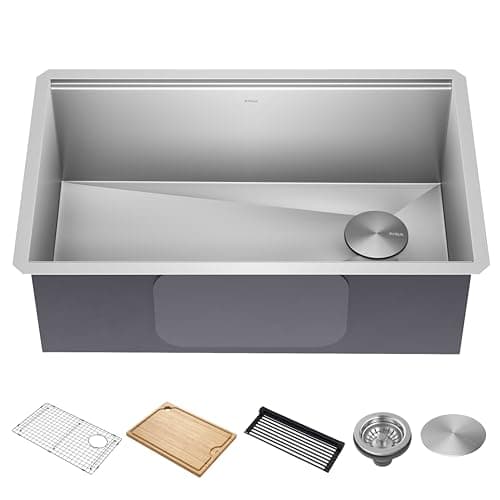
Product photograph supplied by Amazon for this listing, used under the Associates program.
1. Best grid package
Kraus Kore KWU110-30 workstation sink
Kraus · Best for small kitchens that need counter space
The workstation sink we would buy, and the clearest case for 16-gauge steel anywhere in this category: a ledge sink is the one configuration where basin flex is genuinely audible, because accessories rest on the rim and transmit it. Ten inches deep, rear-offset drain, and the grid, mat, board and strainer are in the box rather than a $200 upsell.
Published specifications
- Overall size
- 30" x 19" source
- Bowl size
- 28" x 16" source
- Bowl depth
- 10" source
- Gauge
- 16-gauge stainless steel source
- Minimum cabinet
- 33" left to right, 24" front to back source
- Drain
- Rear offset, 3-1/2" opening source
- Sound damping
- NoiseDefend pads covering over 80% of the basin, plus undercoating source
- Warranty
- Kraus limited lifetime source
What works
- The integrated ledge turns a 30-inch sink into prep counter, the best single trade available in a small kitchen
- Rear-offset drain leaves usable cabinet space under the front of the sink
- Genuine 16-gauge with pads over 80% of the basin — gauge and damping do different jobs, and this sink has both
- A 3-1/2" drain opening takes a standard disposal flange with no adapter
What does not
- Needs a 33-inch cabinet for a 30-inch sink — measure before ordering
- A 10-inch deep bowl is a long reach for a shorter person
- The accessories are the reason to buy it and also the reason it costs more than a plain undermount
Skip it if
Skip it if your run of counter is already generous — you would be paying for prep space you do not need, and a plain 18-gauge undermount will serve.
#ad Affiliate link · Price as of October 16, 2026
Raw specifications: Kraus’s own page for the Kraus Kore KWU110-30 workstation sink.
Product photograph supplied by Amazon for this listing, used under the Associates program.
2. Best included grid, drop-in
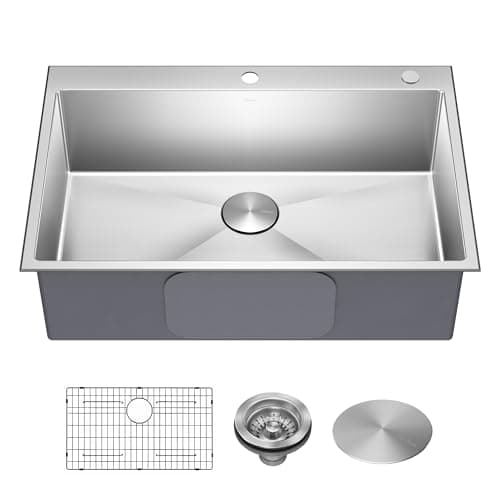
Kraus KHT300-33 drop-in sink
Kraus · Best for replacing a sink without touching the counter
The drop-in we would fit in most kitchens, because it is a 16-gauge sink sold as a dual-mount: the rim is finished to sit on the counter, and the same sink can be undermounted later if you ever replace the countertop. At 10 inches deep with a rear-set drain it behaves like a modern undermount while asking nothing of your existing counter.
Published specifications
- Overall size
- 33" x 22" x 10-5/8" deep source
- Bowl size
- 31" x 18" x 10" deep source
- Gauge
- TRU16 gauge T304 stainless steel source
- Mounting
- Dual mount — drop-in or undermount source
- Faucet holes
- Two pre-drilled, for a faucet and a soap dispenser source
- Drain
- Rear-set source
- Minimum cabinet
- 36" source
- Sound damping
- NoiseDefend pads on all sides plus anti-condensation undercoating source
- Certification
- cUPC to ASME A112.19.3 / CSA B45.4 source
- Included
- Bottom grid, drain assembly with removable strainer, decorative drain cover source
- Warranty
- Kraus limited lifetime source
What works
- 16-gauge steel in a drop-in, which is unusual — most top-mount sinks at this size are 18-gauge or thinner
- Dual mount means the sink survives a future countertop replacement instead of being thrown away with it
- A 10-inch bowl with a rear-set drain leaves usable cabinet space under the front of the sink
- Grid, drain and strainer are in the box, so the only extra part is the sealant
What does not
- A 33-inch sink still needs a 36-inch cabinet, so it is not a drop-in replacement for a 30-inch base unit
- A 10-inch bowl is a long reach for a shorter person, and a drop-in rim sits slightly higher than an undermount one
- Kraus publishes no unit weight for this model, so plan the lift by the shipping box rather than a figure
Skip it if
Skip it if your existing cutout is for a 30-inch sink. A drop-in can cover a slightly smaller hole, never a smaller cabinet.
#ad Affiliate link · Price as of October 16, 2026
Raw specifications: Kraus’s own page for the Kraus KHT300-33 drop-in sink.
Product photograph supplied by Amazon for this listing, used under the Associates program.
3. Most necessary grid
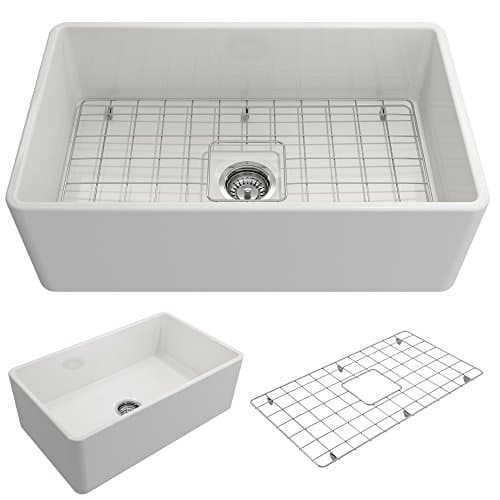
BOCCHI Classico 30-inch fireclay farmhouse sink
BOCCHI · Best for farmhouse style, lighter than cast iron
Fireclay's argument against cast iron is the surface: the glaze is fired onto clay at very high temperature and is non-porous, rather than an enamel layer bonded to metal. This one ships with the bottom grid and strainer, and needs no flange extension for a disposal — a small detail that saves a trip to the store on install day.
Published specifications
What works
- Non-porous glaze, so staining is a cleaning problem rather than a permanent one
- Lighter than an equivalent enameled cast-iron sink, which simplifies cabinet support
- Grid and strainer in the box — the grid is what protects the glaze from dropped cast iron
- Takes a standard disposal flange without an extension kit
What does not
- Fireclay is a ceramic: a hard impact chips it, and a chip is not repairable the way a scratch in stainless is
- Hand-made dimensions vary slightly batch to batch, so cut the cabinet to the sink you received
- No independent lab publishes chip-resistance testing for fireclay sinks, so the material claims here are the manufacturer's
Skip it if
Skip it if your household is hard on a sink — dropped pots and ceramic do not mix. Choose 16-gauge stainless instead.
#ad Affiliate link · Price as of October 16, 2026
Product photograph supplied by Amazon for this listing, used under the Associates program.
4. Best for two bowls
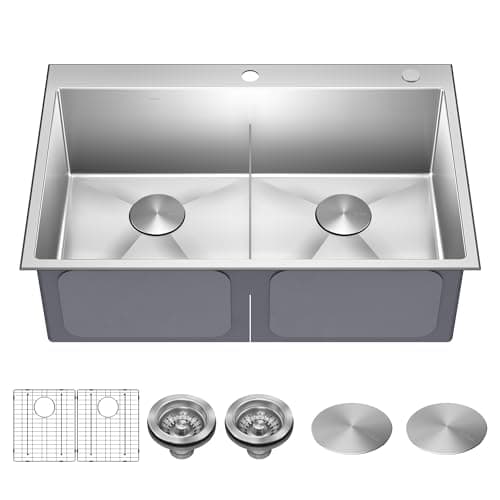
Kraus KHT302-33 double-bowl drop-in sink
Kraus · Best for washing on one side, draining on the other
The double bowl for people who genuinely use two bowls — two equal 15-1/2 inch basins, both 10 inches deep, in the same 16-gauge dual-mount body as the single-bowl KHT300. Equal bowls are the right split if one side lives full of soaking dishes; a 60/40 split is the better choice if what you really want is one usable bowl.
Published specifications
- Overall size
- 33" x 22" x 10-5/8" deep source
- Bowl size
- Two equal bowls, 15-1/2" x 18" x 10" deep source
- Gauge
- TRU16 gauge stainless steel, 10:18 chromium-to-nickel source
- Mounting
- Dual mount — drop-in or undermount source
- Faucet holes
- Two pre-drilled, for a faucet and a soap dispenser source
- Minimum cabinet
- 36" source
- Sound damping
- NoiseDefend pads covering over 80% of the sink, plus undercoating source
- Certification
- cUPC to ASME A112.19.3 / CSA B45.4 source
- Included
- Two bottom grids, two drain assemblies with strainers, cut-out template, mounting hardware source
- Warranty
- Kraus limited lifetime source
What works
- Two 10-inch-deep bowls rather than one deep bowl and one token shallow one
- Pads over 80% of the body — the most complete damping of any sink on this page
- Both drains come with grids and strainers, which on a double bowl is normally two extra purchases
- Dual mount, so the same sink works on your existing counter now and an undermount counter later
What does not
- Each bowl is 15-1/2 inches wide, which will not take a large roasting pan flat — that is the cost of two bowls at 33 inches
- A center divider means the disposal lives under one side only, so decide which before you plumb it
- Two drain assemblies means two more joints under the sink that can weep
Skip it if
Skip it if you wash big sheet pans and roasting trays. One wide bowl beats two narrow ones for that, every time.
#ad Affiliate link · Price as of October 16, 2026
Raw specifications: Kraus’s own page for the Kraus KHT302-33 double-bowl drop-in sink.
Grid, mat or neither
A silicone or rubber mat is the soft alternative. It protects against impact at least as well, it is quieter, and it is kinder to glassware. Its weakness is that it sits flat, traps water underneath and needs lifting and drying — the standing-water problem the grid avoids by having feet. The Kraus Kore ships both, which is the honest answer: use the mat when you are washing glasses, the grid the rest of the time.
If what you actually want is to stop scraps going down the drain, that is a strainer rather than a grid. Best sink strainers covers those, and what not to put in a garbage disposal is the related argument about what should never get past one.
Which to buy
- If your sink included a grid, use it. From day one, not after the first scratch. This is the whole recommendation.
- If your sink is fireclay or composite, buy one. A chip in a glaze is not repairable; a scratch in steel mostly is.
- If your sink is 18-gauge stainless, buy one. Thin steel with bottom pads only is the loudest, most flex-prone combination here.
- If your bowl is very shallow, consider a mat instead. You lose less usable depth and still absorb impact.
For the wider question of what makes a sink survive a decade, kitchen sink materials and how to fix kitchen sink scratches are the two pages that follow this one.
What to take away
- The base of the bowl is where sinks get damaged, and a grid is what keeps pans off it.
- On fireclay and composite it is close to essential - an impact chip in a glaze cannot be repaired.
- It is not a strainer, not a drying rack and not a noise fix; gauge and damping pads do that.
- Four of the sinks on this site include one. The Kraus Premier KTM100-33 does not - budget separately.
- Lift and rinse under the grid occasionally, or grit under its feet will scratch the base.
- A silicone mat protects as well and is kinder to glass, but traps water because it has no feet.
How we sourced this page
Every figure on this page came from one of the following. Where a manufacturer or an independent lab does not publish a number, we say so rather than estimate it.
- Kraus Kore KWU110-30 specification sheet (PDF)
- Kraus Kore KWU110-30 product page (published specifications)
- Kraus KHT300-33 drop-in / undermount single-bowl sink product page (published specifications)
- Kraus KHT302-33 drop-in / undermount double-bowl sink product page (published specifications)
- BOCCHI Classico 30-inch fireclay farmhouse sink — manufacturer listing
- Kraus Premier KTM100-33 drop-in / top-mount sink product page (published specifications)
Common questions
- Are kitchen sink grids necessary?
- On a fireclay or composite sink, close to it - the damage a grid prevents is an impact chip that cannot be repaired. On stainless it is not strictly necessary but it is the cheapest way to keep the base of the bowl from dulling. Four of the sinks we cover include one for exactly that reason.
- Do sink grids scratch the sink?
- They can, in one specific way: grit trapped under the rubber feet grinds against the base when the grid shifts. Lift it out and rinse underneath every so often and that does not happen. A grid sized for a different bowl slides around and is the real risk.
- Are sink grids dishwasher safe?
- Most stainless grids are, and that is the easiest way to clean between the bars. Check the maker's own care instructions for yours, because the rubber or plastic feet are the part that can suffer on a hot cycle.
- Grid or sink mat - which is better?
- A grid lifts items clear so water drains underneath; a mat sits flat, absorbs impact better and is kinder to glassware but traps water. The Kraus Kore ships both, which is the practical answer: mat for glasses, grid the rest of the time.
More in Kitchen Sinks
Three specifications settle almost every kitchen sink question: how thick the steel is, how it meets the counter, and what it is made of. Get those right and brand barely matters.
Read next
Best sink strainer
Best sink strainers
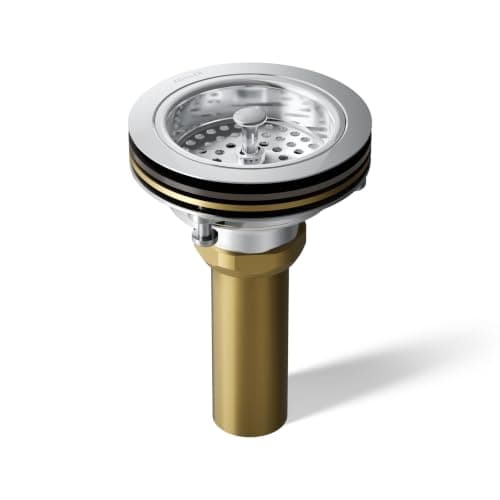
Basket strainer or drop-in screen — what each does, which fits a disposal, and the two worth buying.
Guide
Sink materials compared
Five materials compared on heat, impact, noise and repairability, with the honest failure mode of each one.
Head to head
16 gauge vs 18 gauge
16 gauge is 25% thicker steel. What that buys, what it does not buy, and why sound-deadening coverage is the spec nobody advertises.
Guide
How deep should a sink be
The depth range that suits most kitchens, the four things that constrain it, and four sinks spanning 5.5 to 10 inches of bowl depth.
How to
Fix kitchen sink scratches
Material-by-material scratch repair: what blends out, what improves, and what should be left alone.
Best kitchen sink
Best kitchen sinks
Five sinks across the four materials, compared on sourced dimensions, cabinet requirements and how each one fails.
Found something out of date, or a figure you can source better than we did? Tell us — corrections get read first. Our methodology explains how picks are made, and contact is one click away.