Kitchen Sinks
How deep should a kitchen sink be?
Deeper hides more dishes and splashes less. It also makes you lean further and leaves less room for the plumbing. The ceiling is set by your drain, not your taste.
Disclosure: we earn a commission if you buy through the Amazon links on this page, at no extra cost to you. Commission never decides a verdict or a ranking position — read our editorial policy and affiliate disclosure.
How we assessed these: we compared published manufacturer specifications for the named model numbers, read from each maker's own product page or specification sheet and linked at every figure. We have not tested these sinks and we do not own them. No independent laboratory publishes chip, stain or scratch testing for residential kitchen sinks, so material claims here are the manufacturer's and are labeled as such.
Short answer
Eight to ten inches of bowl depth suits most kitchens. Ten inches lets a roasting pan lie flat, hides a stack of dishes and absorbs the splash from a high-arc faucet. Below eight inches you gain back comfort and plumbing clearance and lose the sheet-pan trick. Your real ceiling is not preference — it is the height of the drain line in the wall, because the sink bottom plus the disposal plus the trap all have to sit above it.
Sink depth is quoted two ways and the difference matters. Bowl depth is measured inside, from the bottom of the basin to the rim, and that is the number that decides what fits. Overall height includes the rim and any apron, which is what has to clear the plumbing underneath. The Kraus KHT300-33 publishes both — a 10-inch bowl inside a sink that is 10-5/8 inches overall.
What depth buys you
- A sheet pan laid flat. The thing a deep bowl does that a shallow one cannot. A half-sheet pan is 18 x 13 inches, so this also needs bowl width, not only depth.
- Less splash. Water falling from a high-arc faucet has energy when it lands. A deep bowl absorbs it; a shallow one bounces it over the rim and onto the cabinet front.
- Dishes out of sight. In an open-plan kitchen a 10-inch bowl hides a day's washing up from the room. A 7-inch bowl does not.
- Soaking a stock pot. Height is what lets a tall pot sit under the faucet and fill without tilting.
What depth costs you
Leaning. A deep bowl puts the bottom of the basin further from you, and the reach is forwards and down, which loads the lower back. If the counter is at a standard 36 inches and you are tall, a 10-inch bowl is comfortable. If you are shorter, or you stand at that sink for long stretches, a shallower bowl genuinely helps and is the main reason 7-1/2 inch sinks are still made in volume.
The second cost is underneath. Everything that happens below the drain — the disposal, the tailpiece, the trap, the fall to the trap arm in the wall — has to fit between the bottom of the sink and that drain line. Every inch of bowl depth is an inch taken from that budget.
| Bowl depth | Suits | Example model | Note |
|---|---|---|---|
| 5 to 6" | Accessible counters; very shallow base cabinets | Kraus KWT310-33/5.5 — 5.5" bowl | ADA compliant; 6" overall |
| 7 to 8" | High trap arms, shorter users, like-for-like swaps | Kraus Premier KTM100-33 — 7-1/2" bowl | 8" overall, 18 gauge |
| 9 to 9-1/2" | The general-purpose middle | Blanco Diamond Silgranit — 9-1/2" bowl | Composite; hides limescale |
| 10" and over | Sheet pans, high-arc faucets, open-plan kitchens | Kraus KHT300-33 — 10" bowl | 10-5/8" overall; 16 gauge |
Depths are read from each maker's own product page or specification sheet for that model number, listed in the sources below. The "suits" column is our editorial read, not a measurement - no standard specifies a sink depth for a given user height, and we will not invent one.
The constraint most people meet: the trap arm
The drain line enters your wall at a fixed height. From the sink's drain opening the water has to pass through a tailpiece, into a P-trap, and along a trap arm that falls slightly toward that wall connection. If the bottom of the sink sits too low, there is not enough vertical room left for the trap to work, and no amount of fiddling fixes it.
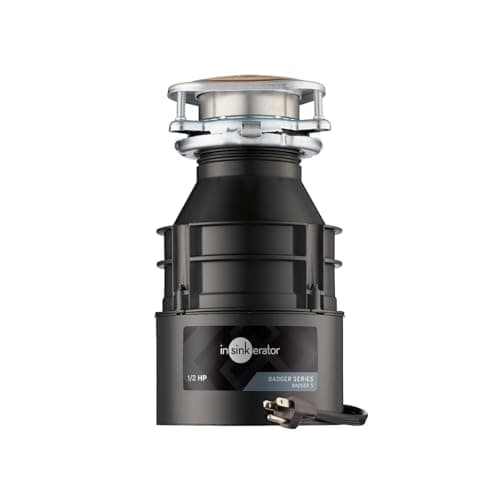
A garbage disposal makes this much tighter, because it hangs below the drain opening before any of the trap work starts. The InSinkErator Badger 5 is 11-1/2 inches tall, the Evolution .75HP is 12.25, the Evolution 1HP is 13, and the batch-feed Cover Control is 14.95. Swapping a shallow sink for a 10-inch bowl and a tall disposal at the same time is how people end up re-plumbing. Garbage disposal sizing and fit is the page to read first, and can you install a garbage disposal in any sink covers the sink side.
Product photograph supplied by Amazon for this listing, used under the Associates program.
1. Best deep bowl
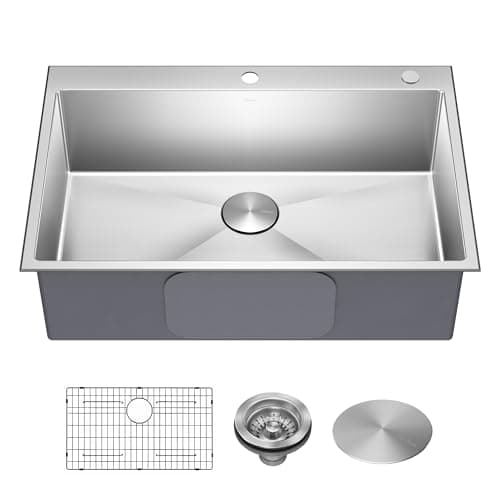
Kraus KHT300-33 drop-in sink
Kraus · Best for replacing a sink without touching the counter
The drop-in we would fit in most kitchens, because it is a 16-gauge sink sold as a dual-mount: the rim is finished to sit on the counter, and the same sink can be undermounted later if you ever replace the countertop. At 10 inches deep with a rear-set drain it behaves like a modern undermount while asking nothing of your existing counter.
Published specifications
- Overall size
- 33" x 22" x 10-5/8" deep source
- Bowl size
- 31" x 18" x 10" deep source
- Gauge
- TRU16 gauge T304 stainless steel source
- Mounting
- Dual mount — drop-in or undermount source
- Faucet holes
- Two pre-drilled, for a faucet and a soap dispenser source
- Drain
- Rear-set source
- Minimum cabinet
- 36" source
- Sound damping
- NoiseDefend pads on all sides plus anti-condensation undercoating source
- Certification
- cUPC to ASME A112.19.3 / CSA B45.4 source
- Included
- Bottom grid, drain assembly with removable strainer, decorative drain cover source
- Warranty
- Kraus limited lifetime source
What works
- 16-gauge steel in a drop-in, which is unusual — most top-mount sinks at this size are 18-gauge or thinner
- Dual mount means the sink survives a future countertop replacement instead of being thrown away with it
- A 10-inch bowl with a rear-set drain leaves usable cabinet space under the front of the sink
- Grid, drain and strainer are in the box, so the only extra part is the sealant
What does not
- A 33-inch sink still needs a 36-inch cabinet, so it is not a drop-in replacement for a 30-inch base unit
- A 10-inch bowl is a long reach for a shorter person, and a drop-in rim sits slightly higher than an undermount one
- Kraus publishes no unit weight for this model, so plan the lift by the shipping box rather than a figure
Skip it if
Skip it if your existing cutout is for a 30-inch sink. A drop-in can cover a slightly smaller hole, never a smaller cabinet.
#ad Affiliate link · Price as of October 16, 2026
Raw specifications: Kraus’s own page for the Kraus KHT300-33 drop-in sink.
Product photograph supplied by Amazon for this listing, used under the Associates program.
2. Best middle ground
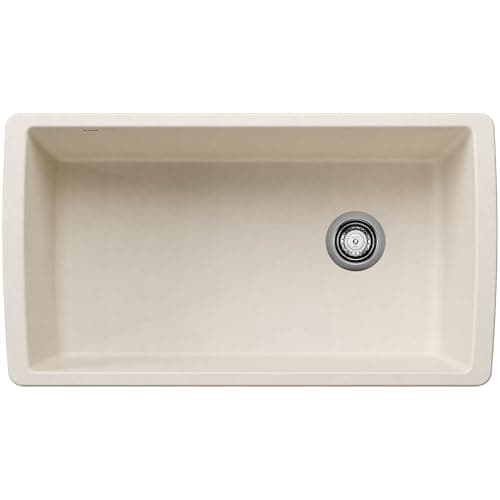
Blanco Diamond Silgranit super single
Blanco · Best for hard water and visible sinks
The granite composite sink that answers the material's usual objection. Silgranit is up to 80% ground granite in an acrylic binder, and what it does better than stainless is hide everything: no water spots, no visible scratch pattern, no dent from a dropped pan. What it does worse is take a screaming-hot pan straight off the burner.
Published specifications
What works
- Hides limescale and water spotting better than any stainless finish — the reason to choose it in hard water
- Color runs through the material, so a scratch does not expose a different substrate
- Quieter than stainless without added pads, because the mass does the damping
- A 9-1/2" bowl is deep enough to lay a sheet pan flat
What does not
- Composite is not stainless: thermal shock is a real limit, so a very hot pan goes on a trivet
- Light colors show tea and turmeric staining more than dark ones
- Blanco publishes no thermal-limit figure, so we will not print one
Skip it if
Skip it if you routinely dump hot pans and boiling stock straight into the sink. Stainless tolerates that; composite is the wrong tool for it.
#ad Affiliate link · Price as of October 16, 2026
Product photograph supplied by Amazon for this listing, used under the Associates program.
3. Best shallow stainless
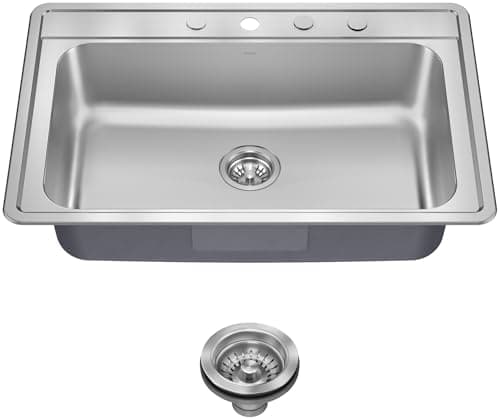
Kraus Premier KTM100-33
Kraus · Best for a like-for-like swap in an existing cutout
The plain, serviceable drop-in, and the one most likely to be a direct swap for what is already in your counter: 33 by 22 inches, a bowl 7-1/2 inches deep, 18-gauge Type 304 steel. The shallow bowl is the point — it is the depth older cabinets and high trap arms were built around, and it is getting hard to buy now that every new sink is ten inches deep.
Published specifications
- Overall size
- 33" x 22" x 8" source
- Bowl size
- 27-4/5" x 16" x 7-1/2" deep source
- Gauge
- 18 gauge, T-304 stainless steel source
- Faucet holes
- Pre-drilled for a faucet; Kraus does not publish a hole count for this model source
- Mounting
- Drop-in / top mount, with a cut-out template in the box source
- Drain
- Rear-set source
- Minimum cabinet
- 36" source
- Sound damping
- NoiseDefend pads on all sides plus anti-condensation undercoating source
- Certification
- cUPC to ASME A112.19.3 / CSA B45.4, and MASS source
- Included
- Drain assembly with removable strainer, mounting hardware, cut-out template source
- Warranty
- Kraus limited lifetime source
What works
- A 7-1/2 inch bowl, which is the depth most older cabinets and shallow trap arms were built around
- A rear-set drain, so the trap sits at the back of the cabinet and leaves the front usable
- NoiseDefend pads on all sides rather than bottom pads only, which is unusual on an 18-gauge sink
- Drain assembly, strainer, hardware and a cut-out template are in the box, so the only extra part is the sealant
What does not
- 18-gauge flexes more than 16-gauge under a dropped pan, and the pads damp drumming rather than remove it
- Kraus does not publish a faucet-hole count for this model, so confirm the drilling matches your counter before ordering
- A 33-inch sink still needs a 36-inch cabinet, so it is not a swap for a 30-inch base unit
Skip it if
Skip it if you want a deep modern basin. At 7-1/2 inches the bowl will not take a sheet pan laid flat.
Raw specifications: Kraus’s own page for the Kraus Premier KTM100-33.
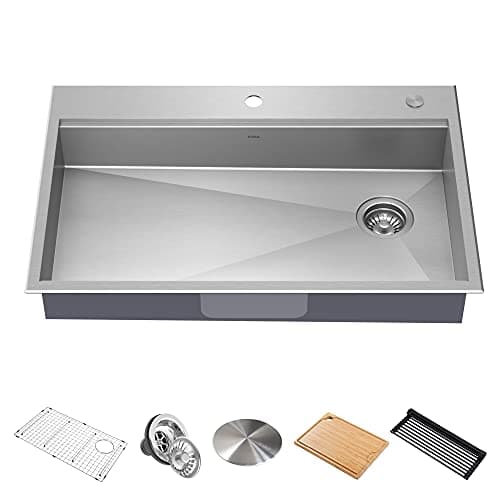
Product photograph supplied by Amazon for this listing, used under the Associates program.
4. Best accessible depth
Kraus KWT310-33/5.5 ADA workstation drop-in sink
Kraus · Best for shallow cabinets and accessible kitchens
The drop-in to buy when depth is the problem rather than the goal. The bowl is 5.5 inches deep, which is what makes it ADA-compliant and also what makes it fit over a shallow trap arm — and it still carries a workstation ledge, so the cutting board and the drying rack recover the working space the shallow bowl costs.
Published specifications
- Overall size
- 33" x 22" x 6" deep source
- Bowl size
- 31" x 16" x 5.5" deep source
- Gauge
- TRU16 gauge stainless steel source
- Mounting
- Dual mount — drop-in or undermount source
- Faucet holes
- One pre-drilled, plus a soap-dispenser hole source
- Drain
- Rear offset source
- Minimum cabinet
- 36" source
- Compliance
- ADA; cUPC to ASME A112.19.3 / CSA B45.4 source
- Included
- Bottom grid, bamboo cutting board, roll-up drying rack, drain assembly, cut-out template source
- Warranty
- Kraus limited lifetime source
What works
- A 5.5-inch bowl clears plumbing that a 10-inch bowl simply will not — the commonest reason a sink upgrade stalls
- ADA-compliant depth, which matters if the kitchen has to be usable seated
- The integrated ledge and included accessories give back the working space the shallow bowl gives up
- Rear-offset drain, so the trap sits at the back of the cabinet rather than the middle
What does not
- 5.5 inches is genuinely shallow: a running faucet splashes more, and tall pots have to be filled at an angle
- The accessories are part of the price, and most households will not use all of them
- A shallow wide bowl shows standing water more obviously than a deep one, so the grid earns its place here
Skip it if
Skip it if you have the clearance for a deep bowl and nobody in the house needs an ADA-height basin. Buy depth instead.
#ad Affiliate link · Price as of October 16, 2026
Raw specifications: Kraus’s own page for the Kraus KWT310-33/5.5 ADA workstation drop-in sink.
Depth and your faucet are one decision
A high-arc faucet over a shallow bowl is the commonest splash complaint in kitchens, and it is pure geometry: the higher the outlet, the faster the water arrives, and a shallow base deflects it over the rim. The Moen Arbor 7594 publishes an 8-1/4 inch spout height and 15-1/2 inches overall. Over a 10-inch bowl that is fine. Over a 7-1/2 inch bowl it will wet the front of the cabinet.
So pick them together. If your sink is already shallow and you are not replacing it, a lower spout is the fix — best kitchen faucets for small sinks is that shortlist. If the sink is deep, best high arc kitchen faucets is where to look.
Does a deeper sink need a thicker gauge?
Not for strength, but the two do travel together. A deeper bowl has more unsupported flat area at the base, so it drums more under a running tap and flexes more under a dropped pan — and 16-gauge steel with damping pads over most of the basin is what makes a deep steel sink quiet. Kraus publishes NoiseDefend pads on all sides plus an undercoating on the KHT300-33 and on the shallower 18-gauge Premier KTM100-33, so between those two it is depth and thickness doing the work rather than the damping.
That is also why the quietest sinks tend to be the deep composite ones: the Blanco Diamond Silgranit is quiet by mass rather than by pads. 16 gauge vs 18 gauge takes the thickness argument apart, and kitchen sink materials covers how each one behaves.
What to take away
- Eight to ten inches of bowl depth suits most kitchens; ten lets a sheet pan lie flat.
- Bowl depth is measured inside; overall height includes the rim. Check which figure you are reading.
- The real ceiling is the height of your wall drain, not your preference.
- A disposal eats 11-1/2 to 15 inches of that budget before the trap gets any.
- A deep bowl means more leaning - a genuine reason shallower sinks are still made.
- Pick sink depth and faucet height together, or a high arc over a shallow bowl will splash.
How we sourced this page
Every figure on this page came from one of the following. Where a manufacturer or an independent lab does not publish a number, we say so rather than estimate it.
- Kraus KHT300-33 drop-in / undermount single-bowl sink product page (published specifications)
- Kraus Premier KTM100-33 drop-in / top-mount sink product page (published specifications)
- Blanco Diamond Silgranit super single bowl sink — manufacturer listing
- Kraus KWT310-33/5.5 ADA workstation drop-in sink product page (published specifications)
- InSinkErator Badger 5 product page (published specifications)
- InSinkErator Evolution 1HP specification sheet (published as Evolution Excel, PDF)
- Moen Arbor 7594 product page (published specifications)
Common questions
- Is a 10 inch deep kitchen sink too deep?
- Not for most people, and it is the depth that lets a half-sheet pan lie flat. It does mean more leaning, so if you are shorter than average or stand at the sink for long stretches, 8 to 9 inches is kinder. What rules it out is plumbing: a 10-inch bowl plus a tall disposal can leave no room for the trap.
- What is the standard depth of a kitchen sink?
- Most US kitchen sinks fall between 7 and 10 inches of bowl depth, and the general-purpose middle is 8 to 9. Older drop-in sinks are commonly 7 to 7-1/2 inches; newer 16-gauge single bowls are commonly 9 to 10.
- Is a deeper sink harder on your back?
- Yes, modestly. The reach is forward and down, and a deeper basin puts the work further from you. The counter height matters as much as the bowl - at a standard 36-inch counter a 10-inch bowl puts the base around 26 inches from the floor.
- How shallow can a kitchen sink be?
- Around 5 to 5-1/2 inches, which is the ADA range - the Kraus KWT310-33/5.5 publishes a 5.5-inch bowl so knees fit under the counter. Below that a sink stops holding enough water to be useful for washing up.
More in Kitchen Sinks
Three specifications settle almost every kitchen sink question: how thick the steel is, how it meets the counter, and what it is made of. Get those right and brand barely matters.
Read next
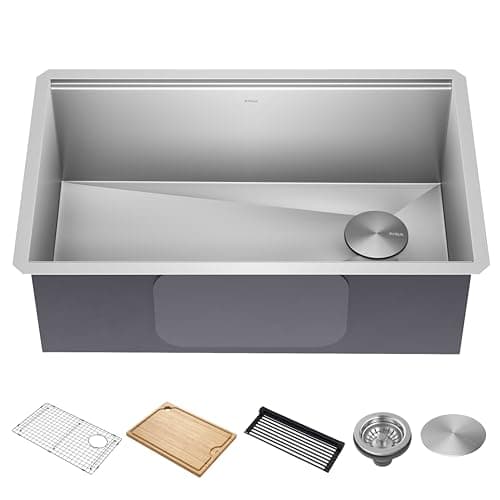
Guide
Sink sizes and cabinet fit
The cabinet-to-sink arithmetic, the four measurements to take, and how a disposal changes the numbers.
Best 33 inch sink
Best 33 inch sinks
Five 33-inch sinks compared on bowl size, depth, mounting and what comes in the box - starting with the cabinet width each one actually requires.
Head to head
16 gauge vs 18 gauge
16 gauge is 25% thicker steel. What that buys, what it does not buy, and why sound-deadening coverage is the spec nobody advertises.
Guide
How to choose a sink
The six decisions in the order that actually works, each with the measurement that settles it — and what to do when two of them conflict.
Guide
Disposal sizing and fit
A height chart for common units, the two measurements to take first, and what thin or deep sinks change.
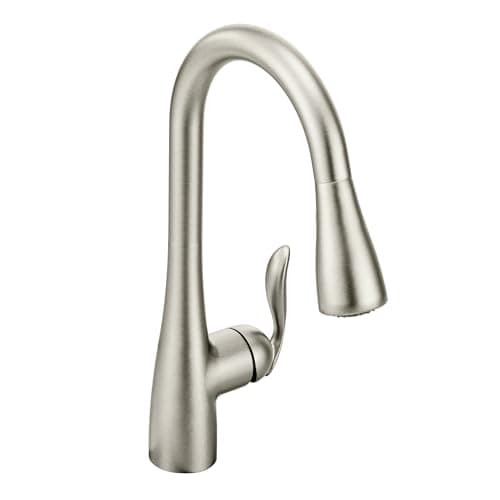
Best high arc faucet
Best high arc faucets
Four high-arc faucets compared on published spout height, reach and overall height, plus the splash problem a high arc creates in a shallow sink.
Found something out of date, or a figure you can source better than we did? Tell us — corrections get read first. Our methodology explains how picks are made, and contact is one click away.