Kitchen Sinks
Alternatives to Blanco Silgranit
Silgranit is a genuinely well-documented composite. Here is what else publishes a comparable number, and for how much less.
Disclosure: we earn a commission if you buy through the Amazon links on this page, at no extra cost to you. Commission never decides a verdict or a ranking position — read our editorial policy and affiliate disclosure.
How we assessed these: we compared published manufacturer specifications for the named model numbers, read from each maker's own product page and linked at every figure. We have not installed or tested these sinks and we do not own them. No independent laboratory publishes comparable wear, chip or noise testing for domestic kitchen sinks, so no such figure appears anywhere on this page.
Short answer
The best alternative to a Blanco Silgranit sink is the Ruvati epiGranite RVG2080: Ruvati publishes 80 percent crushed natural granite in a proprietary resin against Blanco's up to 80 percent ground natural granite, and the same 9-1/2 inch basin depth, for less money. The budget pick is the Kraus Quarza KGD-412B, which is also the only sink here published for a 33 inch cabinet. If you want to leave composite behind entirely, the BOCCHI Classico 30 in fireclay is the honest alternative.
Start with what Blanco actually publishes, because Silgranit's reputation is earned rather than invented. On the Diamond super single in this registry, Blanco publishes Silgranit as up to 80 percent ground natural granite in an acrylic composite, a 33-1/2 by 18-1/2 inch body, a 9-1/2 inch bowl depth, a 36 inch minimum cabinet and a limited lifetime warranty. That mineral figure is the thing worth paying attention to: it is the specification most composite makers decline to state, and stating it is why Silgranit is the benchmark other composites get measured against.
Quick picks
Tap any row to jump to the full write-up. There are no scores here because we run no test lab — how picks are chosen is published in full on our methodology page.
| # | Product | Best for | Our read | Price |
|---|---|---|---|---|
| 1 | 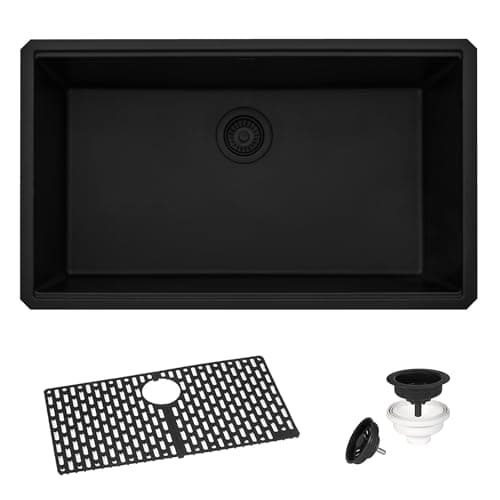 Ruvati epiGranite RVG2080 Best overall alternative | Undermount installs where the mix matters | 80% crushed granite published, same 9-1/2" depth | $349.00 · View on Amazon #ad Affiliate link · Price as of November 11, 2026 |
| 2 | 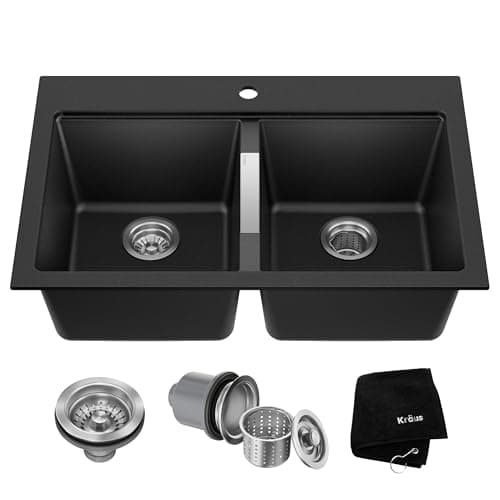 Kraus Quarza KGD-433B double-bowl composite sink Best double bowl | Two bowls in a material that hides marks | Two 9-1/2" bowls, heat safe to 600°F per Kraus | $299.95 · View on Amazon #ad Affiliate link · Price as of November 11, 2026 |
| 3 | 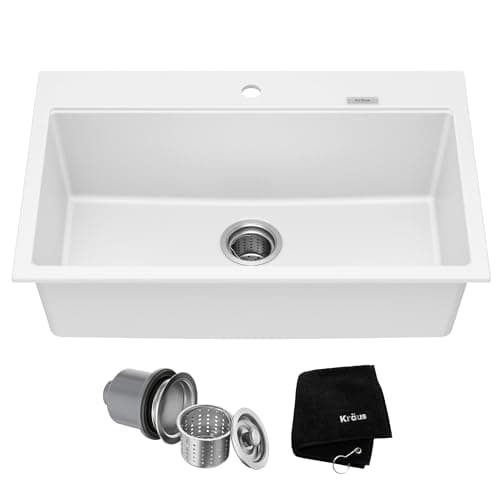 Kraus Quarza KGD-412B composite sink Budget pick | A 33-inch cabinet, either mounting | The cheapest composite here, into a 33" cabinet | |
| 4 | 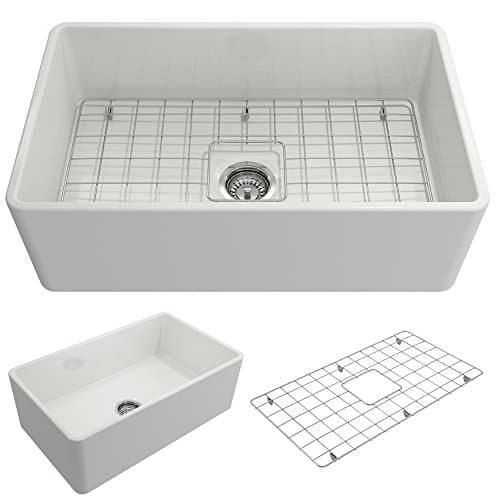 BOCCHI Classico 30-inch fireclay farmhouse sink Best non-composite alternative | Farmhouse style, lighter than cast iron | Fireclay - non-porous glaze instead of stone in resin | $468.80 · View on Amazon #ad Affiliate link · Price as of November 11, 2026 |
Why people look for an alternative
Price, mostly - the Blanco Diamond is the most expensive composite sink in this registry and sits above the $500 band where most composite shopping happens. After that, two fit issues. It publishes a 36 inch minimum cabinet, which rules it out of a kitchen built around 33 inch bases. And it is a super single: one large bowl, no divider. If you want two bowls in composite, Blanco's Diamond is not the sink, whatever the material.
None of those is a criticism of the material. They are reasons the particular model may not suit, and each has a specific answer rather than a general one.
| Sink | Material as published | Bowl depth | Mounting | Min. cabinet |
|---|---|---|---|---|
| Blanco Diamond Silgranit (the original) | Silgranit - up to 80% ground natural granite in an acrylic composite | 9-1/2" | Not published on the listing we read | 36" |
| Ruvati epiGranite RVG2080 | 80% crushed natural granite in a proprietary resin | 9-1/2" | Undermount | 36" |
| Kraus Quarza KGD-433B | Quartz composite - split not published; heat safe to 600°F per Kraus | 9-1/2" both bowls | Dual mount | 36" |
| Kraus Quarza KGD-412B | Natural quartz in acrylic resin - split not published; heat safe to 500°F per Kraus | 8-5/8" | Dual mount | 33" |
| BOCCHI Classico 30 | Fireclay, fired up to 2000°F, non-porous glaze | Not published | Farmhouse apron | 33" |
Blanco figures read from the manufacturer listing linked below; the alternatives from Ruvati's, Kraus's and BOCCHI's own product pages. Where a maker does not publish a figure this table says so rather than estimating one.
Product photograph supplied by Amazon for this listing, used under the Associates program.
1. Best overall alternative
Ruvati epiGranite RVG2080
Ruvati · Best for undermount installs where the mix matters
The composite sink that publishes the figure the others leave out: 80% crushed natural granite, stated on Ruvati's own product page rather than described as stone-like. It is undermount only, 32 inches wide with a 30-1/4 inch basin, which is an unusually high share of the outside dimension given over to usable bowl.
Published specifications
- Overall size
- 32" wide x 19-1/4" front to back source
- Basin size
- 30-1/4" x 16-3/4" x 9-1/2" deep source
- Material
- 80% crushed natural granite in a proprietary resin source
- Mounting
- Undermount source
- Minimum cabinet
- 36" source
- Drain
- Standard 3-1/2" opening; matching strainer included source
- Certification
- cUPC certified by IAPMO to US and Canadian plumbing standards source
- Included
- Silicone rinse grid, strainer drain assembly, cut-out template, mounting clips, installation guide source
- Warranty
- Ruvati limited lifetime source
What works
- 80% crushed granite is published on the product page, so the material claim is checkable rather than atmospheric
- A 30-1/4 inch basin inside a 32-inch sink is the best bowl-to-footprint ratio of the composite sinks here
- A silicone rinse grid in the box, which protects the one surface composite does not forgive
- Single bowl at 9-1/2 inches deep takes a sheet pan flat
What does not
- Undermount only — there is no drop-in version of this model, so a laminate counter rules it out
- Ruvati's product page and its retail copy state different heat-resistance figures, so we quote neither
- No weight published, and a 32-inch composite undermount needs real support under the counter
- Ruvati's parts channel is smaller than Blanco's or Kohler's if a strainer or grid needs replacing in five years
Skip it if
Skip it if your countertop is laminate or butcher block — this sink has no drop-in rim, and an undermount on a wood-based core is a water problem waiting to happen.
#ad Affiliate link · Price as of November 11, 2026
Raw specifications: Ruvati’s own page for the Ruvati epiGranite RVG2080.
Product photograph supplied by Amazon for this listing, used under the Associates program.
2. Best double bowl
Kraus Quarza KGD-433B double-bowl composite sink
Kraus · Best for two bowls in a material that hides marks
The double bowl for anyone who wants two bowls without stainless. Two equal basins 9-1/2 inches deep in a 33 by 22 dual-mount body, and the one composite sink here whose published heat figure — 600°F on Kraus's own page — is high enough that a hot pan straight off the burner stops being the headline risk. The divider is full height, so this is a true 50/50 rather than a low-divide.
Published specifications
- Overall size
- 33" L x 22" W x 10-1/8" D source
- Bowl size
- Two equal bowls, 14-1/4" L x 15-1/2" W x 9-1/2" deep source
- Material
- Quartz composite - natural quartz in acrylic resin; percentage split not published source
- Mounting
- Dual mount - drop-in or undermount source
- Minimum cabinet
- 36" source
- Faucet holes
- One pre-drilled, plus four perforated knockouts source
- Heat
- Kraus states heat safe to 600°F on this model's page source
- Certification
- cUPC to CSA B45.8 / IAPMO Z403, MASS source
- Included
- Two drain assemblies - one with a removable strainer, one with a basket strainer - mounting hardware, cut-out template source
- Warranty
- Kraus limited lifetime source
What works
- Two bowls at 9-1/2 inches deep, not one deep bowl and one token one
- 600°F on Kraus's published figure for this model is the highest heat claim of any sink in this registry
- Composite hides water spots and scratch patterns, which on a double bowl matters twice as much — there is more visible surface
- Both drains ship with assemblies, which on a double bowl is normally a second purchase
What does not
- Each bowl is 14-1/4 inches front to back, so a roasting pan will not lie flat in either
- Composite is heavier than stainless and chips at the rim if a pan lands edge-on; a chip in composite cannot be buffed out the way a scratch in stainless can
- Kraus does not publish a weight for this sink, which matters because an undermount composite sink needs more support than stainless
- The percentage of quartz is unpublished, so the material claim cannot be compared with Blanco's or Ruvati's
Skip it if
Skip it if you wash large sheet pans and roasting trays — at 33 inches, two bowls means neither is wide enough for them.
#ad Affiliate link · Price as of November 11, 2026
Raw specifications: Kraus’s own page for the Kraus Quarza KGD-433B double-bowl composite sink.
Product photograph supplied by Amazon for this listing, used under the Associates program.
3. Budget pick
Kraus Quarza KGD-412B composite sink
Kraus · Best for a 33-inch cabinet, either mounting
The composite sink to fit when the cabinet is the problem. At 30-3/4 inches wide it drops into a 33-inch cabinet where most composite sinks ask for 36, and it is dual mount, so it sits on the counter you already have and can be undermounted later. The bowl is 8-5/8 inches deep rather than the 9-1/2 or 10 you get further up, which is the honest cost of the smaller footprint.
Published specifications
- Overall size
- 30-3/4" L x 20-1/8" W x 9-3/8" D source
- Bowl size
- 28-3/8" L x 14-1/2" W x 8-5/8" deep source
- Material
- Natural quartz and premium acrylic resin - Kraus does not publish the percentage split source
- Mounting
- Dual mount - drop-in or undermount source
- Minimum cabinet
- 33" source
- Faucet holes
- One pre-drilled, plus four scored knockouts for accessories source
- Heat
- Kraus states heat safe to 500°F on this model's page source
- Certification
- cUPC to CSA B45.8 / IAPMO Z403, MASS source
- Included
- Drain assembly with removable basket strainer, mounting hardware, cut-out template source
- Warranty
- Kraus limited lifetime source
What works
- A 33-inch minimum cabinet, where the rest of this category starts at 36 — the single most useful number on the page if your run is tight
- Dual mount, so one sink covers a laminate counter now and a stone counter later
- Four scored knockouts mean a soap dispenser or air switch needs no drilling into composite
- Kraus publishes bowl dimensions separately from overall dimensions, which is what you actually need to compare
What does not
- 8-5/8 inches is the shallowest bowl of the composite sinks here, and it will not take a sheet pan laid flat
- Kraus does not publish the quartz-to-resin percentage for the Quarza line, so you cannot compare the mix against Blanco's or Ruvati's published figures
- Kraus's own page states 500°F for this model while the 33-inch Quarza page states 600°F — same material line, two numbers, so treat either as indicative rather than a specification
- Kraus's own store listed the Black Onyx colorway as out of stock when we checked; the live Amazon listing is the white colorway
Skip it if
Skip it if you have a 36-inch cabinet and no constraint, because the deeper bowls further up this page cost about the same.
Raw specifications: Kraus’s own page for the Kraus Quarza KGD-412B composite sink.
Product photograph supplied by Amazon for this listing, used under the Associates program.
4. Best non-composite alternative
BOCCHI Classico 30-inch fireclay farmhouse sink
BOCCHI · Best for farmhouse style, lighter than cast iron
Fireclay's argument against cast iron is the surface: the glaze is fired onto clay at very high temperature and is non-porous, rather than an enamel layer bonded to metal. This one ships with the bottom grid and strainer, and needs no flange extension for a disposal — a small detail that saves a trip to the store on install day.
Published specifications
What works
- Non-porous glaze, so staining is a cleaning problem rather than a permanent one
- Lighter than an equivalent enameled cast-iron sink, which simplifies cabinet support
- Grid and strainer in the box — the grid is what protects the glaze from dropped cast iron
- Takes a standard disposal flange without an extension kit
What does not
- Fireclay is a ceramic: a hard impact chips it, and a chip is not repairable the way a scratch in stainless is
- Hand-made dimensions vary slightly batch to batch, so cut the cabinet to the sink you received
- No independent lab publishes chip-resistance testing for fireclay sinks, so the material claims here are the manufacturer's
Skip it if
Skip it if your household is hard on a sink — dropped pots and ceramic do not mix. Choose 16-gauge stainless instead.
#ad Affiliate link · Price as of November 11, 2026
Quartz composite versus granite composite
Worth separating, because the names are used loosely. Granite composite is crushed granite in resin; quartz composite is crushed quartz in resin. Both are stone in a binder and both behave broadly the same way: harder and more heat-tolerant than resin alone, chip-prone at an edge if you drop something heavy, and far easier to damage with an abrasive pad than with cooking. The Kraus Quarza range is quartz; the Ruvati epiGranite and Blanco Silgranit are granite. For a buyer the practical difference is smaller than the marketing difference.
What does differ in practice is mounting. The Blanco listing we read does not state its mounting type; the Ruvati is undermount only; both Kraus Quarza sinks are published as dual mount, which means they can drop into a laminate or wood counter now and be undermounted into stone later. If a countertop change is anywhere in your plans, that is a real advantage.
The fireclay option
If what attracted you to Silgranit was a sink that does not look like metal and does not show water marks, fireclay is the other way to get there. BOCCHI publishes the Classico 30 as fireclay fired at temperatures up to 2000 degrees Fahrenheit with a non-porous glaze that resists stains, scratches and thermal shock, a stainless bottom grid and chrome strainer in the box, a 33 inch minimum cabinet and that no flange extension is needed for a garbage disposal. It is an apron-front farmhouse sink, so it is a cabinet modification rather than a swap - fireclay vs stainless steel sinks covers the trade-offs.
Which alternative to buy
- Buy the Ruvati epiGranite RVG2080 if you wanted Silgranit for the material. It publishes the same 80 percent mineral content and the same 9-1/2 inch depth for less.
- Buy the Kraus Quarza KGD-433B if you wanted composite but need two bowls, which the Diamond super single cannot give you.
- Buy the Kraus Quarza KGD-412B as the budget pick, and specifically if your base cabinet is 33 inches - the Blanco needs 36.
- Buy the BOCCHI Classico 30 if the appeal was a non-metal sink rather than a composite one, and you are willing to modify the cabinet.
- Buy the Blanco anyway if you want a super single with the longest-standing published mineral figure in the category. Nothing here takes that away from it.
What to take away
- Blanco publishes Silgranit as up to 80 percent ground natural granite, which is why it is the benchmark composite.
- Ruvati's epiGranite is the only other composite here whose maker publishes a mineral percentage - 80 percent crushed granite.
- The reasons to look elsewhere are price, a 36 inch minimum cabinet and the fact that the Diamond is a single bowl only.
- Kraus publishes heat ratings instead of a mineral split; useful, but a different claim.
- Both Kraus Quarza sinks are dual mount and survive a countertop replacement; the Ruvati is undermount only.
- Fireclay is the non-composite route to the same non-metal, mark-hiding result, at the cost of a cabinet modification.
How we sourced this page
Every figure on this page came from one of the following. Where a manufacturer or an independent lab does not publish a number, we say so rather than estimate it.
- Blanco Diamond Silgranit super single bowl sink — manufacturer listing
- Ruvati epiGranite RVG2080 undermount granite composite sink product page (published specifications)
- Kraus Quarza KGD-433B 33-inch 50/50 double-bowl granite composite sink product page (published specifications)
- Kraus Quarza KGD-412B 31-inch granite composite sink product page (published specifications)
- BOCCHI Classico 30-inch fireclay farmhouse sink — manufacturer listing
Common questions
- What is a good alternative to a Blanco Silgranit sink?
- The Ruvati epiGranite RVG2080. Ruvati publishes 80 percent crushed natural granite in a proprietary resin against Blanco's up to 80 percent ground natural granite, with the same 9-1/2 inch basin depth, at a lower price. It is the only genuine like-for-like substitution on published material content.
- Is Silgranit worth the extra money?
- It buys the longest-standing published mineral figure in the category and a limited lifetime warranty on a super single bowl. If you want two bowls, a 33 inch cabinet or dual mounting, another composite serves you better regardless of price.
- What is Silgranit made of?
- Blanco publishes Silgranit as up to 80 percent ground natural granite in an acrylic composite. That mineral-to-resin ratio is what gives a composite sink its heat tolerance and surface hardness, and it is the specification most composite makers decline to state.
- Is quartz composite as good as granite composite?
- In practice they behave the same way - crushed stone in a resin binder, harder and more heat-tolerant than resin alone, chip-prone at an edge, and more easily damaged by abrasive pads than by cooking. The difference between the two names is smaller than the marketing suggests.
More in Kitchen Sinks
Three specifications settle almost every kitchen sink question: how thick the steel is, how it meets the counter, and what it is made of. Get those right and brand barely matters.
Read next
Best granite composite sink
Best composite sinks
Percent granite, bowl depth, minimum cabinet size and published heat limits for four composite sinks - plus the figures makers leave out.
Best composite sink brand
Composite sink brands
Blanco, Ruvati and Kraus ranked on published mineral content, heat-figure consistency, cabinet minimums, what ships in the box and who documents care.
Best composite under $500
Best composite under $500
The composite sinks under $500 ranked on published mineral content, heat rating and mounting - plus why the best-known one costs more.
Head to head
Granite composite vs stainless
Two materials that fail in opposite ways: heat tolerance against appearance. Plus what quartz composite actually is.
Best sink for hard water
Best sinks for hard water
Four sinks compared on how limescale behaves on each surface, with the honest note on which one still needs wiping dry.
How to
Cleaning a composite sink
Daily, weekly and deep-clean methods taken from Blanco's and Kraus's own published care guidance, including the metal-scuff fix and the do-not-use list.
Found something out of date, or a figure you can source better than we did? Tell us — corrections get read first. Our methodology explains how picks are made, and contact is one click away.