Kitchen Sinks
Drop-in vs undermount kitchen sink
One is better to live with and one is possible on any countertop. Your existing worktop usually settles this before taste gets a say.
Disclosure: we earn a commission if you buy through the Amazon links on this page, at no extra cost to you. Commission never decides a verdict or a ranking position — read our editorial policy and affiliate disclosure.
How we assessed these: the product figures here come from manufacturer specifications with source links. The installation guidance is standard practice for each countertop material rather than a tested comparison, and we say plainly where a job is a trade job.
Short answer
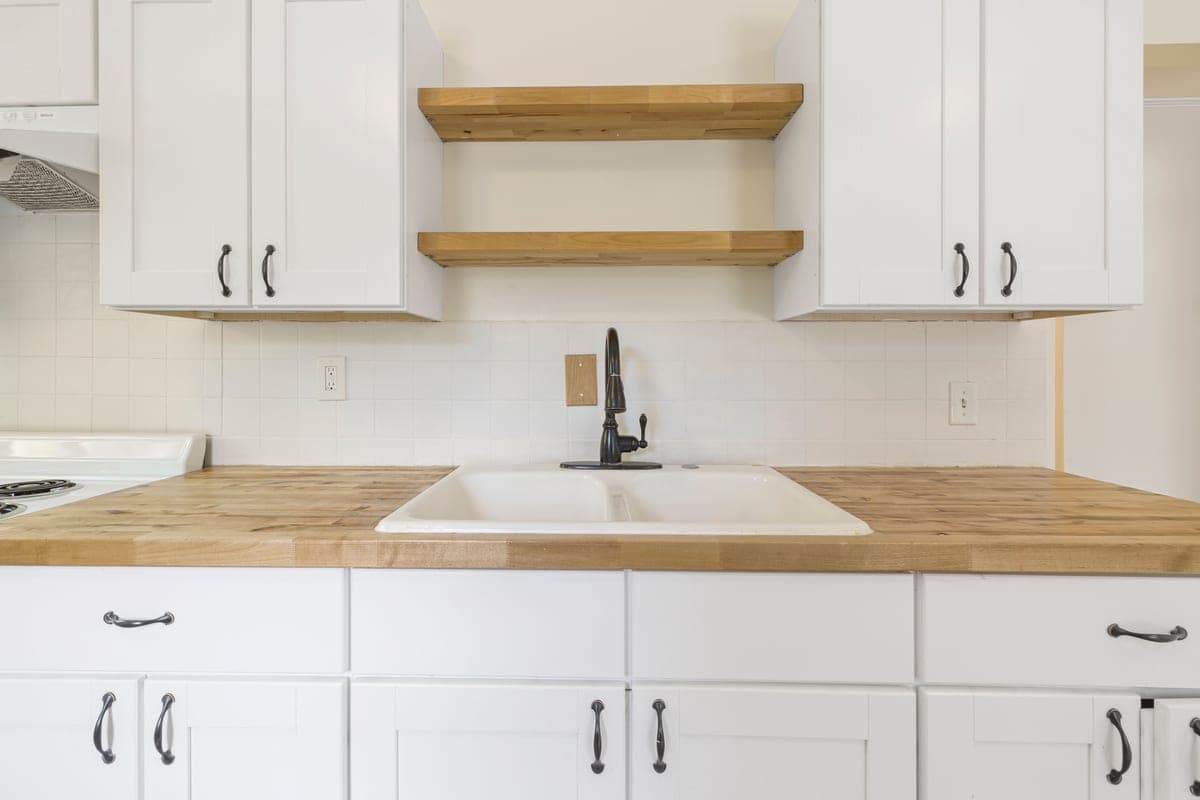
An undermount sink hangs below the counter, so there is no rim to clean around and crumbs sweep straight in. A drop-in sits in the cutout on its own flange, supported by the countertop surface, which means it works on laminate and tile where undermount does not. If your counter is stone or quartz, choose undermount. If it is laminate, choose drop-in.
This looks like an aesthetic decision and is mostly a countertop decision. Both sinks hold the same water; the difference is how they meet the worktop, and what that requires of the worktop.
| Drop-in (top-mount) | Undermount | |
|---|---|---|
| Countertop needed | Any — laminate, tile, stone, wood | Stone, quartz, solid surface, or well-sealed wood |
| Cleaning the counter | Wipe up to the rim, then around it | Sweep straight into the bowl — the main reason to choose it |
| Rim seal | A visible bead that eventually discolors | Hidden silicone joint at the underside |
| DIY fit | Yes, genuinely — one person, an afternoon | Usually a fabricator, especially on stone |
| Retrofit into an existing cutout | Straightforward if sizes match | Needs a new countertop in most cases |
| Usable counter next to the sink | Slightly less — the flange takes space | Right up to the edge |
| Cost of the installation | Low | Higher, and bundled with the countertop |
Why laminate and undermount do not mix
Laminate is a decorative layer over a particleboard core. Cut it for a sink and you expose that core at the edge of the opening. A drop-in sink's flange covers and seals that edge, which is exactly what it needs. An undermount sink leaves it exposed to every splash, and particleboard swells irreversibly when it gets wet. On top of that, the core is not designed to carry a sink's weight hanging from below.
There are purpose-built substrates and specialist installers who do undermount on laminate, and it can be done properly. For most kitchens the honest answer is that drop-in is the right choice on laminate and not a compromise.
Butcher block: yes, with real care
Wood countertops can take an undermount sink, and the detail that decides whether it lasts is sealing the cut. End grain absorbs water like a straw, so the cut edge and the underside around the opening need thorough sealing with a penetrating oil or a film finish before the sink goes in, and the joint needs checking annually. Done properly it is beautiful; done casually it is a black stain spreading out from the sink in two years.
A drop-in on butcher block has the same requirement in milder form, because the flange shields most of the cut.
Quick picks
Tap any row to jump to the full write-up. There are no scores here because we run no test lab — how picks are chosen is published in full on our methodology page.
| # | Product | Best for | Our read | Price |
|---|---|---|---|---|
| 1 | 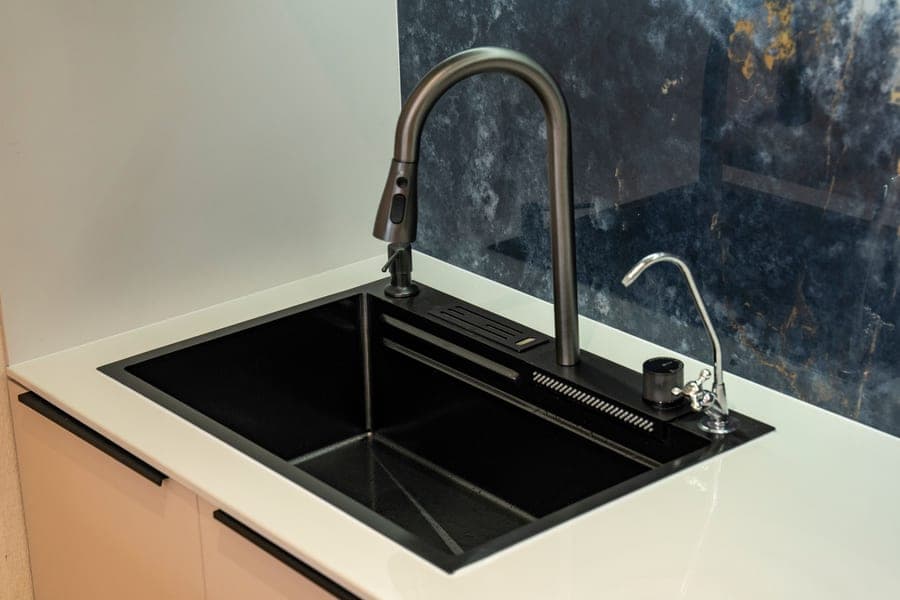 Kraus Kore KWU110-30 workstation sink Best undermount | Small kitchens that need counter space | 16-gauge, rear-offset drain, ledge included | Check price on Amazon #ad Affiliate link · We publish no price; Amazon shows the current one |
| 2 |  Blanco Diamond Silgranit super single Best undermount in composite | Hard water and visible sinks | Hides spotting; needs a 36-inch cabinet | Check price on Amazon #ad Affiliate link · We publish no price; Amazon shows the current one |
| 3 | 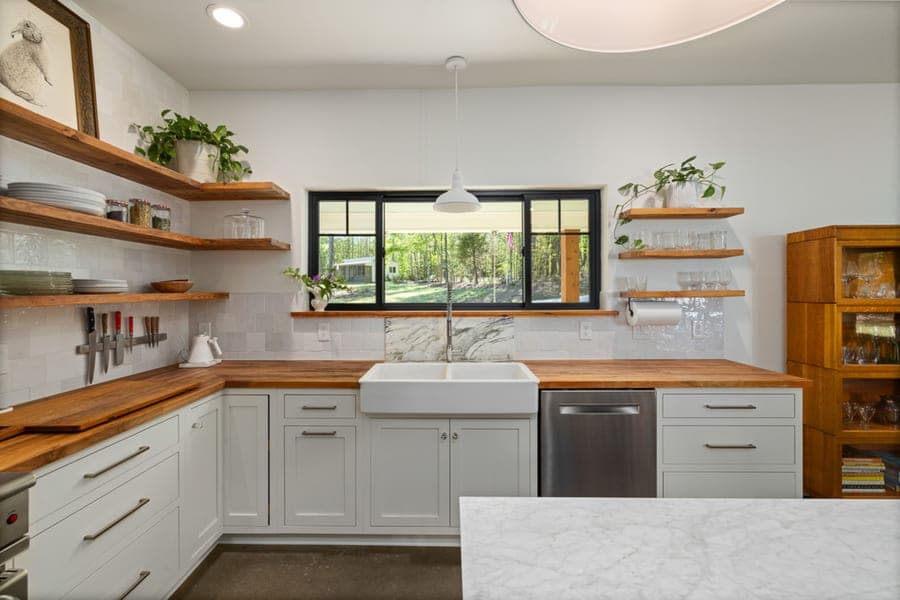 Kohler Whitehaven K-6489 Best if you are rebuilding anyway | Farmhouse looks without a custom cabinet | Apron front — neither drop-in nor undermount | Check price on Amazon #ad Affiliate link · We publish no price; Amazon shows the current one |
What conversion actually costs
Going from drop-in to undermount in an existing kitchen almost always means a new countertop. The existing cutout was sized for a flange to sit on, so it is larger than the sink's bowl opening and cannot simply be re-used; and on laminate the substrate is wrong anyway. Price the countertop first and then decide whether you want the sink.
Going the other way — undermount to drop-in — is much easier, because the drop-in's flange covers the existing opening as long as the new sink is the same size or larger. It is the reason a drop-in is the safe answer when you are replacing a sink and keeping everything else.
The third option
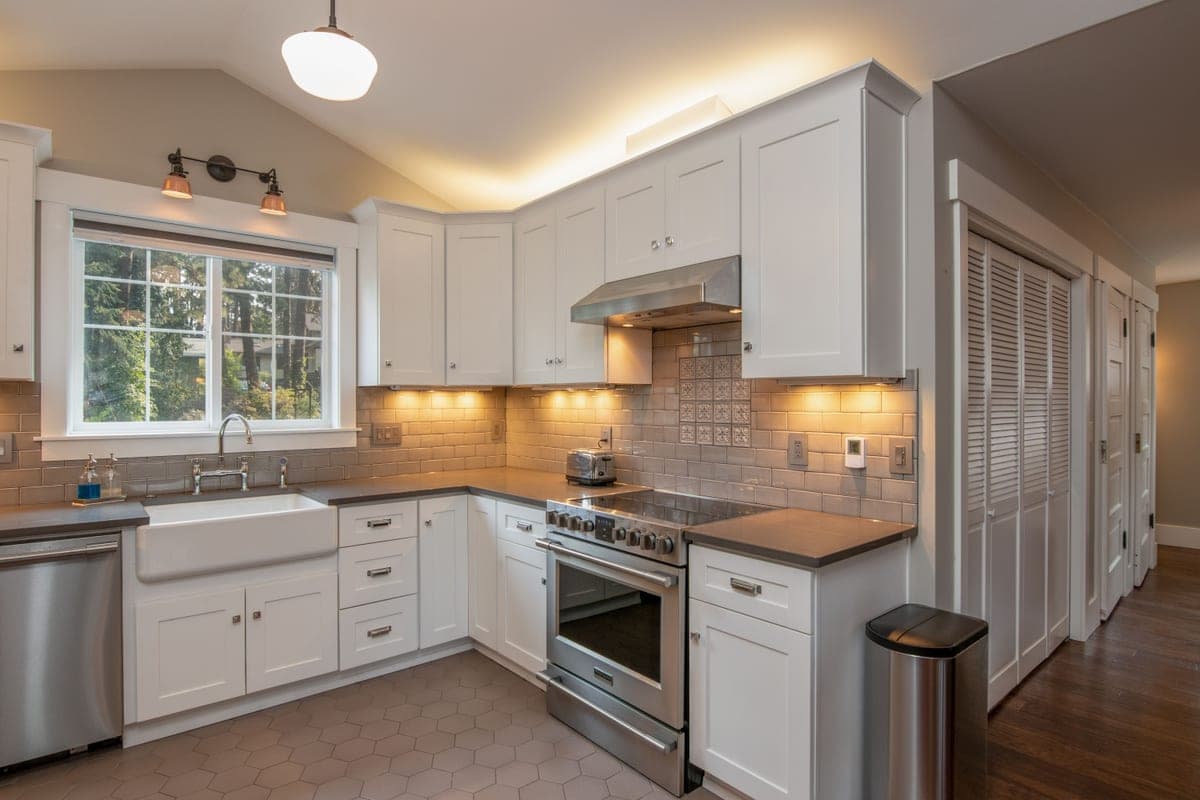
An apron-front sink is neither: it carries its weight on the cabinet and its front face replaces the cabinet face. That makes it independent of the countertop material, which is occasionally the answer when a laminate top rules out undermount but the look matters. It is also considerably more work — see farmhouse sinks.
Photograph shows the product category, not this specific unit. We do not republish manufacturer product photography.
1. Best undermount
Kraus Kore KWU110-30 workstation sink
Kraus · Best for small kitchens that need counter space
The workstation sink we would buy, and the clearest case for 16-gauge steel anywhere in this category: a ledge sink is the one configuration where basin flex is genuinely audible, because accessories rest on the rim and transmit it. Ten inches deep, rear-offset drain, and the grid, mat, board and strainer are in the box rather than a $200 upsell.
Published specifications
- Overall size
- 30" x 19" source
- Bowl size
- 28" x 16" source
- Bowl depth
- 10" source
- Gauge
- 16-gauge stainless steel source
- Minimum cabinet
- 33" left to right, 24" front to back source
- Drain
- Rear offset, 3-1/2" opening source
- Sound damping
- NoiseDefend pads covering over 80% of the basin, plus undercoating source
- Warranty
- Kraus limited lifetime source
What works
- The integrated ledge turns a 30-inch sink into prep counter, the best single trade available in a small kitchen
- Rear-offset drain leaves usable cabinet space under the front of the sink
- Genuine 16-gauge with pads over 80% of the basin — gauge and damping do different jobs, and this sink has both
- A 3-1/2" drain opening takes a standard disposal flange with no adapter
What does not
- Needs a 33-inch cabinet for a 30-inch sink — measure before ordering
- A 10-inch deep bowl is a long reach for a shorter person
- The accessories are the reason to buy it and also the reason it costs more than a plain undermount
Skip it if
Skip it if your run of counter is already generous — you would be paying for prep space you do not need, and a plain 18-gauge undermount will serve.
#ad Affiliate link · We publish no price; Amazon shows the current one
Raw specifications: Kraus’s own page for the Kraus Kore KWU110-30 workstation sink.
Photograph shows the product category, not this specific unit. We do not republish manufacturer product photography.
2. Best undermount in composite
Blanco Diamond Silgranit super single
Blanco · Best for hard water and visible sinks
The granite composite sink that answers the material's usual objection. Silgranit is up to 80% ground granite in an acrylic binder, and what it does better than stainless is hide everything: no water spots, no visible scratch pattern, no dent from a dropped pan. What it does worse is take a screaming-hot pan straight off the burner.
Published specifications
What works
- Hides limescale and water spotting better than any stainless finish — the reason to choose it in hard water
- Color runs through the material, so a scratch does not expose a different substrate
- Quieter than stainless without added pads, because the mass does the damping
- A 9-1/2" bowl is deep enough to lay a sheet pan flat
What does not
- Composite is not stainless: thermal shock is a real limit, so a very hot pan goes on a trivet
- Light colors show tea and turmeric staining more than dark ones
- Blanco publishes no thermal-limit figure, so we will not print one
Skip it if
Skip it if you routinely dump hot pans and boiling stock straight into the sink. Stainless tolerates that; composite is the wrong tool for it.
#ad Affiliate link · We publish no price; Amazon shows the current one
Photograph shows the product category, not this specific unit. We do not republish manufacturer product photography.
3. Best if you are rebuilding anyway
Kohler Whitehaven K-6489
Kohler · Best for farmhouse looks without a custom cabinet
The enameled cast-iron farmhouse sink to buy, mainly for one structural reason: the self-trimming apron overhangs the cabinet face, so installation is a rough cut rather than a cabinetmaker's fit. That detail is the difference between a weekend job and a trade job. It is also heavy enough that the cabinet needs real support.
Published specifications
What works
- Self-trimming apron means a rough cabinet cut, not a precision one
- Enameled cast iron resists chipping, cracking and heat in a way composite does not
- The 2-degree slope and offset drain genuinely reduce standing water
- Kohler stocks matching drains and accessories, so the sink does not orphan
What does not
- Cast iron is heavy — the cabinet needs a proper support frame, and that is the real installation cost
- Enamel dulls under abrasive cleaners, and a dropped cast pan will chip it
- Kohler does not publish a unit weight on the range page, so plan support using your retailer's shipping weight
Skip it if
Skip it if you are installing alone, or over an existing base cabinet you cannot reinforce. Weight decides this one, not looks.
#ad Affiliate link · We publish no price; Amazon shows the current one
Raw specifications: Kohler’s own page for the Kohler Whitehaven K-6489.
What to take away
- Stone or quartz: choose undermount. Laminate: choose drop-in, and do not treat it as a compromise.
- Butcher block takes an undermount only if the cut edge is properly sealed before installation.
- Drop-in to undermount conversion normally means a new countertop; the reverse is easy.
- The everyday benefit of undermount is sweeping the counter straight into the bowl, and it is genuinely noticeable.
How we sourced this page
Every figure on this page came from one of the following. Where a manufacturer or an independent lab does not publish a number, we say so rather than estimate it.
Common questions
- What are the pros and cons of drop-in vs undermount sinks?
- Undermount gives you no rim to clean around, counter space right to the sink edge, and a hidden seal — but needs a countertop that can carry it and usually a fabricator. Drop-in works on any countertop including laminate, is genuinely DIY, and retrofits into an existing cutout, at the cost of a visible rim and a sealant bead that discolors over time.
- Can you use an undermount sink with butcher block?
- Yes, provided the cut edge and the underside around the opening are thoroughly sealed before the sink is fitted, and the joint is inspected annually. End grain absorbs water rapidly, and an unsealed cut is how a dark stain starts spreading from the sink.
- Is it expensive to switch from a drop-in to an undermount sink?
- Usually, because it means a new countertop. The existing cutout was sized for a flange to rest on and is too large to reuse, and laminate substrates are not suitable for undermount at all. Price the countertop before deciding on the sink.
- Which sink type is better for a farmhouse look?
- Neither — a farmhouse look needs an apron-front sink, which is a third mounting type supported by the cabinet rather than the counter. That makes it independent of countertop material but a considerably bigger job, since the cabinet face is modified.
More in Kitchen Sinks
Three specifications settle almost every kitchen sink question: how thick the steel is, how it meets the counter, and what it is made of. Get those right and brand barely matters.
Read next
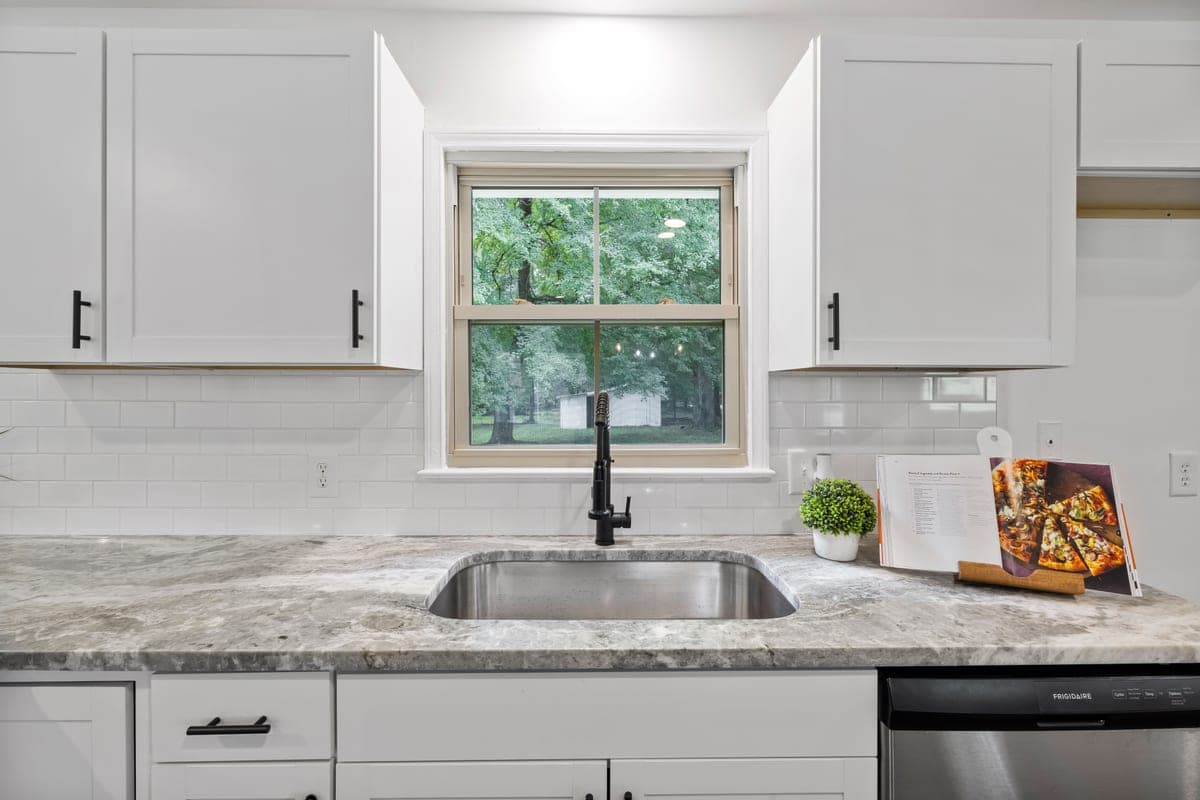
Best undermount sink
Best undermount sinks
Undermount picks by material, and the countertop question that decides whether an undermount sink is possible in your kitchen.
Best farmhouse sink
Farmhouse sinks
Apron-front dimensions, the cabinet modification involved, and why self-trimming is the detail that decides the difficulty.

Guide
Sink sizes and cabinet fit
The cabinet-to-sink arithmetic, the four measurements to take, and how a disposal changes the numbers.

How to
Install an undermount sink
Bracing, sealing and clipping an undermount sink, with separate notes for quartz, granite, laminate and butcher block.
Head to head
16 gauge vs 18 gauge
16 gauge is 25% thicker steel. What that buys, what it does not buy, and why sound-deadening coverage is the spec nobody advertises.
Found something out of date, or a figure you can source better than we did? Tell us — corrections get read first. Our methodology explains how picks are made, and contact is one click away.