Kitchen Sinks
The best granite composite sink brands, judged on what they publish
Every composite sink is minerals in a resin binder. The brands differ in whether they will tell you how much of each, and whether their own two pages agree with one another.
Disclosure: we earn a commission if you buy through the Amazon links on this page, at no extra cost to you. Commission never decides a verdict or a ranking position — read our editorial policy and affiliate disclosure.
How we assessed these: we ranked composite sink brands on what each one publishes, read from the maker's own product and care pages on 2026-10-26 and linked at every figure. We have not installed, tested or owned these sinks. Where a maker states different figures on two pages of the same material line, this page reports the disagreement rather than picking the flattering number. No independent laboratory publishes comparable thermal-shock, abrasion or stain data for composite sinks, so no such figure appears anywhere on this page.
Short answer
Blanco is the strongest granite composite sink brand, because it names its material (Silgranit, up to 80% ground granite), publishes detailed care instructions and sells the consumables for them. Ruvati makes the single most checkable claim - a flat 80% crushed granite. Kraus offers the most installation flexibility, including a 33-inch cabinet minimum, but will not publish its quartz-to-resin split at all.
Composite sink brand comparisons usually rank reputations. That is useless here, because every composite sink on the US market is the same idea: crushed mineral suspended in an acrylic resin, cast in a mold, cured. The differences that survive contact with a real kitchen are documentary. How much mineral is in it? Does the maker say? Does the maker's own heat figure stay the same from one page of its line to the next? Will anyone sell you a replacement strainer basket in year five? Those are answerable before you buy, and they are what this page ranks.
Quick picks
Tap any row to jump to the full write-up. There are no scores here because we run no test lab — how picks are chosen is published in full on our methodology page.
| # | Product | Best for | Our read | Price |
|---|---|---|---|---|
| 1 | 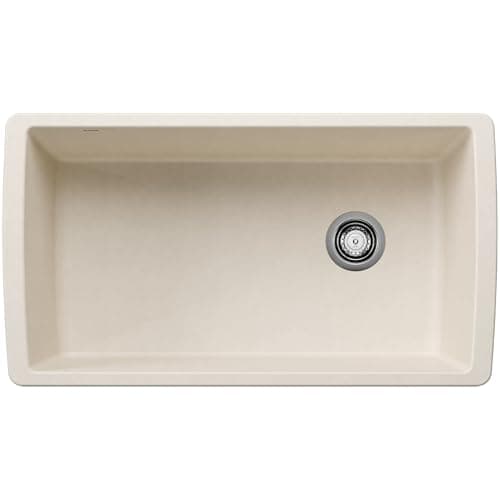 Blanco Diamond Silgranit super single Best composite brand overall | Hard water and visible sinks | Names its mix, documents care in detail, and sells the consumables itself | $584.35 · View on Amazon #ad Affiliate link · Price as of October 26, 2026 |
| 2 | 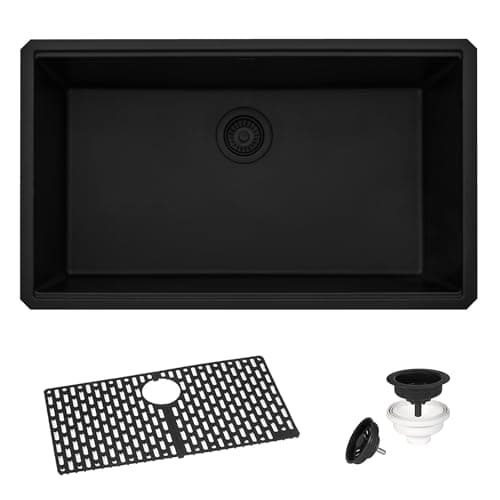 Ruvati epiGranite RVG2080 Most checkable material claim | Undermount installs where the mix matters | A flat 80% crushed granite on the product page - no "up to" | $349.00 · View on Amazon #ad Affiliate link · Price as of October 26, 2026 |
| 3 | 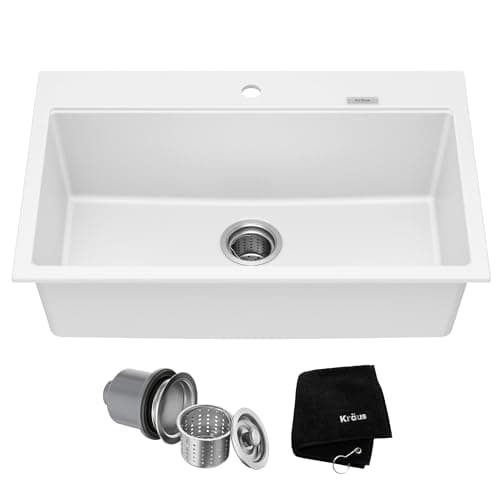 Kraus Quarza KGD-412B composite sink Best fit flexibility | A 33-inch cabinet, either mounting | Dual mount and a 33-inch cabinet minimum, with the vaguest mix of the three | |
| 4 | 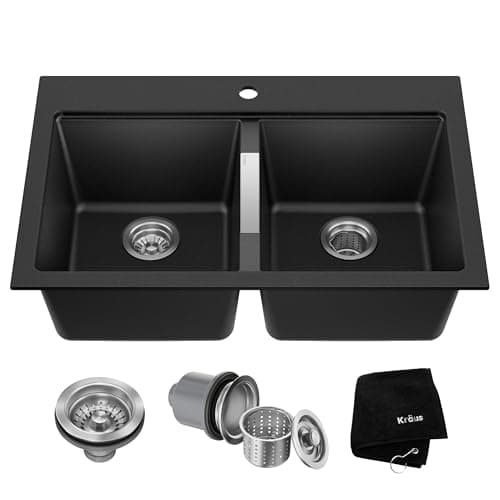 Kraus Quarza KGD-433B double-bowl composite sink Best composite double bowl | Two bowls in a material that hides marks | Two 9-1/2-inch bowls and the highest published heat figure here | $299.95 · View on Amazon #ad Affiliate link · Price as of October 26, 2026 |
The criteria, in the order that separates the brands
We read each maker's own product page and, where one exists, its own care documentation. Nothing below is inferred from price, finish or brand reputation. The order matters: the first two criteria are the only ones where the three brands genuinely diverge, and the last two are where they are all roughly equal.
- Published mineral percentage. The share of crushed stone in the resin is the central specification of the material. A maker that publishes a number has made a claim you can hold it to; a maker that writes "natural quartz and premium acrylic resin" has not.
- Internal consistency of the heat claim. Composite's real weakness is thermal shock. A brand quoting one temperature on one model page and a different one on another page of the same material line is telling you the figure is marketing, not a specification.
- Mounting options and cabinet minimum. Composite is cast, so a drop-in rim either exists on that model or it does not. This is the criterion most likely to disqualify a brand outright for your kitchen.
- What ships in the box. Composite sinks need a rinse grid or mat more than stainless does, and a drain assembly sized to the cast opening. Whether those are included or a second purchase is a real cost difference.
- Published care guidance. Composite is the one sink material where the wrong cleaner does permanent damage. A brand that publishes an explicit do-not-use list is protecting your sink; one that publishes nothing has left you to the internet.
- Warranty and parts channel. All three carry a limited lifetime warranty, so the warranty is not a differentiator. The parts channel very much is.
| Brand | Published mineral content | Published heat figure | Mounting | Cabinet minimum | Own care docs |
|---|---|---|---|---|---|
| Blanco (Silgranit) | Up to 80% ground natural granite | None published | Model-specific; the Diamond here is undermount | 36" | Yes - method, products and an avoid list |
| Ruvati (epiGranite) | 80% crushed natural granite | Product page and retail copy disagree; we quote neither | Undermount only on this model | 36" | Not published for this model |
| Kraus (Quarza) | Not published - "natural quartz and premium acrylic resin" | 500°F on the 31" page, 600°F on the 33" page | Dual mount - drop-in or undermount | 33" (31" model) / 36" (33" model) | Yes - on the product page, naming third-party products |
Read from each maker's own product and care pages on 2026-10-26 and linked at every figure in the sections below. All three brands carry a limited lifetime warranty on these sinks, which is why warranty is absent from this table - it does not separate them.
Product photograph supplied by Amazon for this listing, used under the Associates program.
1. Best composite brand overall
Blanco Diamond Silgranit super single
Blanco · Best for hard water and visible sinks
The granite composite sink that answers the material's usual objection. Silgranit is up to 80% ground granite in an acrylic binder, and what it does better than stainless is hide everything: no water spots, no visible scratch pattern, no dent from a dropped pan. What it does worse is take a screaming-hot pan straight off the burner.
Published specifications
What works
- Hides limescale and water spotting better than any stainless finish — the reason to choose it in hard water
- Color runs through the material, so a scratch does not expose a different substrate
- Quieter than stainless without added pads, because the mass does the damping
- A 9-1/2" bowl is deep enough to lay a sheet pan flat
What does not
- Composite is not stainless: thermal shock is a real limit, so a very hot pan goes on a trivet
- Light colors show tea and turmeric staining more than dark ones
- Blanco publishes no thermal-limit figure, so we will not print one
Skip it if
Skip it if you routinely dump hot pans and boiling stock straight into the sink. Stainless tolerates that; composite is the wrong tool for it.
#ad Affiliate link · Price as of October 26, 2026
Product photograph supplied by Amazon for this listing, used under the Associates program.
2. Most checkable material claim
Ruvati epiGranite RVG2080
Ruvati · Best for undermount installs where the mix matters
The composite sink that publishes the figure the others leave out: 80% crushed natural granite, stated on Ruvati's own product page rather than described as stone-like. It is undermount only, 32 inches wide with a 30-1/4 inch basin, which is an unusually high share of the outside dimension given over to usable bowl.
Published specifications
- Overall size
- 32" wide x 19-1/4" front to back source
- Basin size
- 30-1/4" x 16-3/4" x 9-1/2" deep source
- Material
- 80% crushed natural granite in a proprietary resin source
- Mounting
- Undermount source
- Minimum cabinet
- 36" source
- Drain
- Standard 3-1/2" opening; matching strainer included source
- Certification
- cUPC certified by IAPMO to US and Canadian plumbing standards source
- Included
- Silicone rinse grid, strainer drain assembly, cut-out template, mounting clips, installation guide source
- Warranty
- Ruvati limited lifetime source
What works
- 80% crushed granite is published on the product page, so the material claim is checkable rather than atmospheric
- A 30-1/4 inch basin inside a 32-inch sink is the best bowl-to-footprint ratio of the composite sinks here
- A silicone rinse grid in the box, which protects the one surface composite does not forgive
- Single bowl at 9-1/2 inches deep takes a sheet pan flat
What does not
- Undermount only — there is no drop-in version of this model, so a laminate counter rules it out
- Ruvati's product page and its retail copy state different heat-resistance figures, so we quote neither
- No weight published, and a 32-inch composite undermount needs real support under the counter
- Ruvati's parts channel is smaller than Blanco's or Kohler's if a strainer or grid needs replacing in five years
Skip it if
Skip it if your countertop is laminate or butcher block — this sink has no drop-in rim, and an undermount on a wood-based core is a water problem waiting to happen.
#ad Affiliate link · Price as of October 26, 2026
Raw specifications: Ruvati’s own page for the Ruvati epiGranite RVG2080.
Product photograph supplied by Amazon for this listing, used under the Associates program.
3. Best fit flexibility
Kraus Quarza KGD-412B composite sink
Kraus · Best for a 33-inch cabinet, either mounting
The composite sink to fit when the cabinet is the problem. At 30-3/4 inches wide it drops into a 33-inch cabinet where most composite sinks ask for 36, and it is dual mount, so it sits on the counter you already have and can be undermounted later. The bowl is 8-5/8 inches deep rather than the 9-1/2 or 10 you get further up, which is the honest cost of the smaller footprint.
Published specifications
- Overall size
- 30-3/4" L x 20-1/8" W x 9-3/8" D source
- Bowl size
- 28-3/8" L x 14-1/2" W x 8-5/8" deep source
- Material
- Natural quartz and premium acrylic resin - Kraus does not publish the percentage split source
- Mounting
- Dual mount - drop-in or undermount source
- Minimum cabinet
- 33" source
- Faucet holes
- One pre-drilled, plus four scored knockouts for accessories source
- Heat
- Kraus states heat safe to 500°F on this model's page source
- Certification
- cUPC to CSA B45.8 / IAPMO Z403, MASS source
- Included
- Drain assembly with removable basket strainer, mounting hardware, cut-out template source
- Warranty
- Kraus limited lifetime source
What works
- A 33-inch minimum cabinet, where the rest of this category starts at 36 — the single most useful number on the page if your run is tight
- Dual mount, so one sink covers a laminate counter now and a stone counter later
- Four scored knockouts mean a soap dispenser or air switch needs no drilling into composite
- Kraus publishes bowl dimensions separately from overall dimensions, which is what you actually need to compare
What does not
- 8-5/8 inches is the shallowest bowl of the composite sinks here, and it will not take a sheet pan laid flat
- Kraus does not publish the quartz-to-resin percentage for the Quarza line, so you cannot compare the mix against Blanco's or Ruvati's published figures
- Kraus's own page states 500°F for this model while the 33-inch Quarza page states 600°F — same material line, two numbers, so treat either as indicative rather than a specification
- Kraus's own store listed the Black Onyx colorway as out of stock when we checked; the live Amazon listing is the white colorway
Skip it if
Skip it if you have a 36-inch cabinet and no constraint, because the deeper bowls further up this page cost about the same.
Raw specifications: Kraus’s own page for the Kraus Quarza KGD-412B composite sink.
Product photograph supplied by Amazon for this listing, used under the Associates program.
4. Best composite double bowl
Kraus Quarza KGD-433B double-bowl composite sink
Kraus · Best for two bowls in a material that hides marks
The double bowl for anyone who wants two bowls without stainless. Two equal basins 9-1/2 inches deep in a 33 by 22 dual-mount body, and the one composite sink here whose published heat figure — 600°F on Kraus's own page — is high enough that a hot pan straight off the burner stops being the headline risk. The divider is full height, so this is a true 50/50 rather than a low-divide.
Published specifications
- Overall size
- 33" L x 22" W x 10-1/8" D source
- Bowl size
- Two equal bowls, 14-1/4" L x 15-1/2" W x 9-1/2" deep source
- Material
- Quartz composite - natural quartz in acrylic resin; percentage split not published source
- Mounting
- Dual mount - drop-in or undermount source
- Minimum cabinet
- 36" source
- Faucet holes
- One pre-drilled, plus four perforated knockouts source
- Heat
- Kraus states heat safe to 600°F on this model's page source
- Certification
- cUPC to CSA B45.8 / IAPMO Z403, MASS source
- Included
- Two drain assemblies - one with a removable strainer, one with a basket strainer - mounting hardware, cut-out template source
- Warranty
- Kraus limited lifetime source
What works
- Two bowls at 9-1/2 inches deep, not one deep bowl and one token one
- 600°F on Kraus's published figure for this model is the highest heat claim of any sink in this registry
- Composite hides water spots and scratch patterns, which on a double bowl matters twice as much — there is more visible surface
- Both drains ship with assemblies, which on a double bowl is normally a second purchase
What does not
- Each bowl is 14-1/4 inches front to back, so a roasting pan will not lie flat in either
- Composite is heavier than stainless and chips at the rim if a pan lands edge-on; a chip in composite cannot be buffed out the way a scratch in stainless can
- Kraus does not publish a weight for this sink, which matters because an undermount composite sink needs more support than stainless
- The percentage of quartz is unpublished, so the material claim cannot be compared with Blanco's or Ruvati's
Skip it if
Skip it if you wash large sheet pans and roasting trays — at 33 inches, two bowls means neither is wide enough for them.
#ad Affiliate link · Price as of October 26, 2026
Raw specifications: Kraus’s own page for the Kraus Quarza KGD-433B double-bowl composite sink.
Why Blanco wins on documentation rather than on material
Blanco's Silgranit is published as up to 80% ground natural granite in an acrylic composite. Note the hedge: "up to". Ruvati publishes a flat 80%, which is the stronger claim of the two, and on that single criterion Ruvati beats Blanco. Blanco wins the category anyway, on the criterion nobody thinks about until they have already bought the sink.
Blanco publishes real care documentation for Silgranit: a method, named products of its own, and an explicit list of what will damage the surface. The avoid list is bleach and anything containing a bleaching agent, drain cleaners, cleaners containing chlorine, lyes or solvents, and abrasive cleaners - plus the instruction not to put a pan straight from the heat into the sink, but to let it cool on a mat or board first. It also publishes the fix for the mark composite owners actually get, which is a metal scuff from a pan sliding across the basin: cooking oil on the soft side of a wet sponge, circular motions, rinse warm, dry with microfiber.
That last detail is the whole argument for Blanco. Every composite sink gets metal scuffs. Most owners attack them with the abrasive cleaner under the sink, which is the one thing the material cannot take, and the sink is permanently duller afterwards. Blanco is the brand that tells you not to, in writing, on its own site. It also sells the consumables - DailyClean+, the DeepClean Silgranit Set, its own microfiber cloth - which means there is a defined product for the job rather than a guess.
Ruvati: the clearest claim, the narrowest product
Ruvati publishes 80% crushed natural granite in a proprietary resin on the epiGranite product page. No "up to", no "stone-like", no "granite look". Of the three brands here, this is the only unqualified mineral-content figure, and if the material mix is the specification you care about, Ruvati is the brand that has committed to one.
Ruvati also makes the best use of its footprint. The RVG2080 is 32 inches wide front to back by 19-1/4, with a basin of 30-1/4 by 16-3/4 and a 9-1/2-inch depth - the highest ratio of usable bowl to outside dimension of any composite sink in our registry. A 9-1/2-inch single bowl takes a half-sheet pan lying flat, which is the test most double bowls fail. And it ships with a silicone rinse grid, which matters more on composite than on steel: the grid is what stops a cast-iron pan landing rim-first on the one surface that chips rather than dents.
Against that, two honest limits. The RVG2080 is undermount only - there is no drop-in version of this model, so a laminate or butcher-block countertop rules it out before any of the material comparison matters. And Ruvati's own product page and its retail copy state different heat-resistance figures, so we quote neither; a brand that publishes two numbers for one sink has published none. Ruvati's parts and accessory channel is also smaller than Blanco's or Kohler's, which is the five-year question rather than the first-week one.
Kraus: the most buyable sinks, the vaguest material
Kraus is the brand that will actually fit your kitchen. The Quarza KGD-412B states a 33-inch minimum cabinet where the rest of this category starts at 36, and both Quarza models here are dual mount - drop-in or undermount from the same sink. If your countertop is laminate, Kraus is the only one of the three brands on this page with a composite sink you can legitimately install, because a drop-in rim seals on top of the counter instead of trusting a wood-based core to stay dry underneath.
Kraus also documents the small things well. Both models state bowl dimensions separately from overall dimensions, which is the only way to compare two sinks honestly. Both are cUPC certified to CSA B45.8 / IAPMO Z403. Both pre-drill one faucet hole and score four knockouts, so a soap dispenser or an air switch goes in without anyone taking a drill to cast composite. Drain assemblies and a cut-out template are in the box, and on the double bowl that is two assemblies rather than one.
The failure is at criterion one and criterion two. Kraus describes the Quarza material as natural quartz and premium acrylic resin and does not publish the percentage split, so you cannot compare it against Blanco's "up to 80%" or Ruvati's 80%. And Kraus's own pages state heat safe to 500°F for the 31-inch Quarza and 600°F for the 33-inch Quarza - the same material line, two numbers, on the same website. We quote both and treat neither as a specification. On a page that ranks brands by what they publish, that costs Kraus the top spot even though its sinks are the easiest to buy.
Granite or quartz: the word on the box means less than you think
Blanco calls Silgranit granite. Ruvati calls epiGranite granite. Kraus calls Quarza quartz. The marketing implies three different materials; the construction is one idea with different mineral fillers. Both granite and quartz are hard mineral aggregates held in an acrylic resin matrix, and in both cases it is the resin that decides what the sink cannot take - heat, solvents, bleach, abrasives - because the resin is the weakest component in the composite regardless of which stone is suspended in it.
So do not choose a brand because one says granite and another says quartz. Choose on the percentage, when it is published, because a higher mineral fraction means proportionally less resin at the surface. Then choose on the things that are not about material at all: whether the sink fits your cabinet, whether it has a drop-in rim if you need one, and whether anyone documents how to keep it looking the way it did in the showroom. Kitchen sink materials sets composite against the four other options if you have not settled on composite yet, and granite composite vs stainless steel is the specific comparison most buyers are weighing at this stage.
What none of the three brands publish
Three gaps are universal across the category, and no brand on this page fills them.
- Weight. None of these three publishes a weight for the sinks here. On a 32- or 33-inch composite undermount that is the figure your installer needs, because composite is substantially heavier than 16-gauge steel and an undermount hangs from the counter rather than resting on it.
- A comparable noise measurement. Composite is quieter than stainless because mass damps vibration, and that is physics rather than marketing. But no maker publishes a decibel figure for a sink and no independent laboratory measures them, so nobody can tell you how much quieter, including us.
- Stain and abrasion data. Every brand claims stain resistance. None publishes a test method or a result, and no independent lab publishes comparable figures for composite basins. Lighter colors showing tea and turmeric more than dark ones is the consistent owner-level observation, not a measured property.
We would rather say that plainly than fill the gaps with numbers that would have to be invented. The published-figures rubric this site ranks on is set out in full at our methodology.
The brand matters most after the sale
A composite sink has three consumable parts: the strainer basket, the drain assembly gasket and the rinse grid or mat. All three are specific to the cast opening and the basin shape, and all three are the reason a brand's parts channel is worth more than its material claim in year five. Blanco's is the deepest of the three here, Kraus's is adequate and well documented, Ruvati's is the narrowest.
There is also a cleaning-product dimension that is unique to this material. Kraus publishes care guidance on the product page itself: rinse and wipe the basin with a microfiber cloth after every use to prevent water spots and clouding, use water and a mild ammonia-free liquid soap for a thorough clean, and avoid cleaners with chlorine, bleach or ammonia. For tough stains it names third-party products rather than selling its own. Blanco sells its own. Either is better than silence, and the full routine - including what to do about limescale and metal scuffs - is set out in how to clean a granite composite sink.
Which brand to buy
- Buy Blanco if you want the brand that documents the material properly and sells the consumables for it, and you have a 36-inch cabinet and an undermount-ready countertop.
- Buy Ruvati if the published mineral percentage is the specification that decides it for you, you are undermounting into stone, and you want the most basin per inch of cabinet.
- Buy Kraus if the cabinet is 33 inches, the countertop is laminate or butcher block, or you want one sink that can drop in now and be undermounted after a future counter replacement. Accept that the material mix is unpublished.
- Buy the Kraus double bowl if you want two full-depth bowls in composite rather than steel, and you have a 36-inch cabinet to put it in.
- Buy stainless instead if hot pans go straight from the burner into the sink. That is the one habit composite genuinely cannot absorb, from any brand, at any price.
If you have settled on the material but not the model, the best granite composite kitchen sinks ranks these sinks against each other on bowl depth, footprint and mounting rather than on who made them. Kitchen sink brands does the same job across all five materials, and the best kitchen sinks for hard water is the page to read if spotting is the problem composite is meant to solve for you.
What to take away
- Blanco is the strongest composite brand overall - up to 80% ground granite published, detailed care documentation, and its own consumables.
- Ruvati makes the single most checkable material claim: a flat 80% crushed natural granite, with no hedge.
- Kraus will not publish its quartz-to-resin split, and its own pages state 500°F on one Quarza model and 600°F on another.
- Kraus is still the brand most likely to fit: dual mount on both models and a 33-inch cabinet minimum on the 31-inch sink.
- Granite versus quartz is largely a naming difference. The resin is the weakest component either way, so heat, bleach and abrasives are the limits regardless of brand.
- None of the three publishes a sink weight, a decibel figure or stain-test data, and no independent lab measures them.
- All three carry a limited lifetime warranty, so warranty does not separate them. Parts availability does.
How we sourced this page
Every figure on this page came from one of the following. Where a manufacturer or an independent lab does not publish a number, we say so rather than estimate it.
- Blanco Diamond Silgranit super single bowl sink — manufacturer listing
- BLANCO - cleaning and care of SILGRANIT sinks (manufacturer care guidance)
- Ruvati epiGranite RVG2080 undermount granite composite sink product page (published specifications)
- Kraus Quarza KGD-412B 31-inch granite composite sink product page (published specifications)
- Kraus Quarza KGD-433B 33-inch 50/50 double-bowl granite composite sink product page (published specifications)
- Kraus Quarza KGD-412B product page - care and cleaning guidance (manufacturer)
Common questions
- What is the best granite composite sink brand?
- Blanco, on the evidence available before you buy. It publishes its material as up to 80% ground natural granite, publishes a full care method with an explicit do-not-use list, and sells the cleaning products for it. Ruvati makes a more precise material claim - a flat 80% - and Kraus fits more kitchens, but neither documents ownership as well.
- Is Blanco Silgranit better than Kraus Quarza?
- On published specifications, yes. Blanco states a mineral content for Silgranit and publishes care guidance; Kraus does not publish the Quarza quartz-to-resin split and states 500°F on one Quarza page and 600°F on another. On fit, Kraus wins: the Quarza KGD-412B is dual mount and needs only a 33-inch cabinet.
- Which composite sink brand publishes the mineral percentage?
- Ruvati publishes a flat 80% crushed natural granite for epiGranite. Blanco publishes up to 80% ground natural granite for Silgranit. Kraus describes Quarza as natural quartz and premium acrylic resin without a percentage, so its mix cannot be compared with the other two.
- Is granite composite or quartz composite better?
- The distinction is mostly naming. Both are crushed hard mineral in an acrylic resin matrix, and in both the resin is the weakest component at the surface - which is why heat, bleach, chlorine and abrasive cleaners are the limits for either. Compare published mineral percentages and the fit specifications instead of the word on the box.
- Do composite sink brands publish a heat limit?
- Inconsistently. Kraus publishes 500°F for the 31-inch Quarza and 600°F for the 33-inch Quarza, which are two numbers for one material line. Ruvati's product page and retail copy disagree. Blanco publishes no figure and instead instructs owners to cool a hot pan on a mat or board before putting it in the sink.
- Which composite sink brand works with a laminate countertop?
- Kraus, of the three here. Both Quarza models are dual mount, so they drop in on top of the counter and seal above the laminate core. The Ruvati RVG2080 is undermount only and the Blanco Diamond here is an undermount model, and an undermount sink on a wood-based countertop core is a water problem waiting to happen.
More in Kitchen Sinks
Three specifications settle almost every kitchen sink question: how thick the steel is, how it meets the counter, and what it is made of. Get those right and brand barely matters.
Read next
Best granite composite sink
Best composite sinks
Percent granite, bowl depth, minimum cabinet size and published heat limits for four composite sinks - plus the figures makers leave out.
Head to head
Granite composite vs stainless
Two materials that fail in opposite ways: heat tolerance against appearance. Plus what quartz composite actually is.
How to
Cleaning a composite sink
Daily, weekly and deep-clean methods taken from Blanco's and Kraus's own published care guidance, including the metal-scuff fix and the do-not-use list.
Guide
Kitchen sink brands
Brands ranked on what they publish — gauge, pad coverage, minimum cabinet size, warranty — rather than on reputation.
Guide
Sink materials compared
Five materials compared on heat, impact, noise and repairability, with the honest failure mode of each one.
Best sink for hard water
Best sinks for hard water
Four sinks compared on how limescale behaves on each surface, with the honest note on which one still needs wiping dry.
Found something out of date, or a figure you can source better than we did? Tell us — corrections get read first. Our methodology explains how picks are made, and contact is one click away.