Kitchen Faucets
How to choose a kitchen faucet
Most people choose a finish first and discover the hole count last. Reverse that order and the decision takes twenty minutes instead of three weekends.
Disclosure: we earn a commission if you buy through the Amazon links on this page, at no extra cost to you. Commission never decides a verdict or a ranking position — read our editorial policy and affiliate disclosure.
How we assessed these: we compared published manufacturer specifications for the named model numbers, read from each maker's own product page or specification sheet and linked at every figure. We have not tested these faucets and we do not own them. No independent laboratory publishes failure rates or finish-wear testing for residential kitchen faucets, so where a claim would need that data, this page says so instead of making one.
Short answer
Choose a kitchen faucet in this order: how many holes your sink or counter has, then the spout height and reach your space allows, then pull-down or pull-out, then the valve type, then the finish, then any extras. Hole count and height are physical constraints that cannot be worked around after the fact. Finish and features are preferences. Deciding the constraints first eliminates most of the catalog in five minutes.
Almost every bad kitchen faucet purchase is the same mistake made in a different order. Someone sees a faucet, likes it, buys it, and finds out on install day that their sink has three holes and the faucet needs one, or that the arc stands two inches taller than the wall cabinet above the sink, or that the wand will not reach the far corner of a double bowl. None of those are faults in the faucet. They are the result of choosing in the wrong sequence.
The sequence below is the one we use on every roundup on this site. It runs from the decisions you cannot change to the ones you can, so each step cuts the field down before the next one gets a chance to confuse you.
1. Count the holes — this is the hard constraint
Look at the sink deck or the countertop behind the sink and count the holes. One hole means a single-hole faucet, or any faucet that ships with a deck plate to cover a wider cutout. Three holes at four inches apart is the classic centerset arrangement; three or four at eight inches is widespread. A fourth hole usually held a side sprayer or a soap dispenser.
The good news is that a single-hole faucet with a deck plate covers a three-hole sink, and almost every faucet on this site includes one. The bad news runs the other way: a three-hole faucet cannot be fitted to a one-hole sink without drilling, and drilling a stainless sink is doable while drilling a quartz or granite countertop is a trade call. Faucet hole configurations has the measurements and the exceptions.
2. Measure the space above the sink
Two numbers decide whether a faucet fits: spout height, measured from the deck to the water outlet, and spout reach, measured horizontally from the body to where the water lands. A third — overall height, the top of the arc — decides whether it clears a window sill or a wall cabinet.
Take a tape measure to the space. From the sink deck, how much headroom is there before you hit the sill, the cabinet or the window? Then measure your sink front to back, and halve it: the water should land near the middle of the bowl, not past it. A 9-inch reach lands well in a standard 22-inch-deep sink; in a 16-inch bar sink it overshoots. Spout height and reach works through the arithmetic with published figures for each model.
| Model | Spout height | Spout reach | Overall height | Flow rate |
|---|---|---|---|---|
| Moen Renzo CA87316C | 5.56" | 9.63" | Not published | 1.5 gpm max |
| Delta Leland 9178-AR-DST | 7-7/8" | 9-3/16" | 14-7/8" | 1.8 gpm |
| Moen Arbor 7594 | 8-1/4" | 7-7/8" | 15-1/2" | 1.5 gpm |
| Kraus Bolden KPF-1610 | 6-3/8" | 8-3/4" | 18" | 1.8 gpm aerated |
Every figure comes from the maker's own product page or specification sheet for that exact model number, listed in the sources below. "Not published" means we did not find the figure stated for that model and will not estimate it. Note the Bolden: a low spout outlet under a tall coil, which is why overall height and spout height have to be read as two separate numbers.
3. Pull-down, pull-out, or a side sprayer
A pull-down has a high arc and a wand that pulls straight down into the bowl. It suits a deep single bowl and it needs headroom. A pull-out has a lower spout and a wand that pulls toward you on a longer hose, which suits a shallow sink, a low window and filling a pot on the counter. A side sprayer keeps the spout simple and puts the spray on a separate hole.
This is a workflow choice more than a quality one — all three are made well and badly at every price. Pull-down vs pull-out is the full version, and if you have a three-hole sink and a sprayer hole already, faucets with a side sprayer is the shortlist.
4. Ask what the valve is
The valve is the part that eventually drips, and it is the single best predictor of how long the faucet stays trouble-free. A ceramic-disc cartridge is two polished ceramic discs sliding against each other; it is the specification you want, and makers state it when they use it. Delta publishes Diamond Seal technology on the Leland, which keeps water off the valve entirely.
The reason to care is availability as much as durability: a cartridge is a wear part, and a brand that stocks the replacement for fifteen years is worth more than one that does not. Faucets with ceramic valves lists the models that publish it, and faucet cartridges explained covers identification and replacement.
Product photograph supplied by Amazon for this listing, used under the Associates program.
1. Best default choice
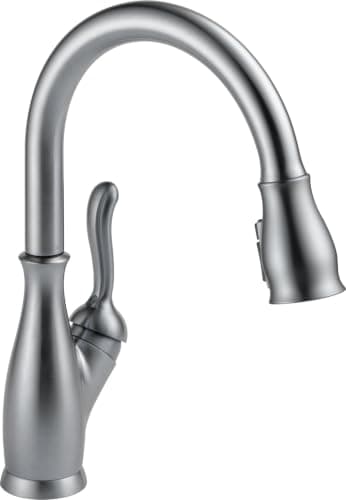
Delta Leland 9178-AR-DST
Delta · Best for most kitchens, one or three holes
The pull-down we would fit in most kitchens, because the two parts that usually fail first on a pull-down are the two Delta engineered around: the docking mechanism and the valve. MagnaTite pulls the wand back into the spout with a magnet instead of relying on a friction collar, and Diamond Seal keeps water off the valve. It ships with a deck plate, so it covers a three-hole sink or mounts through one.
Published specifications
- Flow rate
- 1.8 gpm source
- Spout height
- 7-7/8" deck to outlet source
- Spout reach
- 9-3/16" source
- Overall height
- 14-7/8" source
- Mounting
- Single hole; deck plate included for three-hole sinks source
- Supply lines
- Integrated InnoFlex PEX, pre-attached at the valve source
- Connection
- 3/8" compression source
- Warranty
- Delta limited lifetime source
- Lead compliance
- Meets NSF/ANSI 61 source
What works
- MagnaTite docking is a magnet, not a friction fit — a wand that stops seating is the most common pull-down complaint, and a magnet does not wear the way a plastic collar does
- Spout reach of 9-3/16" clears the far side of a standard 22-inch front-to-back sink
- Diamond Seal keeps water off the valve, which is what the lifetime warranty is really protecting
- Deck plate in the box, so a three-hole sink needs no extra part
What does not
- 1.8 gpm is higher than the 1.5 gpm most competitors now ship, which matters if your area caps flow rate
- Zinc body rather than brass — normal at this price, but this is not a forever faucet
- No independent lab publishes durability figures for this model, so we cannot tell you how the finish looks at year five
Skip it if
Skip it if your sink is a shallow bar sink: at 14-7/8" overall the arc will splash in a basin under about seven inches deep.
Raw specifications: Delta’s own page for the Delta Leland 9178-AR-DST.
Product photograph supplied by Amazon for this listing, used under the Associates program.
2. Best for deep pots
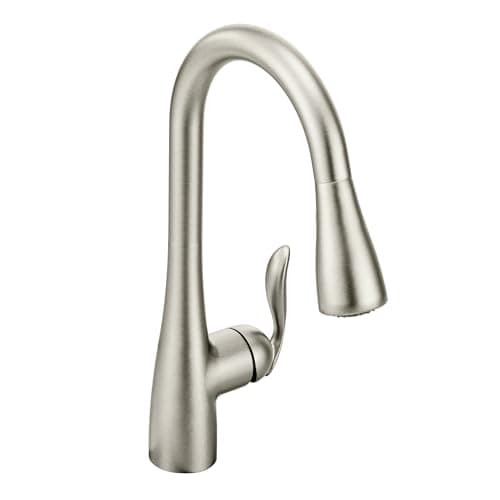
Moen Arbor 7594
Moen · Best for deep pots and hard-water kitchens
The pull-down to buy if you want the taller arc and a finish that hides water spots. Its 8-1/4" spout height is about half an inch more clearance than the Leland, which is the difference between washing a stock pot and fighting one. The tradeoff is reach: 7-7/8" against 9-3/16", so it works closer to the back of the bowl.
Published specifications
What works
- The 8-1/4" spout height is genuine pot clearance, not decorative arc
- Power Boost concentrates the stream for filling and rinsing without raising the rated flow
- Spot Resist Stainless is the single most useful finish choice in a hard-water house
- Reflex docking has been in Moen's line long enough that replacement wands are easy to find
What does not
- Reach is 7-7/8", over an inch shorter than the Leland — on a wide double bowl you will notice
- Moen publishes no independent noise or durability measurement, and neither do we
- The spot-resist coating is a finish, not armor; abrasive cleaners still dull it
Skip it if
Skip it if you have a wide double-bowl sink and want one faucet to reach both drains comfortably — buy reach instead of height.
#ad Affiliate link · Price as of October 16, 2026
Raw specifications: Moen’s own page for the Moen Arbor 7594.
Product photograph supplied by Amazon for this listing, used under the Associates program.
3. Best where height is limited
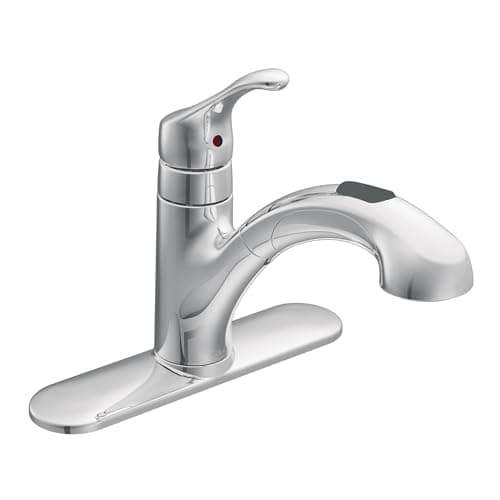
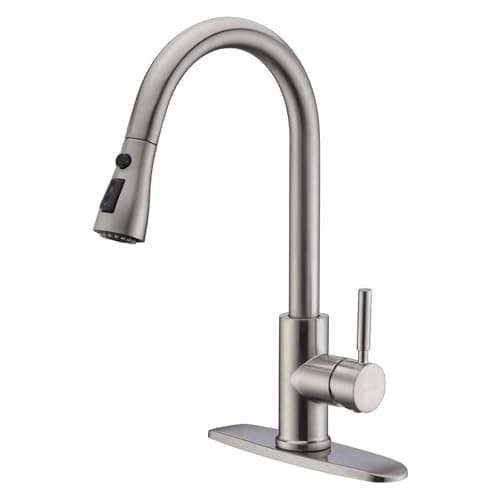
Moen Renzo CA87316C
Moen · Best for low window sills and tight clearance
The faucet for a sink under a window. Its spout stands 5.56 inches tall — low enough to clear a sill that stops a high-arc faucet dead — while still reaching 9.63 inches, which is further than several faucets twice its height. In a rental or a low-clearance kitchen that combination is hard to find.
Published specifications
What works
- A 5.56-inch spout fits under window sills and wall cabinets that rule out a high arc
- 9.63 inches of reach is long for such a low spout — most low-arc faucets give up reach too
- Pull-out wand, so the low spout does not cost you spray range
- Moen's parts channel applies, which is the real argument for buying Moen at any price
What does not
- A low spout means no clearance for tall pots — you fill them in the sink or at an angle
- Moen does not state a body material for this model, so whether it is brass or plated zinc is unpublished — and that is the figure that tells you how long a faucet lasts
- The CA87316C part number is the chrome one, and chrome shows water spotting; Spot Resist Stainless exists in the Renzo line but under a different model number
Skip it if
Skip it if you regularly fill stock pots at the sink. Buy height, and put the faucet somewhere with headroom.
#ad Affiliate link · Price as of October 16, 2026
Raw specifications: Moen’s own page for the Moen Renzo CA87316C.
Product photograph supplied by Amazon for this listing, used under the Associates program.
4. Best on a budget
WEWE A1001L
WEWE · Best for rentals and tight budgets
The budget pick, named with the caveat that belongs on every budget pick: it is 304 stainless with a ceramic cartridge the maker rates at 500,000 cycles, and it is a faucet you will replace rather than repair, because the parts channel behind it is nothing like Moen's or Delta's. On those terms it is a lot of faucet for the money.
Published specifications
What works
- 304 stainless rather than plated zinc at a price where plated zinc is the norm
- A ceramic disc cartridge, which is the valve type that lasts — the same principle as faucets costing four times more
- The pause function is genuinely useful on a pull-down and is often missing at this price
- Light enough that a one-person installation is straightforward
What does not
- The parts channel is the weak point: plan to replace rather than repair in year four
- No published spout height or reach, so check the listing dimensions against your sink before ordering
- 1.8 gpm, and no boost function to make better use of it
Skip it if
Skip it if this is your forever kitchen. Buy a faucet whose cartridge you can still order in ten years — that is the whole argument for the major brands.
#ad Affiliate link · Price as of October 16, 2026
Raw specifications: WEWE’s own page for the WEWE A1001L.
5. Then, and only then, the finish
Finish is the decision everybody makes first and the one with the fewest consequences. Brushed nickel and the spot-resist stainless family hide water spotting and fingerprints best; polished chrome is the hardest-wearing and the most reflective, which means it shows every droplet; matte black hides water and shows dried limescale as a pale film.
If your water is hard, this stops being cosmetic — a brushed finish will look clean for days where chrome looks spotted by lunchtime. Brushed nickel vs chrome is the head-to-head, which finish hides water spots ranks all of them, and faucet finishes explains how each one is applied.
6. Features, ranked by how often they earn their money
- Magnetic docking. The most useful extra on a pull-down. A wand that stops seating is the commonest complaint about pull-downs, and a magnet does not wear the way a friction collar does. Faucets with magnetic docking.
- Touch or touchless. Genuinely useful with raw-meat hands or a toddler on your hip, and it needs batteries or an outlet under the sink. Touch vs touchless.
- A matching soap dispenser. Cheap, uses a hole you may already have, and the only way to get a dispenser that matches the faucet exactly. Faucets with a soap dispenser.
- Filtered water from the faucet. Mostly a separate under-sink system rather than a faucet feature, and the dedicated-tap route is usually better. Filtered water faucets.
What a budget buys at each level
We do not write prices into this copy — the live figure sits in each buy button with the date it was read, and a number typed into a paragraph would be wrong within a week. What we can tell you is what the specification sheets look like as you move up, and that is the more durable information anyway.
At the bottom of the range you get a zinc or plastic body, a working ceramic cartridge, a short warranty and no docking magnet. In the middle you get a magnet, a lifetime warranty on the valve and finish, a published spray-mode count and a brand that stocks parts. At the top you add electronics, a solid brass body and a finish applied by physical vapor deposition rather than plating. Faucets for the money is where that trade-off is argued out, and under $100 and under $200 are the two budget shortlists.
Before you order
- Count the deck holes and their spacing.
- Measure deck-to-sill or deck-to-cabinet headroom, and the sink front to back.
- Look under the sink: is there a shutoff valve on each supply, and is there an outlet if you want an electronic faucet?
- Check the supply connection size on the faucet against what is on your shutoffs — kitchen faucet supply line sizes covers the thread you will meet.
- Confirm a deck plate is in the box if your sink has more holes than the faucet needs.
Once the faucet arrives, how to install a kitchen faucet is the procedure, what tools you need is the short list, and do you need a plumber is the honest answer on whether to hand it over.
What to take away
- Decide in order: holes, height and reach, spray type, valve, finish, features.
- Hole count is the only decision that can make a faucet physically unusable — check it first.
- A single-hole faucet with a deck plate fits a three-hole sink; the reverse needs drilling.
- Spout height, spout reach and overall height are three different numbers and all three matter.
- Ask what the valve is. A ceramic-disc cartridge from a brand that stocks parts is the durability answer.
- Finish is the last decision, not the first — unless your water is hard, in which case it is a function decision.
How we sourced this page
Every figure on this page came from one of the following. Where a manufacturer or an independent lab does not publish a number, we say so rather than estimate it.
- Delta Leland 9178-AR-DST product page (published specifications)
- Moen Arbor 7594 product page (published specifications)
- Moen Renzo CA87316C low-arc pullout kitchen faucet product page
- Kraus Bolden KPF-1610 product page (published specifications)
- WEWE A1001L kitchen faucet — manufacturer product listing
- US EPA WaterSense — bathroom and kitchen faucet flow-rate standards
Common questions
- What should I look for when buying a kitchen faucet?
- In order: that it fits your deck holes, that the spout height clears whatever is above your sink, that the reach lands water in the bowl rather than past it, and that the maker states a ceramic-disc cartridge and stocks replacements. Finish and features come after all four.
- Does a kitchen faucet have to match the sink finish?
- No, and most kitchens do not match them. A brushed faucet over a stainless sink is the commonest combination in the US and reads as deliberate. What does look like a mistake is two different brushed finishes side by side, because the sheens differ between makers.
- How do I know if a kitchen faucet will fit my sink?
- Count the holes and their spacing, then check the faucet's stated mounting requirement and whether a deck plate is included. Then measure your headroom above the deck against the faucet's published overall height, and your sink's front-to-back dimension against its published reach.
- Is a more expensive kitchen faucet worth it?
- Up to the middle of the range, usually yes — that is where a docking magnet, a lifetime valve-and-finish warranty and reliable parts availability appear. Above that you are buying electronics, a brass body and a harder finish process, which are real but optional.
More in Kitchen Faucets
Nine times out of ten the faucet that fails you is the one that did not fit — wrong hole count, wrong reach, wrong finish for your water. Start with the measurements and the rest gets easy.
Read next
Guide
Faucet hole configurations
What each drilling pattern accepts, the standard hole size, how deck plates work, and what adding a hole really involves.
Guide
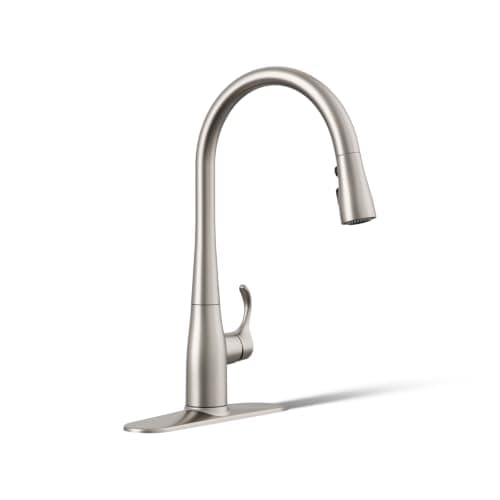
Height and reach guide
Spout height, reach and overall height are three different numbers. Here is which one decides what, and how to measure yours.
Head to head
Pull-down vs pull-out
The hose, the arc and the clearance above your sink decide this one. A table of real differences plus a pick per side.
Head to head
Brushed nickel vs chrome
How the two most-bought faucet finishes differ on water spots, fingerprints, abrasion, cleaning and matching the rest of the kitchen.
Best kitchen faucet
Best kitchen faucets
Five faucets covering the different jobs a kitchen faucet does, ranked on sourced specifications rather than brand.
How to
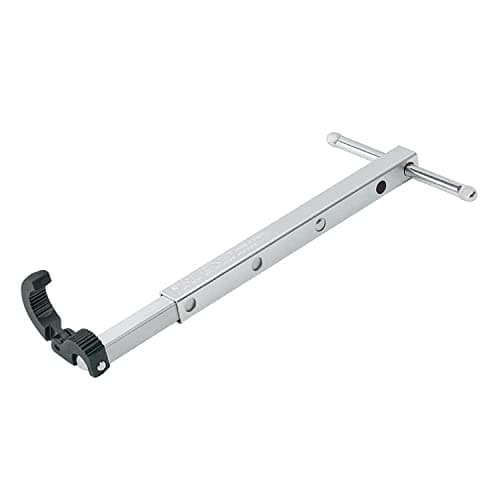
Install a kitchen faucet
Ten steps, branched by hole configuration, with the tools and parts list up front and the when-to-stop line stated plainly.
Found something out of date, or a figure you can source better than we did? Tell us — corrections get read first. Our methodology explains how picks are made, and contact is one click away.