Kitchen Faucets
Kitchen faucet height and spout reach
Three measurements, frequently confused, that between them decide whether a faucet clears your cabinet, reaches your drain, and keeps the water in the sink.

Disclosure: we earn a commission if you buy through the Amazon links on this page, at no extra cost to you. Commission never decides a verdict or a ranking position — read our editorial policy and affiliate disclosure.
Short answer
Spout height is deck to water outlet and decides pot clearance. Spout reach is the horizontal distance from the faucet body to the center of the stream, and decides whether water lands near the drain. Overall height is the tallest point of the faucet and decides whether it fits under your cabinet or window. All three are published; all three matter for different reasons.
Faucet listings mix these up constantly, and "height" in a product title usually means overall height, which is the least useful of the three for deciding how a faucet will work. Here is what each one does.
The three measurements
| Measurement | Measured from | What it decides |
|---|---|---|
| Spout height | Deck or counter to the water outlet | What fits under the stream — pots, pitchers, sheet pans on edge |
| Spout reach | Center of the faucet body to the center of the stream | Where the water lands in the bowl, and whether it reaches a second bowl |
| Overall height | Deck to the highest point of the faucet | Whether the faucet fits under a cabinet, window sill or shelf |
How to measure your own sink in three steps
- From the faucet hole to the center of the drain: this is the reach you want, plus or minus an inch. Most kitchen sinks land between 7 and 10 inches.
- From the deck up to the underside of anything above — window sill, cabinet, shelf. This is your maximum overall height, and subtract an inch so the wand can be lifted out of its dock.
- The depth of the basin, from rim to base. Under about 7 inches, choose a shorter spout or expect splash; 9 inches or more will take any arc comfortably.
Why tall faucets splash in shallow sinks
Water leaving a spout accelerates as it falls, and when it hits a hard flat surface it scatters. The higher the spout and the shallower the basin, the more of that scatter clears the rim. This is why bar and prep sinks are fitted with short faucets and why a beautiful 16-inch faucet over an old 5-inch drop-in basin is a wet countertop waiting to happen.
Two mitigations that work: an aerated stream (which entrains air and lands softer than a solid jet), and aiming the stream at the sloped part of the basin rather than the flat base. Neither fixes a genuinely mismatched pair. If you have a shallow sink, read pull-down vs pull-out — the lower spout of a pull-out is the real answer.
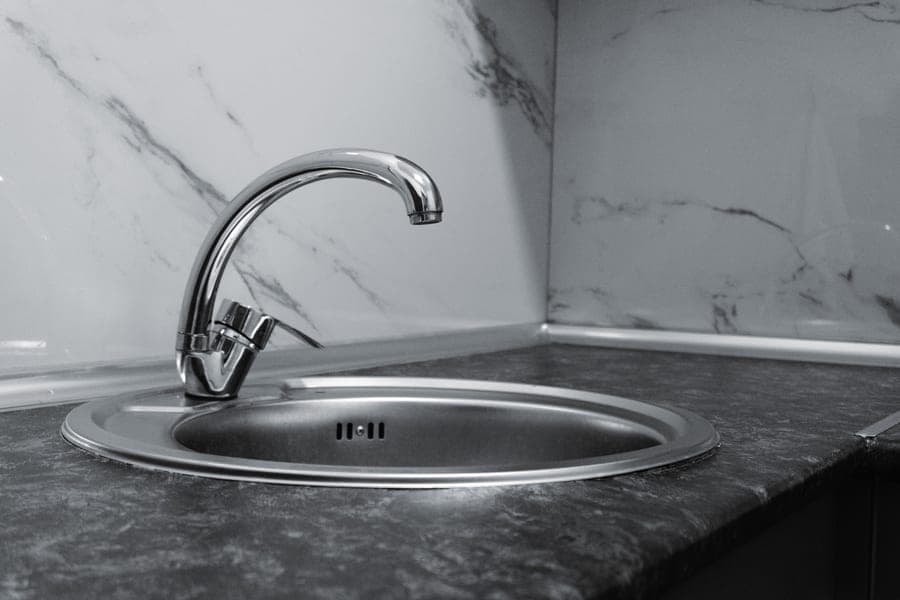
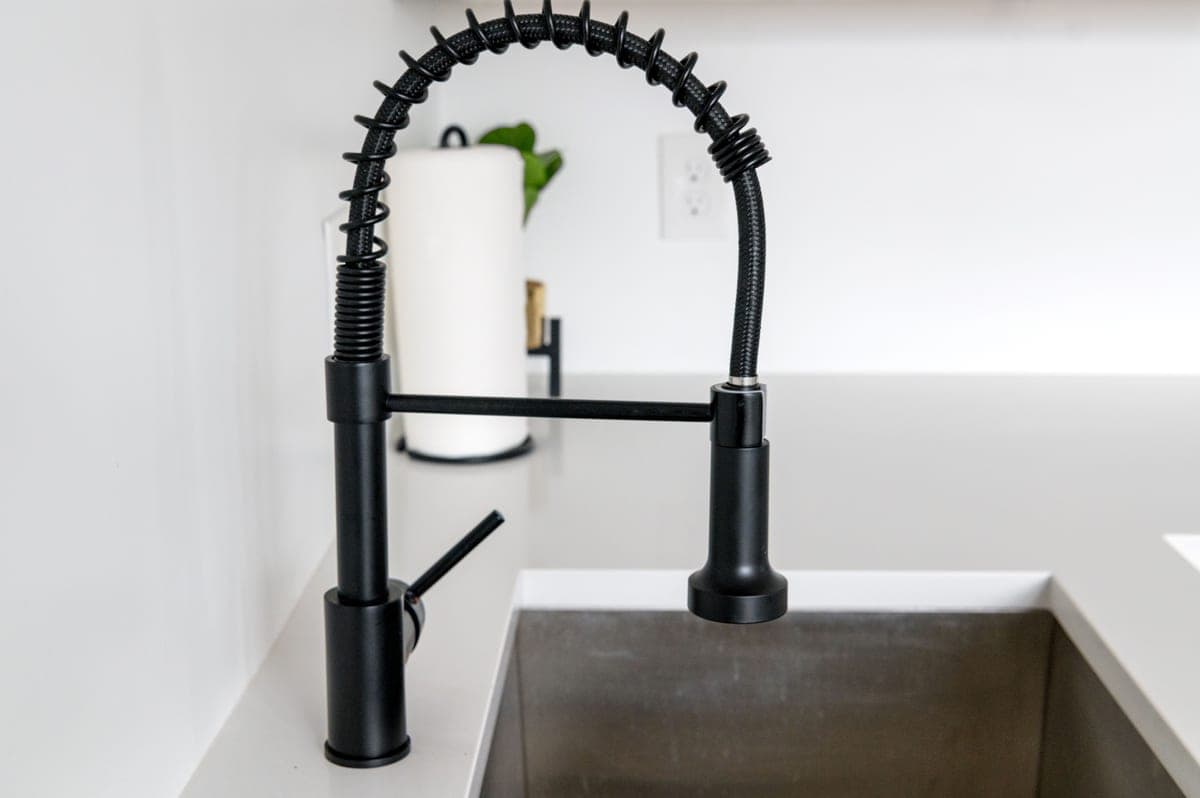
Photograph shows the product category, not this specific unit. We do not republish manufacturer product photography.
1. Best reach
Kohler Simplice K-596
Kohler · Best for wide bowls and long reach
The value pick with the longest reach of the three mainstream pull-downs, and the only one whose third spray function is genuinely useful rather than a novelty: Boost raises flow by 30% while you hold it, then drops back to 1.5 gpm. If your sink is wide, this is the one that reaches.
Published specifications
What works
- 9" reach, matching the longest in this roundup
- Boost is a real feature: 30% more flow on demand, then back to 1.5 gpm
- Sweep spray is a blade rather than a cone, which is better at pushing debris toward a drain
- Kohler publishes a full dimensional spec sheet, which makes hole and cabinet planning easy
What does not
- A three-function head has more moving parts than a two-function one, which is more to go wrong
- The gooseneck shape sets the handle further back than some people like on a shallow deck
- No published independent test data on this model, from anyone
Skip it if
Skip it if you want the simplest possible faucet — a two-function wand is one less thing to break.
#ad Affiliate link · We publish no price; Amazon shows the current one
Raw specifications: Kohler’s own page for the Kohler Simplice K-596.
Photograph shows the product category, not this specific unit. We do not republish manufacturer product photography.
2. Best height
Moen Arbor 7594
Moen · Best for deep pots and hard-water kitchens
The pull-down to buy if you want the taller arc and a finish that hides water spots. Its 8-1/4" spout height is about half an inch more clearance than the Leland, which is the difference between washing a stock pot and fighting one. The tradeoff is reach: 7-7/8" against 9-3/16", so it works closer to the back of the bowl.
Published specifications
What works
- The 8-1/4" spout height is genuine pot clearance, not decorative arc
- Power Boost concentrates the stream for filling and rinsing without raising the rated flow
- Spot Resist Stainless is the single most useful finish choice in a hard-water house
- Reflex docking has been in Moen's line long enough that replacement wands are easy to find
What does not
- Reach is 7-7/8", over an inch shorter than the Leland — on a wide double bowl you will notice
- Moen publishes no independent noise or durability measurement, and neither do we
- The spot-resist coating is a finish, not armor; abrasive cleaners still dull it
Skip it if
Skip it if you have a wide double-bowl sink and want one faucet to reach both drains comfortably — buy reach instead of height.
#ad Affiliate link · We publish no price; Amazon shows the current one
Raw specifications: Moen’s own page for the Moen Arbor 7594.
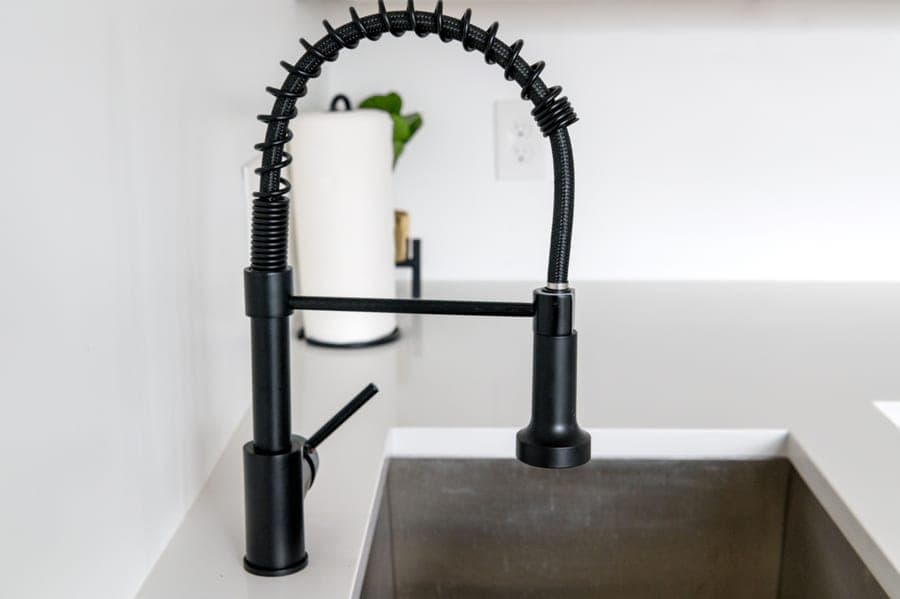
Photograph shows the product category, not this specific unit. We do not republish manufacturer product photography.
3. Best under a low cabinet
Kraus Bolden KPF-1610
Kraus · Best for commercial look under a cabinet
A real coil-spring commercial-style faucet at a normal price, and short enough at 18 inches to fit under a standard upper cabinet — which is exactly where most commercial-style faucets fail. The spout is low at 6-3/8" and the reach moderate, so it suits a deep single bowl rather than a wide double.
Published specifications
What works
- At 18 inches tall it clears most upper cabinets, unlike the 24-inch-plus commercial faucets
- The exposed coil spring is the actual commercial mechanism, not a decorative sleeve
- Single-hole install with pre-attached lines and a counterweight in the box
- Kraus publishes dimensions for every finish variant, which is unusual at this price
What does not
- Coil springs collect grease and need wiping; that is the real ownership cost of the look
- 180-degree swivel, not 360 — plan which way the spout needs to face
- 6-3/8" spout height is low for a tall stock pot
Skip it if
Skip it if you have an apron-front sink with a high front rim — measure before committing to a low spout.
#ad Affiliate link · We publish no price; Amazon shows the current one
Raw specifications: Kraus’s own page for the Kraus Bolden KPF-1610.
Double bowls make reach non-negotiable
On a single bowl, a short-reach faucet is an inconvenience. On a double bowl it can be a genuine failure: if the faucet swivels but does not reach past the divider, the second bowl is only usable for soaking. Measure from the faucet hole to the center of the far bowl, and accept that some faucets simply cannot serve a wide double-bowl sink. Our single bowl vs double bowl page covers the configuration side of the same question.
Apron-front sinks and the front-rim problem
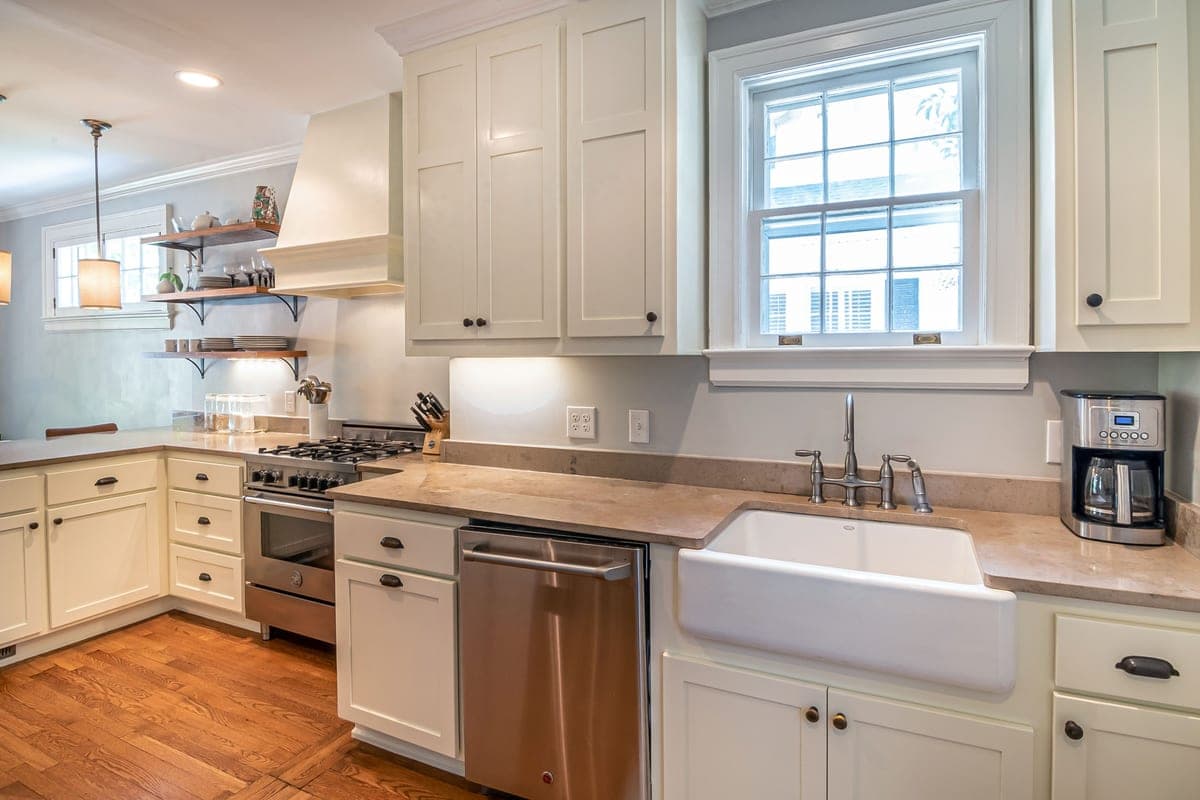
A farmhouse sink's front rim stands proud of the counter, and its basin is set forward. That changes the geometry twice: you need slightly more reach to get over the center of the bowl, and you need to check that a low-spout faucet clears the rim at all. This is the single most common fitment surprise with apron sinks, and it is why we wrote best faucet for a farmhouse sink as its own page rather than a paragraph.
What to take away
- Reach decides where the water lands; height decides what fits under it; overall height decides whether the faucet fits the space.
- Subtract an inch from your available clearance so the spray wand can be lifted out of its dock.
- A tall spout over a shallow basin splashes, and no feature fixes that — choose a lower spout instead.
- On a double-bowl sink, measure to the center of the far bowl. Some faucets cannot serve it at all.
How we sourced this page
Every figure on this page came from one of the following. Where a manufacturer or an independent lab does not publish a number, we say so rather than estimate it.
Common questions
- How tall should a kitchen faucet be?
- Tall enough to clear the largest thing you wash regularly, and short enough to fit under whatever is above the sink. In practice that means a spout height of 8 inches or more if you wash stock pots, and an overall height at least an inch less than your deck-to-cabinet clearance so the wand can be lifted out.
- What is a good spout reach for a kitchen faucet?
- Enough to put the stream near the drain. Measure from the faucet hole to the center of the drain — usually 7 to 10 inches on a standard sink — and buy a reach within an inch of that. On a double bowl, measure to the center of the far bowl instead.
- Will a tall faucet splash in my sink?
- In a basin shallower than about 7 inches, probably yes. The drop distance gives the water velocity and a flat basin base scatters it over the rim. An aerated stream helps a little; a shorter spout helps a lot.
- Does spout height include the spray head?
- No. Spout height is measured to the water outlet, which on a pull-down is the underside of the docked spray head. Overall height is measured to the top of the faucet, which is usually the top of the arc. Manufacturers publish both, and confusing them is how people buy a faucet that does not fit under a cabinet.
More in Kitchen Faucets
Nine times out of ten the faucet that fails you is the one that did not fit — wrong hole count, wrong reach, wrong finish for your water. Start with the measurements and the rest gets easy.
Read next
Guide
Faucet hole configurations
What each drilling pattern accepts, the standard hole size, how deck plates work, and what adding a hole really involves.
Head to head
Pull-down vs pull-out
The hose, the arc and the clearance above your sink decide this one. A table of real differences plus a pick per side.

Best pull-down faucet
Best pull-down faucets
Three mainstream pull-downs compared on reach, arc height and docking mechanism — the specs that decide how one ages.
Head to head
Single vs double bowl
What a divider costs you, who genuinely benefits from two bowls, and what is involved in swapping a double for a single.
Best faucet for a farmhouse sink
Best faucet for a farmhouse sink
Why apron sinks change faucet geometry, the two measurements to take, and four faucets that suit the configuration.
Found something out of date, or a figure you can source better than we did? Tell us — corrections get read first. Our methodology explains how picks are made, and contact is one click away.