Guides
What size are kitchen faucet supply lines?
Supply lines have two different ends and people buy the wrong one by measuring the wrong end. Here is which number matters and where to read it.
Disclosure: we earn a commission if you buy through the Amazon links on this page, at no extra cost to you. Commission never decides a verdict or a ranking position — read our editorial policy and affiliate disclosure.
How we assessed these: we publish only the connection sizes each manufacturer states on its own product page for the named model numbers. Fittings vary by faucet and by country, so this page tells you where to read your own figure rather than asserting a universal one. No figure here is recalled or inferred.
Short answer
The size that decides what you buy is the connection at the shut-off valve, and on every faucet in this registry whose maker publishes it, that is a 3/8-inch compression fitting — Delta on the Leland 9178, Moen on the Arbor 7594, the Method 7585C, the Renzo CA87316C and both Sombra models. The faucet end varies by model and is often not a fitting at all, because many faucets now ship with their supply lines already attached.
Supply lines confuse people because they have two different ends doing two different jobs, and the one you can see easily is not the one that matters. Underneath the sink, the line runs from the angle stop in the wall up to the faucet. The angle-stop end is a standard plumbing fitting. The faucet end is whatever that faucet's maker decided, and increasingly the answer is "nothing, because it is already connected."
The valve end: 3/8-inch compression
The standard American kitchen angle stop takes a 3/8-inch compression fitting, and this is the figure the faucet makers publish. Delta states a 3/8-inch compression connection on the Leland 9178 and on the Leland Touch2O 9178T. Moen states 3/8-inch compression on the Arbor 7594, the Method 7585C, the Renzo CA87316C, the Sombra 87701 pullout and the Sombra 87702 with side spray.
Compression is worth understanding because it changes how you tighten it. The seal is made by a soft brass ring — a ferrule — crushed between the nut and the pipe as you tighten. That means no tape and no compound, and it means snug plus a modest further turn rather than as hard as you can pull. Over-tightening a compression fitting deforms the ferrule and makes it weep, which is the opposite of what the person doing it intended.
The faucet end: often already decided
Two of the faucets here remove this question entirely. Delta ships integrated InnoFlex PEX supply lines pre-attached at the valve on the Leland, so the faucet arrives with its lines on and there is no faucet-end fitting for you to get wrong. Moen's Duralock quick connect on the Arbor, Method and Renzo does the same job for the sprayer hose: a push-fit collar rather than a coupling tightened by feel in the dark.
That is the single best reason to choose a faucet on its connections rather than its looks, and it is why easiest kitchen faucets to install ranks the market on exactly this. A joint you never make cannot weep, and the joints you make blind at the back of a cabinet are the ones most likely to.
| Faucet | Connection at the shut-off valve | What the faucet brings |
|---|---|---|
| Delta Leland 9178 | 3/8" compression | Integrated InnoFlex PEX supply lines, pre-attached at the valve |
| Delta Leland Touch2O 9178T | Not published as a separate figure | Same body as the manual Leland; deck plate included |
| Moen Arbor 7594 | 3/8" compression | Duralock quick connect; deck plate included |
| Moen Method 7585C | 3/8" compression | Duralock quick connect; 68-inch hose; deck plate included |
| Moen Renzo CA87316C | 3/8" compression | Duralock quick connect; deck plate included |
| Moen Sombra 87701 pullout | 3/8" compression | 59-inch hose; matching soap dispenser included |
| Moen Sombra 87702 side spray | 3/8" compression | Side spray included; deck plate included |
Every figure comes from Delta's or Moen's own product page for that model number, listed in the sources below. Cells reading "not published" mean we did not find the figure stated for that model and will not infer it from a sibling product. Faucets from other makers may differ — read the specification for the model you are buying.

Photograph shows the product category, not this specific unit. We do not republish manufacturer product photography.
1. Fewest connections to make
Delta Leland 9178-AR-DST
Delta · Best for most kitchens, one or three holes
The pull-down we would fit in most kitchens, because the two parts that usually fail first on a pull-down are the two Delta engineered around: the docking mechanism and the valve. MagnaTite pulls the wand back into the spout with a magnet instead of relying on a friction collar, and Diamond Seal keeps water off the valve. It ships with a deck plate, so it covers a three-hole sink or mounts through one.
Published specifications
- Flow rate
- 1.8 gpm source
- Spout height
- 7-7/8" deck to outlet source
- Spout reach
- 9-3/16" source
- Overall height
- 14-7/8" source
- Mounting
- Single hole; deck plate included for three-hole sinks source
- Supply lines
- Integrated InnoFlex PEX, pre-attached at the valve source
- Connection
- 3/8" compression source
- Warranty
- Delta limited lifetime source
- Lead compliance
- Meets NSF/ANSI 61 source
What works
- MagnaTite docking is a magnet, not a friction fit — a wand that stops seating is the most common pull-down complaint, and a magnet does not wear the way a plastic collar does
- Spout reach of 9-3/16" clears the far side of a standard 22-inch front-to-back sink
- Diamond Seal keeps water off the valve, which is what the lifetime warranty is really protecting
- Deck plate in the box, so a three-hole sink needs no extra part
What does not
- 1.8 gpm is higher than the 1.5 gpm most competitors now ship, which matters if your area caps flow rate
- Zinc body rather than brass — normal at this price, but this is not a forever faucet
- No independent lab publishes durability figures for this model, so we cannot tell you how the finish looks at year five
Skip it if
Skip it if your sink is a shallow bar sink: at 14-7/8" overall the arc will splash in a basin under about seven inches deep.
#ad Affiliate link · We publish no price; Amazon shows the current one
Raw specifications: Delta’s own page for the Delta Leland 9178-AR-DST.

Photograph shows the product category, not this specific unit. We do not republish manufacturer product photography.
2. Easiest hose connection
Moen Arbor 7594
Moen · Best for deep pots and hard-water kitchens
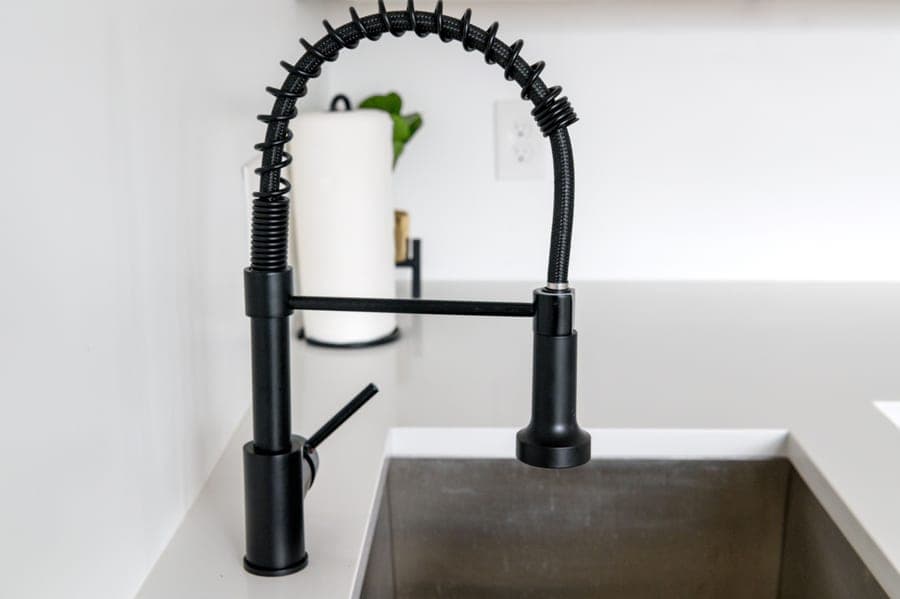
The pull-down to buy if you want the taller arc and a finish that hides water spots. Its 8-1/4" spout height is about half an inch more clearance than the Leland, which is the difference between washing a stock pot and fighting one. The tradeoff is reach: 7-7/8" against 9-3/16", so it works closer to the back of the bowl.
Published specifications
What works
- The 8-1/4" spout height is genuine pot clearance, not decorative arc
- Power Boost concentrates the stream for filling and rinsing without raising the rated flow
- Spot Resist Stainless is the single most useful finish choice in a hard-water house
- Reflex docking has been in Moen's line long enough that replacement wands are easy to find
What does not
- Reach is 7-7/8", over an inch shorter than the Leland — on a wide double bowl you will notice
- Moen publishes no independent noise or durability measurement, and neither do we
- The spot-resist coating is a finish, not armor; abrasive cleaners still dull it
Skip it if
Skip it if you have a wide double-bowl sink and want one faucet to reach both drains comfortably — buy reach instead of height.
#ad Affiliate link · We publish no price; Amazon shows the current one
Raw specifications: Moen’s own page for the Moen Arbor 7594.
Photograph shows the product category, not this specific unit. We do not republish manufacturer product photography.
3. Longest reach under the sink
Moen Sombra 87701SRS
Moen · Best for pull-out range plus a matching dispenser
The pull-out we would fit, and the one that quietly solves a second problem: it ships with a matching soap dispenser, so a three-hole sink converting to a single-hole faucet has something to put in the spare hole that was designed alongside it. A 59-inch hose and a 9.93-inch spout give it genuine range.
Published specifications
What works
- A 59-inch hose reaches a bucket on the floor, which is the whole reason to choose pull-out over pull-down
- The soap dispenser is matched and included rather than an approximate-finish afterthought
- One-to-four-hole mounting covers essentially every sink drilling
- Spot Resist Stainless is the finish to have in hard water
What does not
- 8.45 inches of reach is mid-range — a wide double bowl will want more
- Moen does not publish a warranty term on this product page, so we do not state one
- Pull-out wands sit lower, so a tall stock pot is a tighter fit than under a high-arc pull-down
Skip it if
Skip it if your sink is deep and you mostly wash tall cookware — a high-arc pull-down gives you clearance this does not.
#ad Affiliate link · We publish no price; Amazon shows the current one
Raw specifications: Moen’s own page for the Moen Sombra 87701SRS.

Photograph shows the product category, not this specific unit. We do not republish manufacturer product photography.
4. What you will need anyway
RIDGID Model 1017 telescoping basin wrench
RIDGID · Best for any faucet removal or install
The one tool that decides whether a faucet swap is a two-hour job or a six-hour one. Faucet mounting nuts sit behind the sink where no normal wrench reaches; a basin wrench's spring-loaded head ratchets one-handed in that space. The telescoping shank is what gets you from a shallow vanity to a deep kitchen cabinet.
Published specifications
What works
- The 10-to-17-inch telescoping shank covers both a shallow bathroom vanity and a deep kitchen base cabinet
- One-handed ratcheting matters, because the other hand is holding a flashlight
- Alloy steel jaws grip a plastic mounting nut without crushing it
- The head locks at an angle, which is how you reach a nut behind a disposal
What does not
- A single-purpose tool that lives in a drawer between faucet jobs
- A badly corroded nut still needs penetrating oil and patience, not a better wrench
- No substitute for clearing the cabinet out before you start
Skip it if
Skip it if a plumber is fitting the faucet — they own one, and you would use yours perhaps twice a decade.
#ad Affiliate link · We publish no price; Amazon shows the current one
Raw specifications: RIDGID’s own page for the RIDGID Model 1017 telescoping basin wrench.
Length: measure, then add
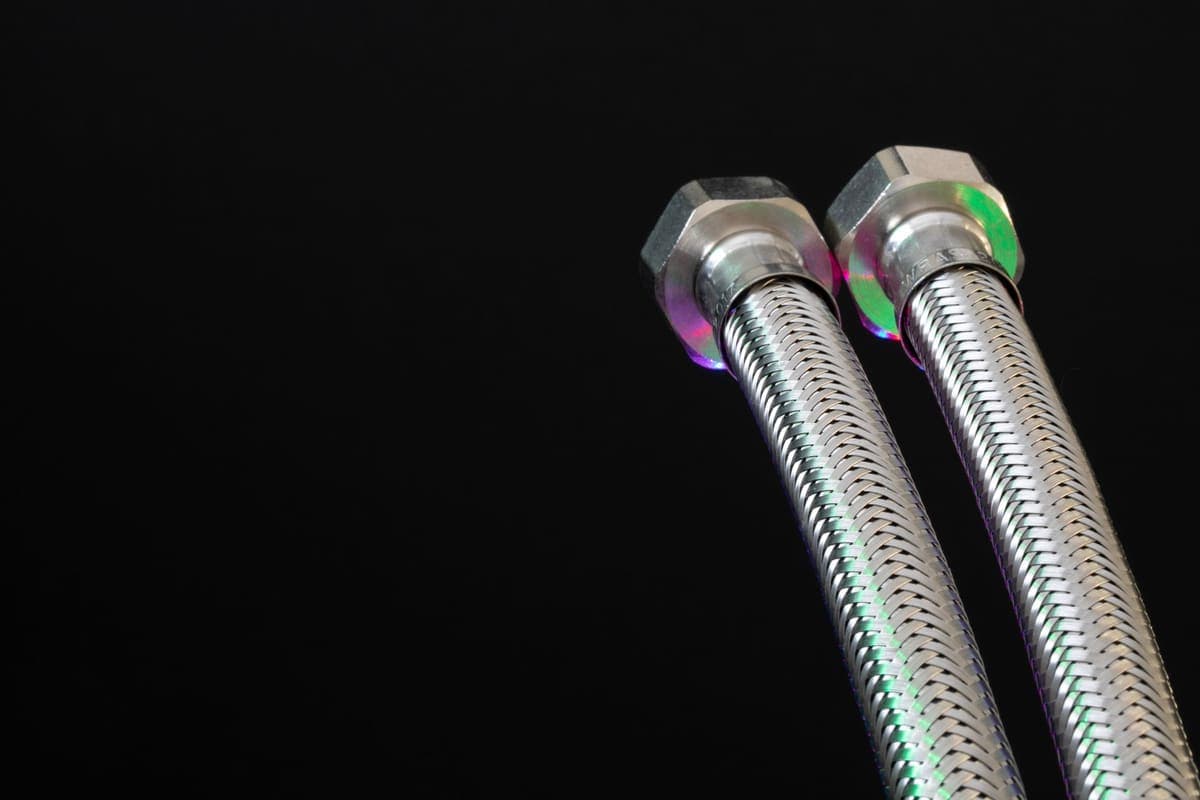
The length nobody publishes and everybody gets wrong. Measure from the outlet of the shut-off valve, up and along whatever route the line will actually take, to where it connects at the faucet — then add several inches. A supply line should curve gently rather than being pulled taut, because a line under tension puts a side load on both fittings and a kinked braided line is a failed braided line.
A line that is too long is a non-problem: it loops. A line that is too short is a trip to the store with the water off. If the faucet ships with lines already attached, the question becomes whether those reach your valves, which depends on how high the valves sit — and that is a measurement you can take now, before ordering anything.
What to buy, and when to replace
- Braided stainless, not plastic or chrome-plated copper. Braided lines are flexible, do not kink the way soft copper does, and are the current standard for a reason.
- Replace them whenever the cabinet is open. They are cheap, they live under constant pressure in a cupboard nobody inspects, and a perished one empties into the floor.
- Never reuse an old ferrule on a new line. The brass ring deforms permanently on first tightening. New line, new nut and ferrule.
- No tape, no compound on compression. The seal is metal on metal. Tape on the threads does nothing and misleads whoever opens it next.
- PTFE tape only on threaded pipe, which in most kitchen faucet installations means nothing at all.
A weeping connection under a sink is the commonest post-installation complaint in this whole category, and it is almost always one of three things: an over-tightened compression fitting, a reused ferrule, or a line pulled taut. Kitchen faucet leaking diagnosis separates a supply-line leak from a faucet leak, which look identical in a dark cabinet and are completely different problems.
Before you order
- Photograph the existing connection at both shut-off valves.
- Confirm the valves actually close. A valve that fails changes the job entirely.
- Measure the route from each valve outlet to the faucet connection, then add a few inches.
- Read the new faucet's specification for its connection size and whether lines are pre-attached.
- Buy new braided lines of the right size and generous length, even if the old ones look fine.
- Have a basin wrench on hand — the mounting hardware is a separate problem from the supply lines.
Then what tools do you need to install a kitchen faucet covers the rest of the list, and how to install a kitchen faucet is the procedure itself.
What to take away
- The size that matters is at the shut-off valve, and every faucet here that publishes it says 3/8-inch compression.
- Compression fittings seal with a crushed brass ferrule — no tape, no compound, and do not over-tighten.
- Many faucets now arrive with supply lines pre-attached, which removes the faucet-end question entirely.
- Measure the route and add a few inches. A taut line side-loads both fittings; a long one simply loops.
- Buy braided stainless, and replace both lines whenever the cabinet is open.
- Never reuse a ferrule. It deforms permanently the first time it is tightened.
How we sourced this page
Every figure on this page came from one of the following. Where a manufacturer or an independent lab does not publish a number, we say so rather than estimate it.
Common questions
- What size are most kitchen faucet supply lines?
- At the shut-off valve, 3/8-inch compression is what every faucet in this registry that publishes a connection specifies — Delta on the Leland and Moen across the Arbor, Method, Renzo and Sombra ranges. The faucet end varies by model, and on many modern faucets the lines are already attached so there is no second fitting at all.
- How long should kitchen faucet supply lines be?
- Long enough to curve gently from the valve outlet to the faucet with a few inches spare. Measure the actual route rather than the straight-line distance, and err long. A line pulled taut puts a side load on both fittings and is far more likely to weep than one that loops.
- Do you need plumber's tape on faucet supply lines?
- No, not on a compression fitting, which is what a kitchen faucet supply line uses at the shut-off valve. The seal is made by a brass ferrule crushed between the nut and the pipe. Tape belongs on threaded pipe connections, and most faucet installations have none.
- Should I replace supply lines when I replace a kitchen faucet?
- Yes, unless they are demonstrably recent. They are inexpensive, they sit under constant pressure in a cupboard nobody looks in, and replacing them while the cabinet is already empty costs almost nothing compared with finding a perished one has been weeping behind a bin.
- Can you reuse a compression ferrule on a new supply line?
- No. The brass ring deforms permanently the first time it is tightened, and it is shaped to the pipe and nut it was crushed against. A new braided supply line comes with its own nut and ferrule — use those.
More in Guides
Organized by task, not by date, because a faucet install guide does not go stale and should not get buried under a blog feed. Every guide includes the honest point at which to call a plumber.
Read next

Guide
Faucet installation tools
The six tools and three supplies a kitchen faucet swap actually needs, why a basin wrench is the one that decides the job, and what the faucet should bring with it.

How to
Install a kitchen faucet
Ten steps, branched by hole configuration, with the tools and parts list up front and the when-to-stop line stated plainly.
How to
How to remove a faucet
The removal procedure step by step, the three things that seize, and what to do when the mounting nut will not turn.
Easiest faucet to install
Easiest to install
Four faucets chosen on the connections you actually have to make under the sink, plus the one tool none of them removes the need for.
Troubleshooting
Faucet leaking diagnosis
Four leak locations, four different causes, ranked by how common each one actually is.

Guide
Plumber's putty vs silicone
Where each sealant belongs on a sink, the three surfaces that rule putty out, and why most modern faucets need neither.
Found something out of date, or a figure you can source better than we did? Tell us — corrections get read first. Our methodology explains how picks are made, and contact is one click away.