Guides
The best faucet for a farmhouse sink
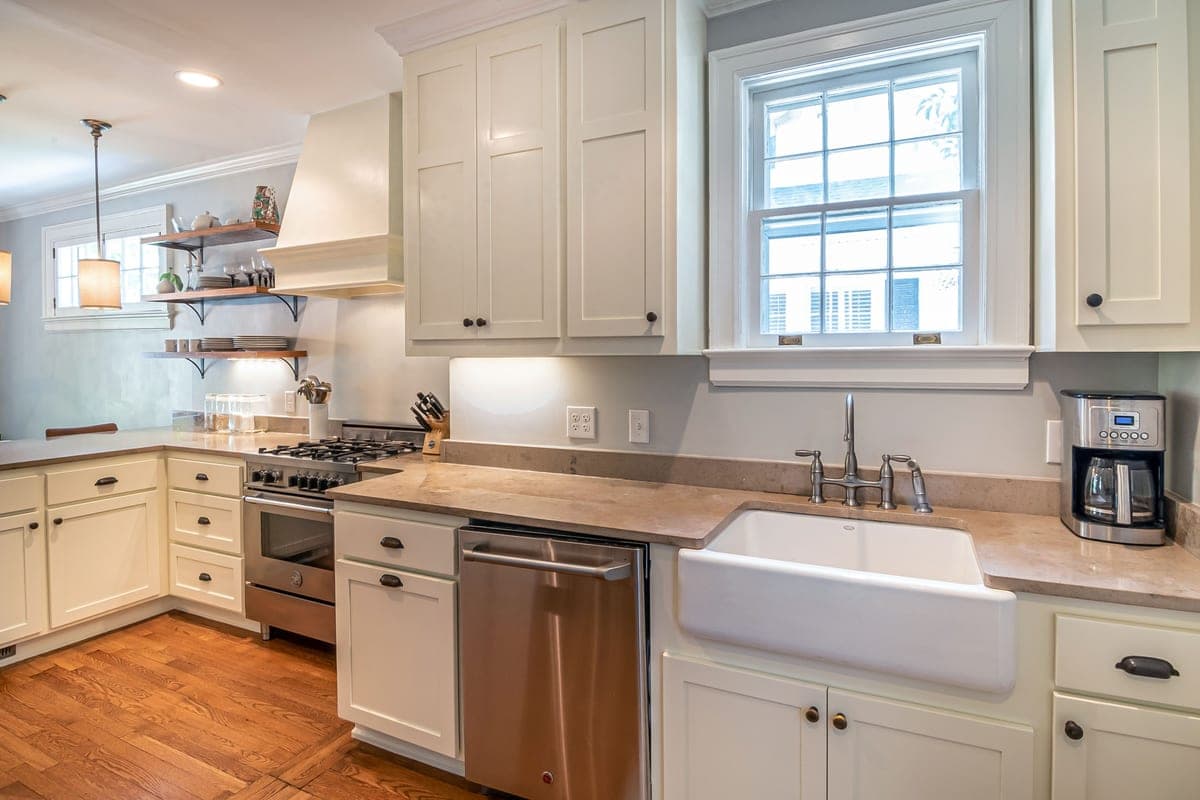
An apron sink moves the bowl forward and raises the front rim. Both change what a faucet has to do, and it is the most common fitment surprise there is.
Disclosure: we earn a commission if you buy through the Amazon links on this page, at no extra cost to you. Commission never decides a verdict or a ranking position — read our editorial policy and affiliate disclosure.
How we assessed these: faucet and sink figures come from manufacturer specifications with source links on every value. We have not installed these combinations; the geometry here is arithmetic from published dimensions, which is why we show the numbers rather than asserting a conclusion.
Short answer
A farmhouse sink sets the bowl forward of a standard sink and raises the front rim above the counter, so the faucet needs more reach to put water over the center of the bowl, and enough spout height to clear the rim comfortably. Aim for 9 inches of reach or more, and measure from the faucet hole to the center of the bowl before buying.
This page exists because the apron-sink and faucet combination is the most common fitment surprise in a kitchen, and no competitor covers both categories well enough to explain the interaction. It is pure geometry and it is easy to get right once you see the numbers.
Quick picks
Tap any row to jump to the full write-up. There are no scores here because we run no test lab — how picks are chosen is published in full on our methodology page.
| # | Product | Best for | Our read | Price |
|---|---|---|---|---|
| 1 | 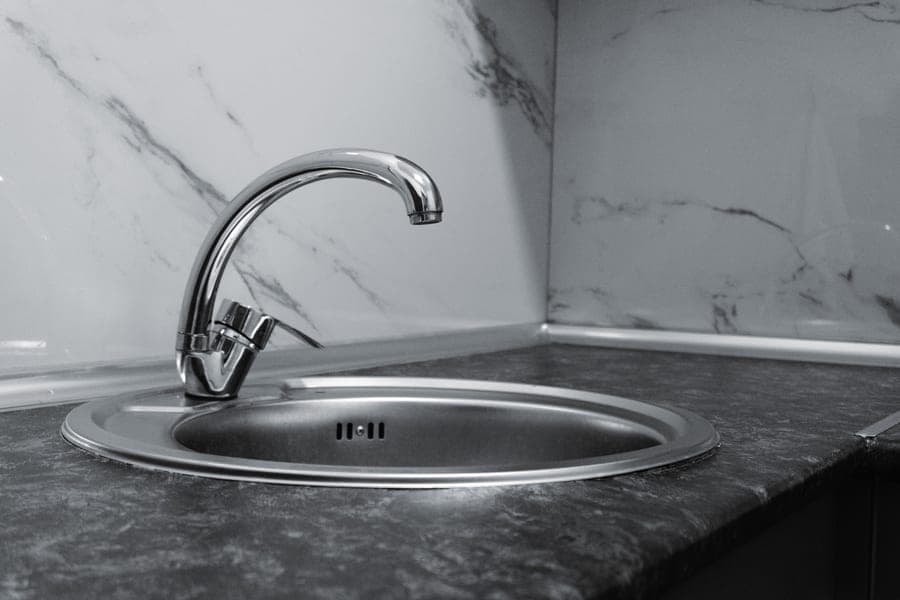 Kohler Simplice K-596 Best overall for an apron sink | Wide bowls and long reach | Nine inches of reach clears a forward-set bowl | Check price on Amazon #ad Affiliate link · We publish no price; Amazon shows the current one |
| 2 |  Delta Leland 9178-AR-DST Best pull-down alternative | Most kitchens, one or three holes | 9-3/16 inch reach, magnetic docking, deck plate included | Check price on Amazon #ad Affiliate link · We publish no price; Amazon shows the current one |
| 3 |  Kohler Artifacts K-76519-4 bridge faucet Best period match | Period kitchens with two deck holes | A true bridge, if your deck is drilled for two holes | Check price on Amazon #ad Affiliate link · We publish no price; Amazon shows the current one |
| 4 | 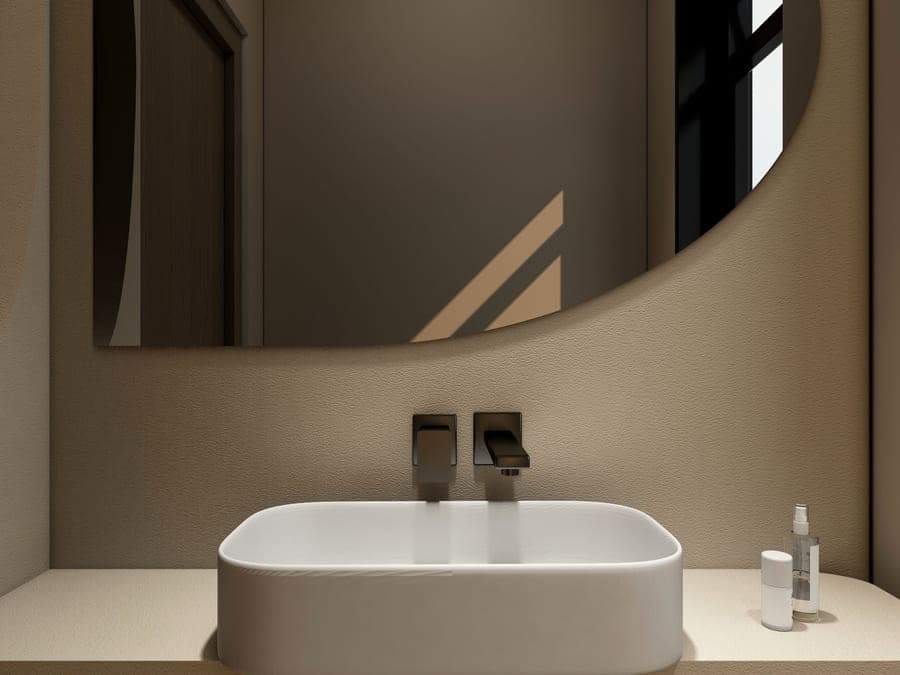 Moen Arbor 7594 Best if pot clearance matters most | Deep pots and hard-water kitchens | Tallest spout here, though the shortest reach | Check price on Amazon #ad Affiliate link · We publish no price; Amazon shows the current one |
What an apron sink changes
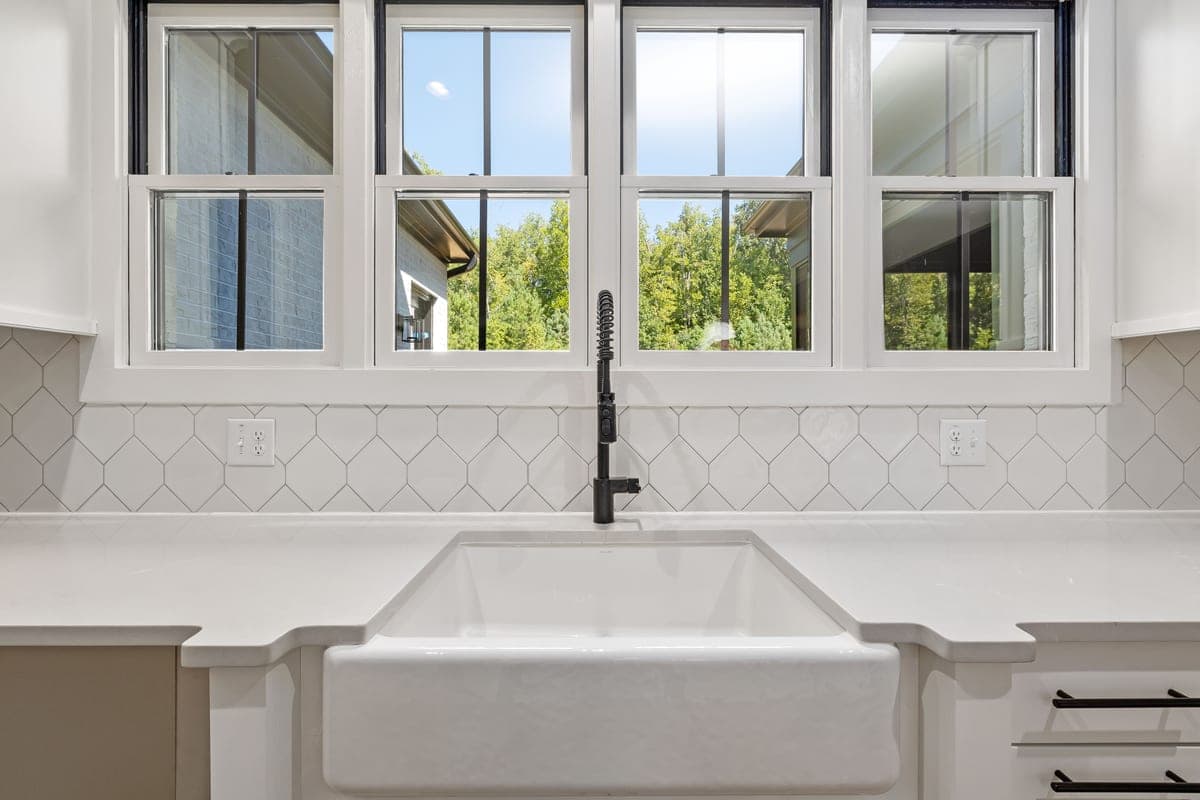
The bowl moves forward. An apron sink's front face replaces the cabinet face, so the whole basin sits further toward you than a standard sink in the same run. The faucet, meanwhile, is mounted in the same place — the counter behind the sink. So the distance from the faucet to the center of the bowl is greater than it would be with a drop-in or undermount sink.
The front rim stands proud. A farmhouse sink's rim rises above the counter surface. That is a design feature and it interacts with low-spout faucets: water from a short spout can land uncomfortably close to the rim, and a low spout sits visually below the sink's own line.
Front-to-back depth is larger. The Kohler Whitehaven K-6489 is 21-9/16 inches front to back, and in a standard 24-inch-deep counter that leaves very little space behind the bowl for the faucet. Check where your faucet holes actually fall relative to the sink's back edge before choosing anything.
The two measurements to take
- Faucet hole to the center of the bowl. On a 30 to 36-inch apron sink this is typically 9 to 11 inches, against 7 to 9 on a standard sink. Buy reach within an inch of it.
- Counter to the top of the front rim, and counter to the underside of anything above. The first tells you the minimum spout height that looks and works right; the second is your maximum overall height, less an inch so a pull-down wand can be lifted out of its dock.
| Faucet | Spout reach | Spout height | Overall height |
|---|---|---|---|
| Kohler Simplice K-596 | 9" | Not published | Not published |
| Delta Leland 9178 | 9-3/16" | 7-7/8" | 14-7/8" |
| Moen Arbor 7594 | 7-7/8" | 8-1/4" | 15-1/2" |
| Kraus Bolden KPF-1610 | 8-3/4" | 6-3/8" | 18" |
Where a manufacturer does not publish a figure, the cell says so. Reach is the number that matters most on an apron sink.
Why reach beats height here
On a standard sink, spout height and reach trade off and either can be the priority. On an apron sink the bowl has moved toward you, so reach becomes the binding constraint: a 7-7/8-inch reach faucet over a forward-set bowl puts the water in the back third of the basin, which is where you are least likely to be washing anything.
That is why the Kohler Simplice at 9 inches and the Delta Leland at 9-3/16 are our first two picks, and why the Moen Arbor — an excellent faucet and our pick for pot clearance elsewhere — is fourth here rather than first. It is the same faucet it always was; the sink changed what matters.
Bridge faucets and apron sinks
Visually this is the natural pairing, and it is the reason bridge faucets still sell. Two practical conditions: the deck has to be drilled for a two-hole widespread installation at the correct spacing, and you accept a fixed spout with a separate side sprayer rather than a pull-down wand. If both are true, a bridge faucet over an apron sink is the best-looking arrangement in kitchen plumbing.
If your deck is drilled single-hole, the decision is made for you — a bridge faucet cannot be adapted down. See bridge kitchen faucets and faucet hole configurations.
Photograph shows the product category, not this specific unit. We do not republish manufacturer product photography.
1. Best overall for an apron sink
Kohler Simplice K-596
Kohler · Best for wide bowls and long reach
The value pick with the longest reach of the three mainstream pull-downs, and the only one whose third spray function is genuinely useful rather than a novelty: Boost raises flow by 30% while you hold it, then drops back to 1.5 gpm. If your sink is wide, this is the one that reaches.
Published specifications
What works
- 9" reach, matching the longest in this roundup
- Boost is a real feature: 30% more flow on demand, then back to 1.5 gpm
- Sweep spray is a blade rather than a cone, which is better at pushing debris toward a drain
- Kohler publishes a full dimensional spec sheet, which makes hole and cabinet planning easy
What does not
- A three-function head has more moving parts than a two-function one, which is more to go wrong
- The gooseneck shape sets the handle further back than some people like on a shallow deck
- No published independent test data on this model, from anyone
Skip it if
Skip it if you want the simplest possible faucet — a two-function wand is one less thing to break.
#ad Affiliate link · We publish no price; Amazon shows the current one
Raw specifications: Kohler’s own page for the Kohler Simplice K-596.
Photograph shows the product category, not this specific unit. We do not republish manufacturer product photography.
2. Best pull-down alternative
Delta Leland 9178-AR-DST
Delta · Best for most kitchens, one or three holes
The pull-down we would fit in most kitchens, because the two parts that usually fail first on a pull-down are the two Delta engineered around: the docking mechanism and the valve. MagnaTite pulls the wand back into the spout with a magnet instead of relying on a friction collar, and Diamond Seal keeps water off the valve. It ships with a deck plate, so it covers a three-hole sink or mounts through one.
Published specifications
What works
- MagnaTite docking is a magnet, not a friction fit — a wand that stops seating is the most common pull-down complaint, and a magnet does not wear the way a plastic collar does
- Spout reach of 9-3/16" clears the far side of a standard 22-inch front-to-back sink
- Diamond Seal keeps water off the valve, which is what the lifetime warranty is really protecting
- Deck plate in the box, so a three-hole sink needs no extra part
What does not
- 1.8 gpm is higher than the 1.5 gpm most competitors now ship, which matters if your area caps flow rate
- Zinc body rather than brass — normal at this price, but this is not a forever faucet
- No independent lab publishes durability figures for this model, so we cannot tell you how the finish looks at year five
Skip it if
Skip it if your sink is a shallow bar sink: at 14-7/8" overall the arc will splash in a basin under about seven inches deep.
#ad Affiliate link · We publish no price; Amazon shows the current one
Raw specifications: Delta’s own page for the Delta Leland 9178-AR-DST.
Photograph shows the product category, not this specific unit. We do not republish manufacturer product photography.
3. Best period match
Kohler Artifacts K-76519-4 bridge faucet
Kohler · Best for period kitchens with two deck holes
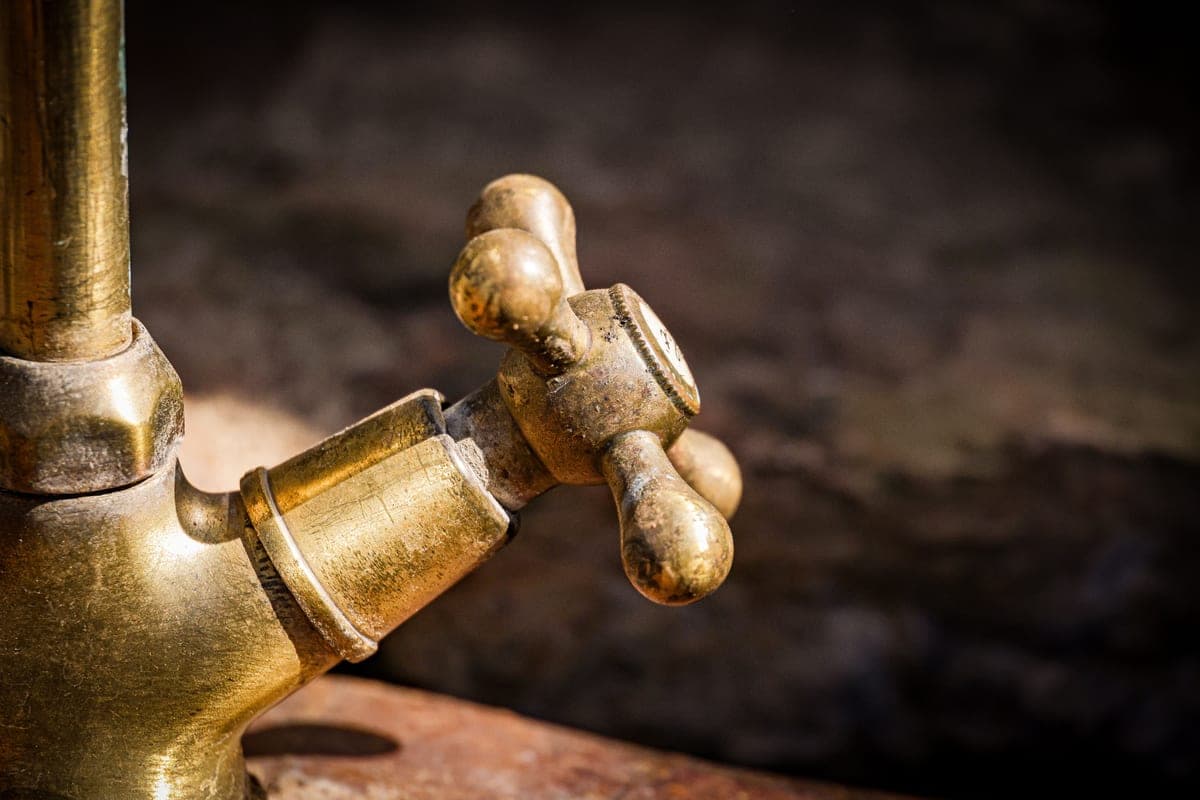
If you want a bridge faucet, buy one from a manufacturer that will still stock parts for it in ten years, because a bridge faucet is a two-valve assembly and the valves are what ages. This is a genuine two-hole bridge with a separate side sprayer, which is how the configuration is meant to work — not a single-hole faucet with a decorative crossbar.
Published specifications
What works
- A true bridge: the horizontal tube is the plumbing, which is the whole point of the style
- Two-hole spacing works on sinks drilled for a widespread set
- Kohler parts availability is the strongest argument for buying a bridge faucet from Kohler
- The side sprayer keeps spray duty off the spout, so the spout stays simple
What does not
- Two valves means two cartridges to replace instead of one
- Bridge faucets are the hardest style to clean around — the crossbar traps splash
- Kohler does not publish a flow rate for every finish of this model, so we do not state one
Skip it if
Skip it if your sink is drilled single-hole, or if you want a pull-down wand — bridge faucets and pull-down wands are mutually exclusive.
#ad Affiliate link · We publish no price; Amazon shows the current one
Raw specifications: Kohler’s own page for the Kohler Artifacts K-76519-4 bridge faucet.
Photograph shows the product category, not this specific unit. We do not republish manufacturer product photography.
4. Best if pot clearance matters most
Moen Arbor 7594
Moen · Best for deep pots and hard-water kitchens
The pull-down to buy if you want the taller arc and a finish that hides water spots. Its 8-1/4" spout height is about half an inch more clearance than the Leland, which is the difference between washing a stock pot and fighting one. The tradeoff is reach: 7-7/8" against 9-3/16", so it works closer to the back of the bowl.
Published specifications
What works
- The 8-1/4" spout height is genuine pot clearance, not decorative arc
- Power Boost concentrates the stream for filling and rinsing without raising the rated flow
- Spot Resist Stainless is the single most useful finish choice in a hard-water house
- Reflex docking has been in Moen's line long enough that replacement wands are easy to find
What does not
- Reach is 7-7/8", over an inch shorter than the Leland — on a wide double bowl you will notice
- Moen publishes no independent noise or durability measurement, and neither do we
- The spot-resist coating is a finish, not armor; abrasive cleaners still dull it
Skip it if
Skip it if you have a wide double-bowl sink and want one faucet to reach both drains comfortably — buy reach instead of height.
#ad Affiliate link · We publish no price; Amazon shows the current one
Raw specifications: Moen’s own page for the Moen Arbor 7594.
Pot fillers, briefly
A wall-mounted pot filler above a farmhouse sink solves the clearance question by ignoring it: it folds flat against the wall when not in use and swings out over the bowl when needed. It is a second fixture rather than an alternative to the main faucet, it needs a cold-water supply run inside the wall, and it is properly a remodel decision rather than a sink accessory. Worth knowing it exists; not worth planning a kitchen around.
Putting it together
- Stainless or composite apron sink, single-hole deck: the Kohler Simplice or the Delta Leland. Buy the reach.
- Fireclay or cast iron apron sink, two-hole deck, period kitchen: the Kohler Artifacts bridge, with its side sprayer.
- Deep apron sink, tall cookware, generous clearance above: the Moen Arbor, accepting the shorter reach.
- No upper cabinet above the sink: a commercial-style faucet becomes viable, and looks superb over an apron sink — see commercial style faucets.
What to take away
- An apron sink moves the bowl forward, so reach is the binding constraint rather than height.
- Measure faucet hole to bowl center — typically 9 to 11 inches on an apron sink — and buy reach to match.
- Check front-to-back depth against your counter, or the faucet will have nowhere to mount.
- A bridge faucet needs a two-hole deck and rules out a pull-down wand. Both, not either.
How we sourced this page
Every figure on this page came from one of the following. Where a manufacturer or an independent lab does not publish a number, we say so rather than estimate it.
- Kohler Simplice K-596 specification sheet (PDF)
- Delta Leland 9178-AR-DST product page (published specifications)
- Moen Arbor 7594 product page (published specifications)
- Kraus Bolden KPF-1610 product page (published specifications)
- Kohler Artifacts two-hole bridge kitchen sink faucet K-76519-4 product page
- Kohler Whitehaven apron-front sink range (published specifications)
- BOCCHI Classico 30-inch fireclay farmhouse sink — manufacturer listing
Common questions
- What faucet style is best for a farmhouse sink?
- A high-arc pull-down with 9 inches or more of spout reach, because an apron sink sets the bowl forward and a short-reach faucet lands water at the back of the basin. A bridge faucet is the best period match if your deck is drilled for two holes and you can live without a pull-down wand.
- Do farmhouse sinks need a special faucet?
- Not a special type, but a longer reach than a standard sink needs — the bowl sits forward and the front rim stands proud of the counter. Measure from the faucet hole to the center of the bowl and buy reach within an inch of that figure.
- Is a bridge faucet good for a farmhouse sink?
- Visually it is the natural pairing, and functionally it works provided your deck is drilled for a two-hole widespread installation and you accept a fixed spout with a separate side sprayer. A single-hole deck cannot take a bridge faucet at all.
- How much spout reach do I need for a farmhouse sink?
- Usually 9 inches or more. On a 30 to 36-inch apron sink the distance from the faucet hole to the center of the bowl is typically 9 to 11 inches, against 7 to 9 on a standard sink, because the basin sits further forward.
More in Guides
Organized by task, not by date, because a faucet install guide does not go stale and should not get buried under a blog feed. Every guide includes the honest point at which to call a plumber.
Read next
Best farmhouse sink
Farmhouse sinks
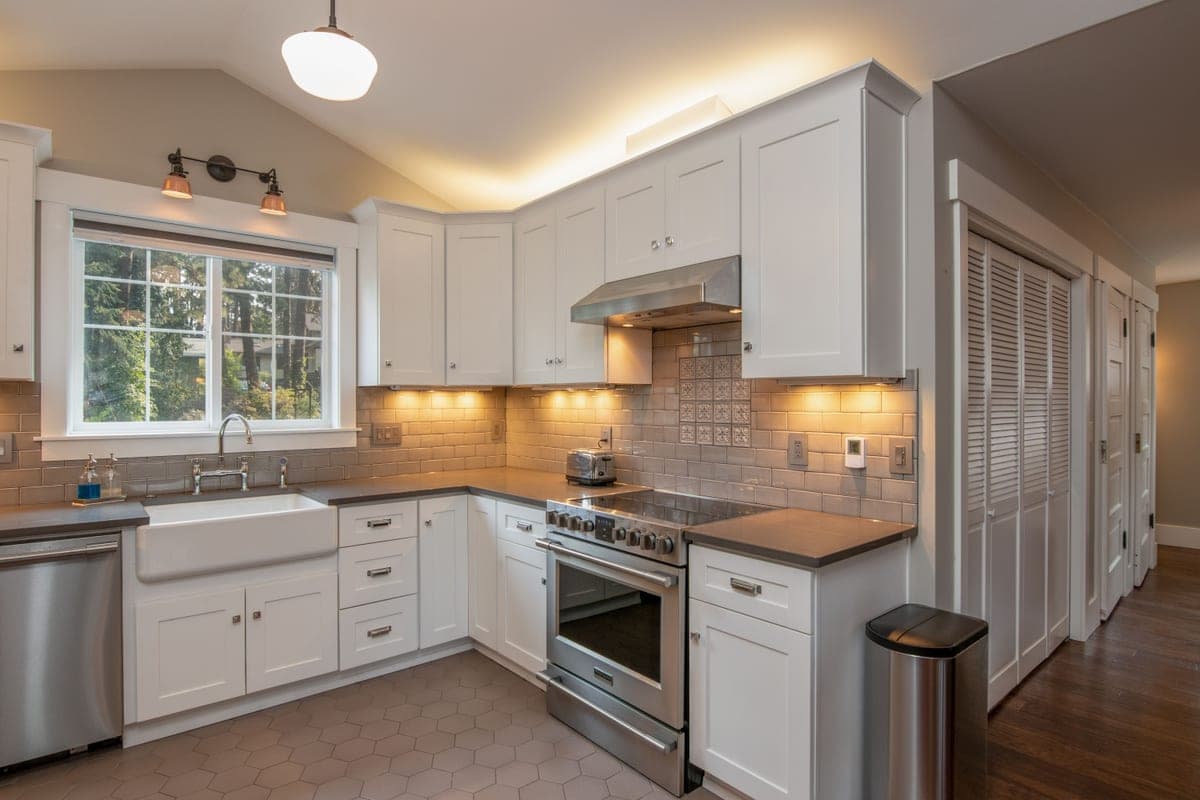
Apron-front dimensions, the cabinet modification involved, and why self-trimming is the detail that decides the difficulty.
Best bridge faucet
Bridge faucets
How a bridge faucet is plumbed, why it needs two deck holes, and what two valves mean for maintenance in ten years.

Guide
Height and reach guide
Spout height, reach and overall height are three different numbers. Here is which one decides what, and how to measure yours.
Guide
Fireclay sinks
How fireclay is made, what the glaze does, whether it chips, and how it stacks up against cast iron and stainless.
Best kitchen faucet
Best kitchen faucets
Five faucets covering the different jobs a kitchen faucet does, ranked on sourced specifications rather than brand.
Guide
Disposal sizing and fit
A height chart for common units, the two measurements to take first, and what thin or deep sinks change.
Found something out of date, or a figure you can source better than we did? Tell us — corrections get read first. Our methodology explains how picks are made, and contact is one click away.