Guides
How to fix kitchen sink scratches
Stainless can be blended. Composite can be improved. Ceramic and enamel cannot be repaired, and knowing which you have saves making things worse.

Disclosure: we earn a commission if you buy through the Amazon links on this page, at no extra cost to you. Commission never decides a verdict or a ranking position — read our editorial policy and affiliate disclosure.
Short answer
On brushed stainless, light scratches can be blended along the grain with a fine non-woven abrasive pad matched to the finish. On composite, a mild abrasive cream improves the appearance because the color runs through the material. On fireclay, enamel and ceramic, scratches and chips cannot be repaired — only touched up cosmetically.
The first question is not how to repair a scratch but whether your sink's surface can be worked at all. Getting that wrong turns a scratch into a permanently visible patch.
Brushed stainless steel: blending, not removing
A brushed finish is a directional pattern of fine abrasions. A scratch is simply a deeper abrasion going the wrong way, so the repair is to re-establish the pattern around it until the scratch is no longer distinguishable from the finish. You are not removing metal from the scratch; you are matching the surface to it.
Blending a scratch in brushed stainless
Clean and dry the area completely
Grit under a pad will cut new scratches in the wrong direction.
Test in an inconspicuous spot first
Inside the bowl near the back corner, or under the rim. Confirm the pad matches your finish before touching a visible area.
Work along the grain only, with light even pressure
Straight strokes following the existing lines, past the ends of the scratch so the blend has no boundary.
Widen the blended area gradually
Feather outward rather than concentrating on the scratch. A polished patch is more visible than the scratch was.
Clean, dry and assess in raking light
Look along the surface, not at it. If it still shows, repeat lightly rather than pressing harder.
Granite and quartz composite: improve, do not sand
Composite's advantage is that color runs through the material, so a scratch exposes more of the same color rather than a different substrate. What shows is usually a white or pale scuff — often material transferred from a pan rather than a cut in the sink at all.
Try a mild abrasive cream cleaner on a damp cloth first, because that removes transferred metal and frequently makes the mark disappear entirely. If a genuine scratch remains, manufacturers generally recommend their own care products; do not use sandpaper or a power tool on a composite basin, because the surface texture is part of the finish and cannot be re-created.
Fireclay, enamel and ceramic: cosmetic only
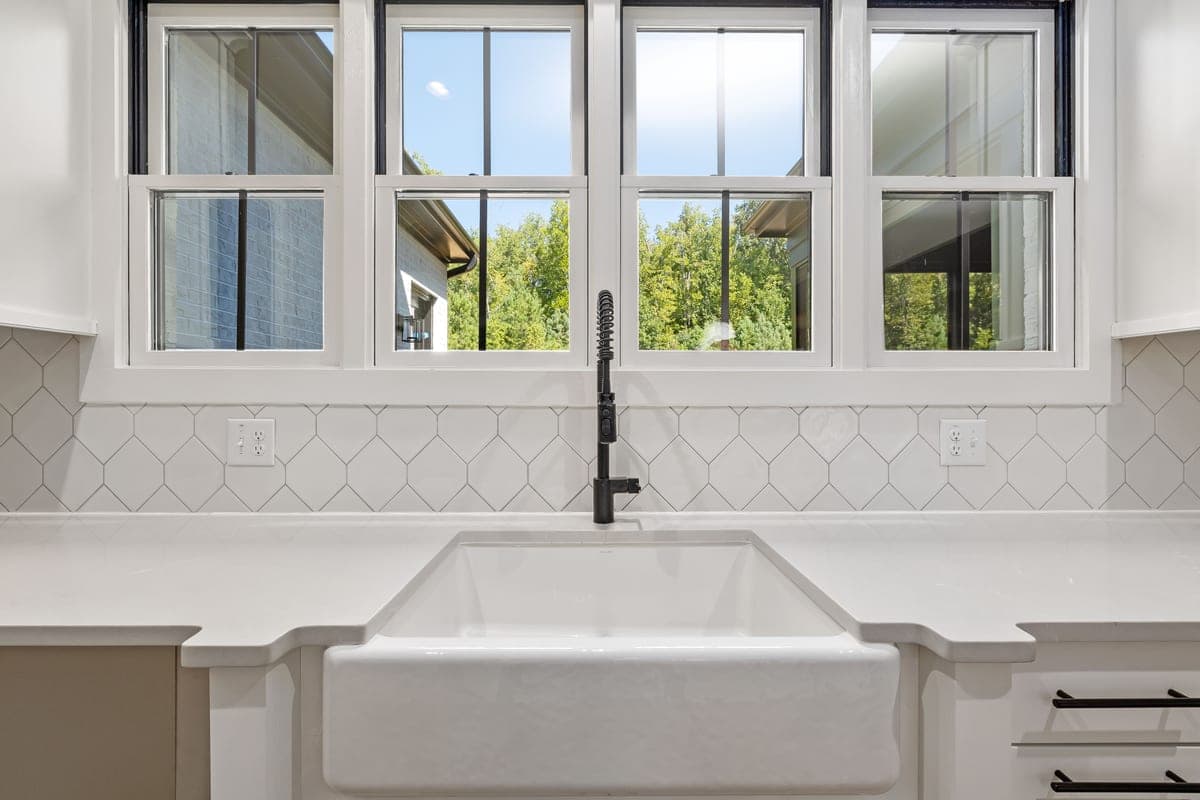
These surfaces are glass. A scratch in the glaze cannot be polished out, and a chip that removes glaze cannot be repaired — only filled. Touch-up kits exist, they are a color match at best, and they are visible in raking light. The honest position is that a chip in a ceramic sink is permanent, and the useful response is prevention.
That is why a bottom grid matters so much on these materials, and why BOCCHI includes a stainless grid with the Classico. Fit it and leave it in.
Black and dark sinks: a special case
Dark composite and matte black sinks show scuffs more than dark stainless does, and most of what looks like a scratch is a metal transfer mark from a pan. A mild abrasive cream removes those. What dark surfaces also show is a dull film from soap residue and hard-water minerals, which is not a scratch at all and responds to a proper clean and a dry. Attacking that with an abrasive pad creates real damage in pursuit of a problem that was not there.
Quick picks
Tap any row to jump to the full write-up. There are no scores here because we run no test lab — how picks are chosen is published in full on our methodology page.
| # | Product | Best for | Our read | Price |
|---|---|---|---|---|
| 1 | 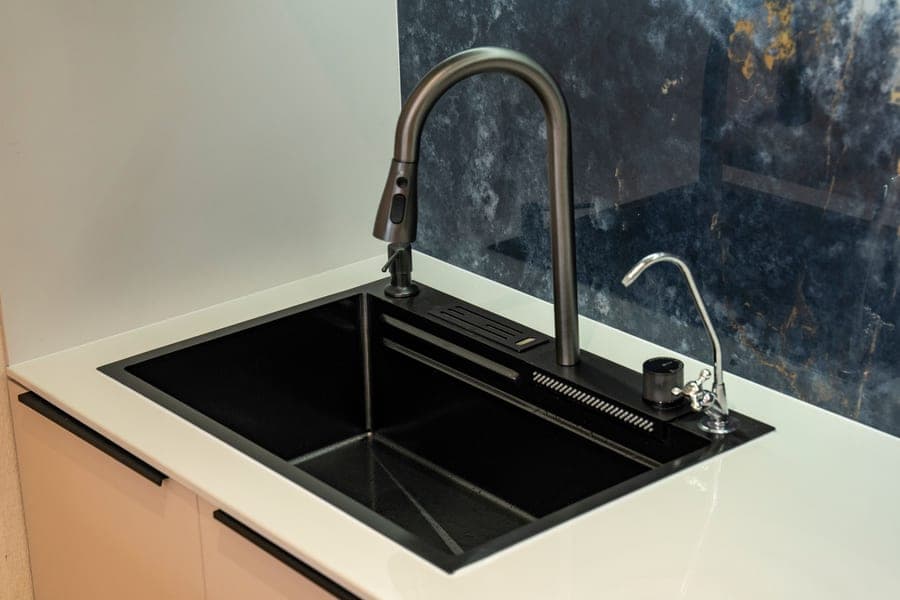 Kraus Kore KWU110-30 workstation sink Prevention, properly | Small kitchens that need counter space | Bottom grid included; keeps cookware off the base | Check price on Amazon #ad Affiliate link · We publish no price; Amazon shows the current one |
| 2 |  Blanco Diamond Silgranit super single The material that hides scratches | Hard water and visible sinks | Color runs through, so a scratch shows the same material | Check price on Amazon #ad Affiliate link · We publish no price; Amazon shows the current one |
Prevention, which is most of the answer
- Use a bottom grid. It keeps cookware off the base, which is where nearly all scratches occur.
- Do not use the basin as a chopping surface. Obvious, and it still happens.
- Do not drag cast iron across it. Lift rather than slide.
- Never use steel wool or a scouring pad. On stainless it leaves iron particles that rust; on every other material it dulls the surface.
- Choose the material for your household. If pans get dropped, stainless dents where ceramic chips — see sink materials.
Photograph shows the product category, not this specific unit. We do not republish manufacturer product photography.
1. Prevention, properly
Kraus Kore KWU110-30 workstation sink
Kraus · Best for small kitchens that need counter space
The workstation sink we would buy, and the clearest case for 16-gauge steel anywhere in this category: a ledge sink is the one configuration where basin flex is genuinely audible, because accessories rest on the rim and transmit it. Ten inches deep, rear-offset drain, and the grid, mat, board and strainer are in the box rather than a $200 upsell.
Published specifications
- Overall size
- 30" x 19" source
- Bowl size
- 28" x 16" source
- Bowl depth
- 10" source
- Gauge
- 16-gauge stainless steel source
- Minimum cabinet
- 33" left to right, 24" front to back source
- Drain
- Rear offset, 3-1/2" opening source
- Sound damping
- NoiseDefend pads covering over 80% of the basin, plus undercoating source
- Warranty
- Kraus limited lifetime source
What works
- The integrated ledge turns a 30-inch sink into prep counter, the best single trade available in a small kitchen
- Rear-offset drain leaves usable cabinet space under the front of the sink
- Genuine 16-gauge with pads over 80% of the basin — gauge and damping do different jobs, and this sink has both
- A 3-1/2" drain opening takes a standard disposal flange with no adapter
What does not
- Needs a 33-inch cabinet for a 30-inch sink — measure before ordering
- A 10-inch deep bowl is a long reach for a shorter person
- The accessories are the reason to buy it and also the reason it costs more than a plain undermount
Skip it if
Skip it if your run of counter is already generous — you would be paying for prep space you do not need, and a plain 18-gauge undermount will serve.
#ad Affiliate link · We publish no price; Amazon shows the current one
Raw specifications: Kraus’s own page for the Kraus Kore KWU110-30 workstation sink.
Photograph shows the product category, not this specific unit. We do not republish manufacturer product photography.
2. The material that hides scratches
Blanco Diamond Silgranit super single
Blanco · Best for hard water and visible sinks
The granite composite sink that answers the material's usual objection. Silgranit is up to 80% ground granite in an acrylic binder, and what it does better than stainless is hide everything: no water spots, no visible scratch pattern, no dent from a dropped pan. What it does worse is take a screaming-hot pan straight off the burner.
Published specifications
What works
- Hides limescale and water spotting better than any stainless finish — the reason to choose it in hard water
- Color runs through the material, so a scratch does not expose a different substrate
- Quieter than stainless without added pads, because the mass does the damping
- A 9-1/2" bowl is deep enough to lay a sheet pan flat
What does not
- Composite is not stainless: thermal shock is a real limit, so a very hot pan goes on a trivet
- Light colors show tea and turmeric staining more than dark ones
- Blanco publishes no thermal-limit figure, so we will not print one
Skip it if
Skip it if you routinely dump hot pans and boiling stock straight into the sink. Stainless tolerates that; composite is the wrong tool for it.
#ad Affiliate link · We publish no price; Amazon shows the current one
What to take away
- Identify the material first. Stainless blends, composite improves, ceramic and enamel cannot be repaired.
- On stainless, work along the grain only and feather outward. Cross-grain marks are permanent.
- Most marks on dark composite are transferred metal, not scratches — a mild cream cleaner removes them.
- A bottom grid prevents more damage than any repair technique fixes.
How we sourced this page
Every figure on this page came from one of the following. Where a manufacturer or an independent lab does not publish a number, we say so rather than estimate it.
Common questions
- Can scratches be removed from a stainless steel sink?
- Light scratches can be blended, not removed: you re-establish the brushed pattern around the scratch with a fine non-woven pad, working along the grain, until it no longer stands out. Deep cross-grain scratches cannot be blended away, and coarse abrasives make things worse.
- How do you fix scratches on a black kitchen sink?
- Start with a mild abrasive cream cleaner on a damp cloth, because most marks on dark sinks are metal transferred from cookware rather than scratches in the surface. If a genuine scratch remains, use the manufacturer's recommended care product — never sandpaper or a power tool on composite.
- Can you repair a scratch in a ceramic or fireclay sink?
- Not properly. The glaze is a glass layer and a scratch or chip in it cannot be polished out; touch-up kits are a color match at best and remain visible in raking light. Prevention with a bottom grid is the real answer for these materials.
- What causes most kitchen sink scratches?
- Cookware moving on the basin base — dragging a pan, dropping a lid, standing cast iron in the sink. That is why a bottom grid is the single most effective preventive measure, and why better sinks include one in the box.
More in Guides
Organized by task, not by date, because a faucet install guide does not go stale and should not get buried under a blog feed. Every guide includes the honest point at which to call a plumber.
Read next
How to
Clean a stainless steel sink
The weekly method, what causes brown marks, and the products that permanently damage a brushed finish.
Guide
Sink materials compared
Five materials compared on heat, impact, noise and repairability, with the honest failure mode of each one.
Head to head
Granite composite vs stainless
Two materials that fail in opposite ways: heat tolerance against appearance. Plus what quartz composite actually is.
Guide
Fireclay sinks
How fireclay is made, what the glaze does, whether it chips, and how it stacks up against cast iron and stainless.
Head to head
16 gauge vs 18 gauge
16 gauge is 25% thicker steel. What that buys, what it does not buy, and why sound-deadening coverage is the spec nobody advertises.
Found something out of date, or a figure you can source better than we did? Tell us — corrections get read first. Our methodology explains how picks are made, and contact is one click away.