Kitchen Faucets
The best kitchen faucet material
Solid brass, 304 stainless or plated zinc alloy decides how long a faucet body lasts. The catch is that most manufacturers will not tell you which one you are buying.
Disclosure: we earn a commission if you buy through the Amazon links on this page, at no extra cost to you. Commission never decides a verdict or a ranking position — read our editorial policy and affiliate disclosure.
How we assessed these: we read each manufacturer's own published product page for the named model numbers on 2026-10-19 and report only what it states about body material, waterway and lead compliance. Where a maker publishes no body material, this page says so rather than inferring one from price or brand. We have not sectioned any faucet, no independent laboratory publishes comparable corrosion or durability data for kitchen faucet bodies, and no such figure appears here.
Short answer
Solid brass is the best kitchen faucet body material, with 304 stainless steel a close and often cheaper second; plated zinc alloy is the budget default and the one with the shortest realistic life. The practical problem is that most manufacturers do not publish which they used, so the buyable version of this question is: which faucets state a material, and what do you do about the ones that do not?
There are three materials in a kitchen faucet body, and they are not interchangeable. Brass is a copper-zinc alloy, machinable, corrosion-resistant and heavy. Austenitic 304 stainless steel is corrosion-resistant without plating, which is why it can be left raw rather than finished. Zinc alloy — usually a die-cast ZAMAK type — is cheap to mold into complex shapes and relies entirely on its plating to keep water away from the metal.
Quick picks
Tap any row to jump to the full write-up. There are no scores here because we run no test lab — how picks are chosen is published in full on our methodology page.
| # | Product | Best for | Our read | Price |
|---|---|---|---|---|
| 1 | 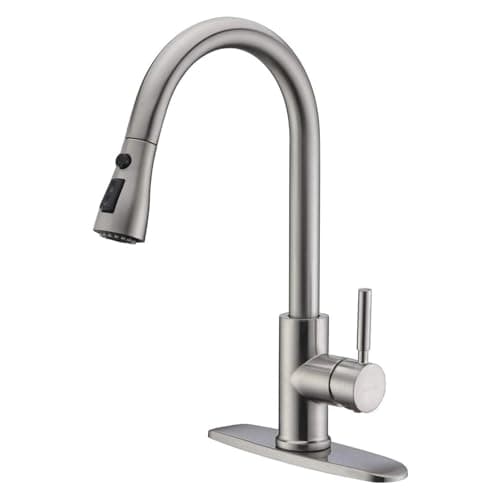 WEWE A1001L Best published material | Rentals and tight budgets | 304 stainless body, stated on the maker's own page, at the bottom of the market | |
| 2 | 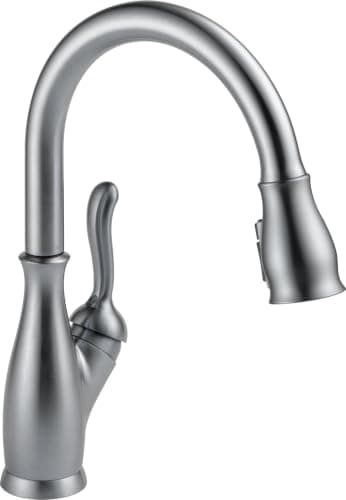 Delta Leland 9178-AR-DST Best lead-safety documentation | Most kitchens, one or three holes | NSF/ANSI 61 and 372, plus lined waterways - body material not published | |
| 3 | 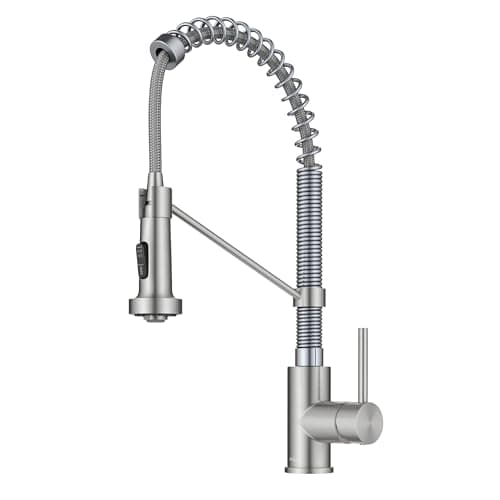 Kraus Bolden KPF-1610 Most honest vague answer | Commercial look under a cabinet | "Heavy-duty metal body" and a ceramic cartridge, published as such | $199.95 · View on Amazon #ad Affiliate link · Price as of October 19, 2026 |
| 4 | 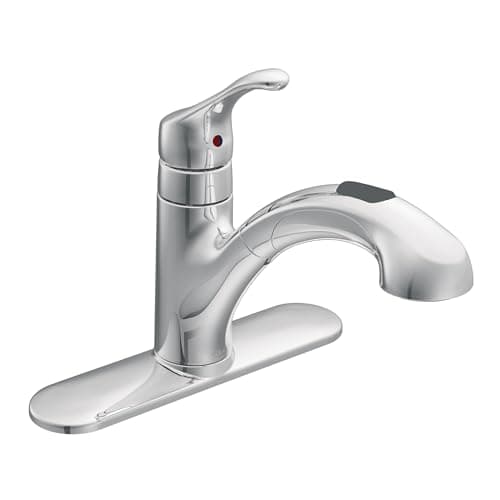 Moen Renzo CA87316C Best parts channel instead | Low window sills and tight clearance | No body material published; Moen's parts availability is the hedge | $113.99 · View on Amazon #ad Affiliate link · Price as of October 19, 2026 |
What each material actually does
Solid brass
Brass is the traditional answer and still the best one. It resists dezincification and pitting in potable water far better than zinc alloy, it threads and machines cleanly so joints seal properly, and because it is corrosion-resistant in its own right the finish on top is cosmetic rather than structural. When a brass faucet's plating finally wears, you get a brass-colored patch; when a zinc faucet's plating wears, you get corrosion.
The cost is weight and money. A solid-brass body is the single biggest contributor to a faucet's price at the top of the market, which is exactly why the brands that use it tend to say so, and the brands that do not tend to say nothing.
304 stainless steel
Stainless is the modern alternative and, in a kitchen, an excellent one. 304 — the 18/8 chromium-nickel grade — needs no plating to resist corrosion, so a stainless faucet can be finished by brushing the metal itself. That removes the single most common cosmetic failure in faucets, which is plating lifting or flaking at a high-wear edge. It is also lighter than brass, which makes a one-person installation easier.
Its weaknesses are manufacturing ones rather than ownership ones: stainless is harder to cast into intricate shapes than zinc and harder to machine than brass, so stainless faucets tend to have simpler geometry. If you want a heavily sculpted spout or a period bridge faucet, you will not find it in stainless.
Plated zinc alloy
Zinc alloy is not a scandal and it is not a defect. It is the normal material for a mid-market faucet body, it molds into complex shapes cheaply, and a well-plated zinc faucet with a brass or polymer waterway inside gives years of ordinary service. What it does not do is forgive a plating failure. Once water reaches the zinc at a worn edge or a nicked thread, corrosion starts and it does not stop, and no finish repair fixes it.
Many mid-market faucets manage this by lining the waterway — running the water through a brass or polymer tube inside the zinc shell so the structural metal never touches it. That is a real engineering answer, and when a manufacturer describes lined waterways, this is what they mean.
| Material | Corrosion resistance | Depends on plating | Weight | Typical market position |
|---|---|---|---|---|
| Solid brass | High in potable water | No - plating is cosmetic | Heaviest | Upper mid-market and above |
| 304 stainless steel | High without plating | No - can be finished raw | Lighter than brass | Spans budget to upper mid |
| Plated zinc alloy (ZAMAK) | Low once plating is breached | Yes - entirely | Light | Budget to mid-market default |
This table describes the materials, not any specific faucet. No independent laboratory publishes comparable corrosion or service-life data for kitchen faucet bodies, so there is no measured ranking to give - the properties above are general metallurgy, and the per-model section below sticks to what each maker publishes.
The real finding: most makers do not publish it
We read the manufacturer's own product page for every faucet in this site's registry. Here is what they say about body material, verbatim in substance:
- WEWE publishes "304 stainless steel" as the body material for the A1001L. That is a specific, checkable claim at the bottom of the market.
- Kraus publishes a "heavy-duty metal body" for the KPF-1610, and separately notes that the spray head uses both metal and plastic components. Vague, but honestly vague - and the plastic disclosure is more than most give.
- Delta publishes NSF/ANSI 61 and 372 certification and lined waterways for the Leland 9178, and does not state what the body is made of.
- Moen publishes no body material for the Renzo CA87316C.
That is the honest state of the market, and it is why this page is laid out the way it is rather than as a ranked list of materials you can go and buy. The material is the specification that most determines how long a faucet body lasts, and it is the specification most consistently withheld. Anyone telling you a specific mid-market faucet is "solid brass" without quoting the maker is guessing.
What "lead free" means, and why it is not a material claim
Brass contains zinc, and historically some plumbing brass contained lead as a machining aid. US federal law now caps that. Under section 1417 of the Safe Drinking Water Act, as amended by the Reduction of Lead in Drinking Water Act of 2011, "lead free" means a weighted average of 0.25% lead across the wetted surfaces of a pipe, fitting or fixture, and 0.2% for solder and flux. The previous threshold was 8%.
So when a faucet is described as lead free, or certified to NSF/ANSI 61 and 372, or compliant with California AB 1953, that is a statement about what is in contact with your water — not about whether the body is brass, stainless or zinc. Every faucet sold legally for potable water in the US meets it. It is a floor, not a differentiator, and it tells you nothing about service life.
The part that fails is not the body anyway
This is the uncomfortable counterweight to everything above. In normal domestic use the faucet body outlives the parts bolted into it. What fails, in rough order: the valve cartridge, the pull-down hose or its docking magnet, the aerator, the sprayer head's internal diverter, and the supply connections. The body is usually the last thing standing.
Which means a published body material is worth real money only if you can also get the wear parts. A solid brass body with a discontinued cartridge is a boat anchor; a zinc body from a brand that still stocks a $12 cartridge in year ten is a faucet. Faucet cartridges explained covers the valve type that matters — ceramic disc — and how long do kitchen faucets last sets out which part gives way first.
That is also why Moen appears on this page at all. Moen publishes nothing about the Renzo's body material, and Moen's parts channel is the strongest argument for buying Moen at any price. The two facts sit together honestly: an unpublished body plus a cartridge you can still order is a better ten-year bet than a published body plus a dead parts line.
Material against finish, which is a different question
Body material and finish get conflated constantly, including in search results for this query. The body is the structural metal underneath. The finish is what sits on top of it — chrome plating, a PVD coating, a brushed-nickel layer, a powder-coated black. A stainless faucet may be finished in its own brushed metal; a zinc faucet is always wearing something.
The finish decides what the faucet looks like after five years of hands and water spots; the body decides whether there is a faucet there at all. Both matter, separately. Kitchen faucet finishes covers the finish side in full, which finish hides water spots answers the hard-water version of the question, and brushed nickel vs chrome is the specific comparison most people are actually weighing.
Hard water changes the ranking slightly
Autocomplete pairs this query with hard water, and reasonably so. Scale does not attack the body material — it attacks the aerator, the sprayer face and the valve seat. So in a hard-water kitchen the body material drops in importance and three other things rise: a ceramic disc cartridge, a rubber-nub sprayer face you can rub clean, and an aerator you can unscrew.
In other words, do not pay a premium for brass to solve a scale problem. The best kitchen faucet for hard water picks on the specifications that actually address it, and the best kitchen sinks for hard water is the matching sink page, since a composite sink does more for spotting than any faucet can.
How to buy around an unpublished material
- Look for a published body material first. If a maker states 304 stainless or solid brass, that is checkable and it is worth something.
- If none is published, buy the parts channel. A brand that stocks cartridges for discontinued models is the next best protection against a short life.
- Check the waterway, not just the shell. Lined waterways, where published, mean the structural metal is not in contact with your water.
- Insist on a ceramic disc cartridge. It is the part that fails, and it is the one spec at the bottom of the market worth refusing to compromise on.
- Treat lead-free certification as a floor. Everything legal meets it; it is not evidence of a better body.
- Ignore weight-in-the-hand as proof. It is a clue, and a weak one.
If the whole decision still feels unresolved, that is because this specification genuinely is. How to choose a kitchen faucet runs the six decisions in the order that stops you falling for something that will not fit, and kitchen faucet brands ranks makers on warranty terms and parts availability — which, on the evidence of this page, is the specification that is actually available to compare.
What to take away
- Solid brass is the best body material, 304 stainless a close and often cheaper second, plated zinc alloy the budget default.
- Most manufacturers do not publish a body material at all - of the four faucets here, one states 304 stainless, one says "heavy-duty metal", and two say nothing.
- "Lead free" means a 0.25% weighted average across wetted surfaces under federal law. Every legal faucet meets it; it is a floor, not a differentiator.
- The body usually outlives the cartridge, hose and aerator, so parts availability beats material when you cannot have both.
- Zinc's weakness is dependence on plating - once water reaches the metal at a worn edge, corrosion does not stop.
- In hard water, the body material barely matters. The cartridge, the aerator and the sprayer face do.
How we sourced this page
Every figure on this page came from one of the following. Where a manufacturer or an independent lab does not publish a number, we say so rather than estimate it.
- WEWE A1001L kitchen faucet — manufacturer product listing
- Delta Leland 9178-AR-DST product page (published specifications)
- Kraus Bolden KPF-1610 product page (published specifications)
- Moen Renzo CA87316C low-arc pullout kitchen faucet product page
- US EPA — use of lead-free pipes, fittings, fixtures, solder and flux for drinking water (Safe Drinking Water Act section 1417)
Common questions
- What is the best material for a kitchen faucet?
- Solid brass, with 304 stainless steel a close second that is often cheaper. Both resist corrosion without relying on their plating. Plated zinc alloy is the budget and mid-market default and works well until the plating is breached, after which corrosion is not repairable.
- Is stainless steel or brass better for a kitchen faucet?
- For an owner, they are close. Brass machines and seals better and takes any finish; 304 stainless resists corrosion without plating, so it can be finished raw and cannot suffer a plating failure. Brass allows more sculpted shapes. Either is a better body than plated zinc.
- Are zinc alloy faucets bad?
- No - they are the normal mid-market body and give years of ordinary service, especially where the waterway is lined so water never touches the zinc. The risk is specific: once the plating is breached at a worn edge or nicked thread, corrosion starts and no finish repair stops it.
- Why do manufacturers not list the faucet body material?
- They are not required to, and for a zinc body it is not a selling point. Of the four faucets on this page, only WEWE publishes a specific body material; Kraus publishes "heavy-duty metal body"; Delta and Moen publish none for the models we read. Anyone claiming otherwise without quoting the maker is guessing.
- Does lead free mean the faucet is brass?
- No. Under section 1417 of the Safe Drinking Water Act, lead free means a weighted average of 0.25% lead across wetted surfaces, and every faucet legally sold for drinking water in the US meets it. It describes what touches your water, not what the body is made of.
- What is the best kitchen faucet material for hard water?
- The body material is close to irrelevant for scale. What matters is a ceramic disc cartridge, a rubber-nub sprayer face you can rub clean and an aerator that unscrews. Spend there rather than paying a premium for brass to solve a water-chemistry problem.
More in Kitchen Faucets
Nine times out of ten the faucet that fails you is the one that did not fit — wrong hole count, wrong reach, wrong finish for your water. Start with the measurements and the rest gets easy.
Read next
Guide
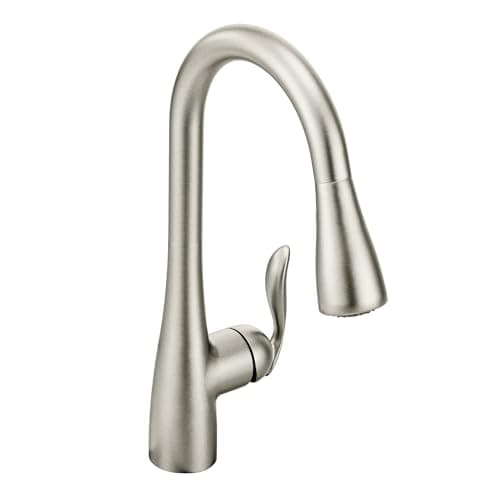
Faucet finishes
Every mainstream finish compared on what it hides, what it shows, and whether it is a plating, a PVD coating or living metal.
Guide
Faucet cartridges explained
The four valve types, how to identify yours without guessing, and what a replacement cartridge really costs.
Guide
Kitchen faucet brands
Brands ranked on warranty terms and parts availability for discontinued models — the specs that decide repairability.
Guide
How long do faucets last?
What wears out on a kitchen faucet and in what order — and why parts availability decides the real lifespan, not build quality.
Best for hard water
Best for hard water
Hard water spots the finish and scales the aerator. These picks address both, and the cheapest fix is a part you can already replace.
Guide
How to choose a faucet
The six decisions a kitchen faucet needs, in the order that stops you falling in love with something that will not fit your sink.
Found something out of date, or a figure you can source better than we did? Tell us — corrections get read first. Our methodology explains how picks are made, and contact is one click away.