Guides
How many gallons does a kitchen sink hold?
There is no published figure for this, because makers publish dimensions instead. Three numbers and one division get you the answer for any sink.

Disclosure: we earn a commission if you buy through the Amazon links on this page, at no extra cost to you. Commission never decides a verdict or a ranking position — read our editorial policy and affiliate disclosure.
How we assessed these: the capacities on this page are arithmetic on each manufacturer's own published bowl dimensions, using the exact definition of a US liquid gallon as 231 cubic inches. The method is shown so you can check it. No manufacturer publishes a capacity figure for any of these sinks, so none is quoted as though it were a specification, and every figure here is a brim-full rectangular maximum rather than a measured volume.
Short answer
A standard 33-inch single-bowl kitchen sink holds roughly 24 US gallons filled to the brim — the Kraus KHT300-33's published 31 by 18 by 10 inch bowl works out at 24.2. A shallower 7-1/2 inch bowl of the same footprint holds about 14.4. In practice you never get the brim-full figure, because the drain opening and the slope take some of it.
No sink manufacturer we know of publishes a capacity in gallons. They publish bowl dimensions, which is more useful anyway, because it lets you work out the answer for whatever sink you are looking at. The arithmetic is one multiplication and one division.
The method
A US liquid gallon is defined as exactly 231 cubic inches. So:
- Multiply the bowl's three published dimensions — length by width by depth, all in inches. That gives cubic inches.
- Divide by 231. That gives US gallons.
- Use the bowl dimensions, not the overall size. Overall size includes the rim, which holds nothing. Every maker publishes both, and the gap is often two inches in each direction.
Worked example, using Kraus's published figures for the KHT300-33: 31 × 18 × 10 = 5,580 cubic inches. 5,580 ÷ 231 = 24.2 gallons. That is the whole calculation.
| Sink | Published bowl dimensions | Cubic inches | US gallons, brim-full |
|---|---|---|---|
| Kraus KHT300-33 | 31" x 18" x 10" deep | 5,580 | 24.2 |
| Kohler Whitehaven K-6489 | 30-3/4" x 18-1/16" x 9" deep | 4,999 | 21.6 |
| Kraus Kore KWU110-30 | 28" x 16" x 10" deep | 4,480 | 19.4 |
| Kraus Premier KTM100-33 | 27-4/5" x 16" x 7-1/2" deep | 3,336 | 14.4 |
| Kraus KHT302-33 (per bowl) | 15-1/2" x 18" x 10" deep | 2,790 | 12.1 |
| Kraus KWT310-33/5.5 | 31" x 16" x 5.5" deep | 2,728 | 11.8 |
Dimensions are each manufacturer's own published bowl figures, linked below; the cubic inches and gallons are arithmetic on them at 231 cubic inches per US gallon. These are rectangular-box maxima. Real bowls have radiused corners and a slope to the drain, so the true brim-full volume is a little less than the table says, and the usable volume is less again.
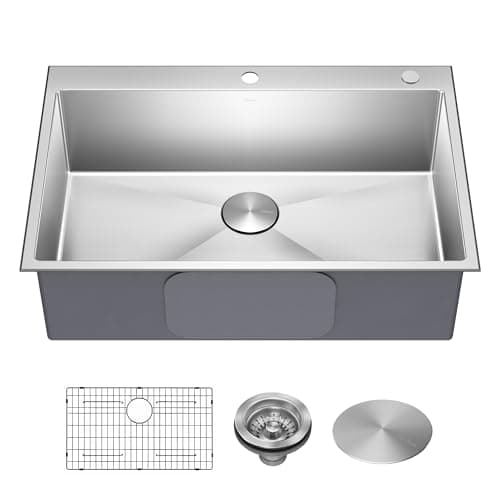
Product photograph supplied by Amazon for this listing, used under the Associates program.
1. Largest here
Kraus KHT300-33 drop-in sink
Kraus · Best for replacing a sink without touching the counter
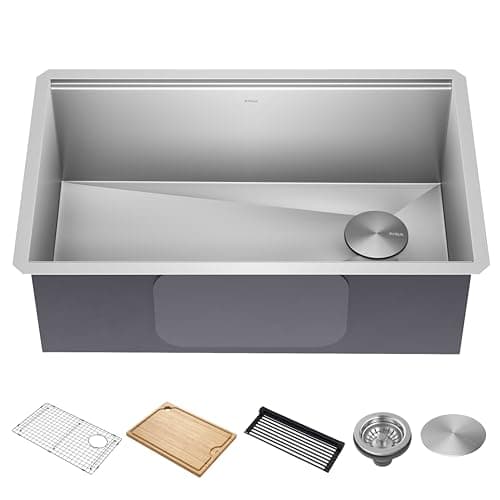
The drop-in we would fit in most kitchens, because it is a 16-gauge sink sold as a dual-mount: the rim is finished to sit on the counter, and the same sink can be undermounted later if you ever replace the countertop. At 10 inches deep with a rear-set drain it behaves like a modern undermount while asking nothing of your existing counter.
Published specifications
- Overall size
- 33" x 22" x 10-5/8" deep source
- Bowl size
- 31" x 18" x 10" deep source
- Gauge
- TRU16 gauge T304 stainless steel source
- Mounting
- Dual mount — drop-in or undermount source
- Faucet holes
- Two pre-drilled, for a faucet and a soap dispenser source
- Drain
- Rear-set source
- Minimum cabinet
- 36" source
- Sound damping
- NoiseDefend pads on all sides plus anti-condensation undercoating source
- Certification
- cUPC to ASME A112.19.3 / CSA B45.4 source
- Included
- Bottom grid, drain assembly with removable strainer, decorative drain cover source
- Warranty
- Kraus limited lifetime source
What works
- 16-gauge steel in a drop-in, which is unusual — most top-mount sinks at this size are 18-gauge or thinner
- Dual mount means the sink survives a future countertop replacement instead of being thrown away with it
- A 10-inch bowl with a rear-set drain leaves usable cabinet space under the front of the sink
- Grid, drain and strainer are in the box, so the only extra part is the sealant
What does not
- A 33-inch sink still needs a 36-inch cabinet, so it is not a drop-in replacement for a 30-inch base unit
- A 10-inch bowl is a long reach for a shorter person, and a drop-in rim sits slightly higher than an undermount one
- Kraus publishes no unit weight for this model, so plan the lift by the shipping box rather than a figure
Skip it if
Skip it if your existing cutout is for a 30-inch sink. A drop-in can cover a slightly smaller hole, never a smaller cabinet.
#ad Affiliate link · Price as of October 17, 2026
Raw specifications: Kraus’s own page for the Kraus KHT300-33 drop-in sink.
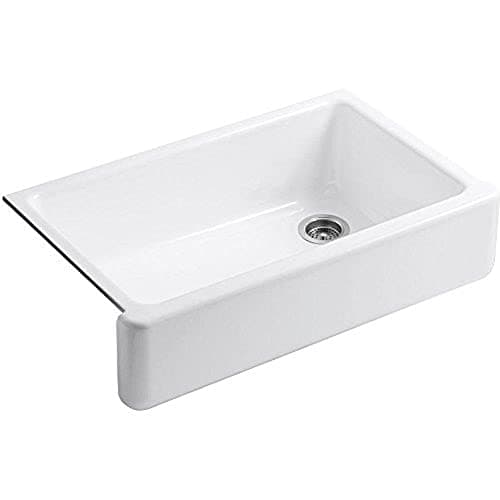
Product photograph supplied by Amazon for this listing, used under the Associates program.
2. Largest non-stainless
Kohler Whitehaven K-6489
Kohler · Best for farmhouse looks without a custom cabinet
The enameled cast-iron farmhouse sink to buy, mainly for one structural reason: the self-trimming apron overhangs the cabinet face, so installation is a rough cut rather than a cabinetmaker's fit. That detail is the difference between a weekend job and a trade job. It is also heavy enough that the cabinet needs real support.
Published specifications
What works
- Self-trimming apron means a rough cabinet cut, not a precision one
- Enameled cast iron resists chipping, cracking and heat in a way composite does not
- The 2-degree slope and offset drain genuinely reduce standing water
- Kohler stocks matching drains and accessories, so the sink does not orphan
What does not
- Cast iron is heavy — the cabinet needs a proper support frame, and that is the real installation cost
- Enamel dulls under abrasive cleaners, and a dropped cast pan will chip it
- Kohler does not publish a unit weight on the range page, so plan support using your retailer's shipping weight
Skip it if
Skip it if you are installing alone, or over an existing base cabinet you cannot reinforce. Weight decides this one, not looks.
#ad Affiliate link · Price as of October 17, 2026
Raw specifications: Kohler’s own page for the Kohler Whitehaven K-6489.
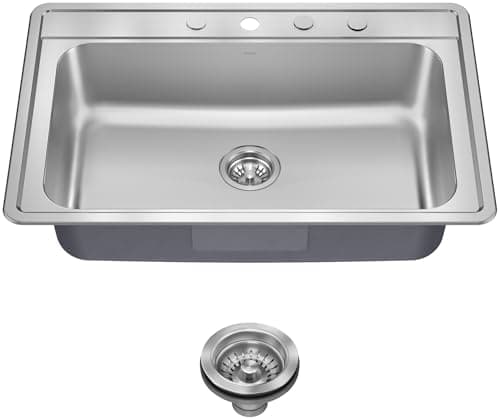
Product photograph supplied by Amazon for this listing, used under the Associates program.
3. The shallow standard
Kraus Premier KTM100-33
Kraus · Best for a like-for-like swap in an existing cutout
The plain, serviceable drop-in, and the one most likely to be a direct swap for what is already in your counter: 33 by 22 inches, a bowl 7-1/2 inches deep, 18-gauge Type 304 steel. The shallow bowl is the point — it is the depth older cabinets and high trap arms were built around, and it is getting hard to buy now that every new sink is ten inches deep.
Published specifications
- Overall size
- 33" x 22" x 8" source
- Bowl size
- 27-4/5" x 16" x 7-1/2" deep source
- Gauge
- 18 gauge, T-304 stainless steel source
- Faucet holes
- Pre-drilled for a faucet; Kraus does not publish a hole count for this model source
- Mounting
- Drop-in / top mount, with a cut-out template in the box source
- Drain
- Rear-set source
- Minimum cabinet
- 36" source
- Sound damping
- NoiseDefend pads on all sides plus anti-condensation undercoating source
- Certification
- cUPC to ASME A112.19.3 / CSA B45.4, and MASS source
- Included
- Drain assembly with removable strainer, mounting hardware, cut-out template source
- Warranty
- Kraus limited lifetime source
What works
- A 7-1/2 inch bowl, which is the depth most older cabinets and shallow trap arms were built around
- A rear-set drain, so the trap sits at the back of the cabinet and leaves the front usable
- NoiseDefend pads on all sides rather than bottom pads only, which is unusual on an 18-gauge sink
- Drain assembly, strainer, hardware and a cut-out template are in the box, so the only extra part is the sealant
What does not
- 18-gauge flexes more than 16-gauge under a dropped pan, and the pads damp drumming rather than remove it
- Kraus does not publish a faucet-hole count for this model, so confirm the drilling matches your counter before ordering
- A 33-inch sink still needs a 36-inch cabinet, so it is not a swap for a 30-inch base unit
Skip it if
Skip it if you want a deep modern basin. At 7-1/2 inches the bowl will not take a sheet pan laid flat.
Raw specifications: Kraus’s own page for the Kraus Premier KTM100-33.
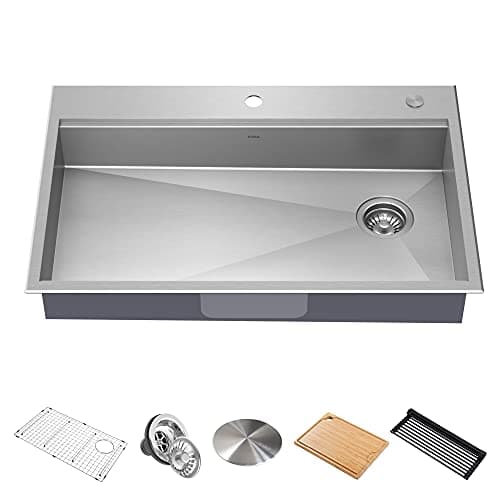
Product photograph supplied by Amazon for this listing, used under the Associates program.
4. Smallest here
Kraus KWT310-33/5.5 ADA workstation drop-in sink
Kraus · Best for shallow cabinets and accessible kitchens
The drop-in to buy when depth is the problem rather than the goal. The bowl is 5.5 inches deep, which is what makes it ADA-compliant and also what makes it fit over a shallow trap arm — and it still carries a workstation ledge, so the cutting board and the drying rack recover the working space the shallow bowl costs.
Published specifications
- Overall size
- 33" x 22" x 6" deep source
- Bowl size
- 31" x 16" x 5.5" deep source
- Gauge
- TRU16 gauge stainless steel source
- Mounting
- Dual mount — drop-in or undermount source
- Faucet holes
- One pre-drilled, plus a soap-dispenser hole source
- Drain
- Rear offset source
- Minimum cabinet
- 36" source
- Compliance
- ADA; cUPC to ASME A112.19.3 / CSA B45.4 source
- Included
- Bottom grid, bamboo cutting board, roll-up drying rack, drain assembly, cut-out template source
- Warranty
- Kraus limited lifetime source
What works
- A 5.5-inch bowl clears plumbing that a 10-inch bowl simply will not — the commonest reason a sink upgrade stalls
- ADA-compliant depth, which matters if the kitchen has to be usable seated
- The integrated ledge and included accessories give back the working space the shallow bowl gives up
- Rear-offset drain, so the trap sits at the back of the cabinet rather than the middle
What does not
- 5.5 inches is genuinely shallow: a running faucet splashes more, and tall pots have to be filled at an angle
- The accessories are part of the price, and most households will not use all of them
- A shallow wide bowl shows standing water more obviously than a deep one, so the grid earns its place here
Skip it if
Skip it if you have the clearance for a deep bowl and nobody in the house needs an ADA-height basin. Buy depth instead.
#ad Affiliate link · Price as of October 17, 2026
Raw specifications: Kraus’s own page for the Kraus KWT310-33/5.5 ADA workstation drop-in sink.
Why you never get the number in the table
Three things take volume away, and they are worth knowing because together they account for a lot of it.
The corners are not square. A pressed stainless bowl has a radius in every corner and along the bottom edges, and a cast or fireclay bowl has more. That radius removes material from the calculation that a rectangular box assumes is there.
The bowl slopes to the drain. The Kohler Whitehaven publishes a 2-degree basin slope toward an offset drain, which is a genuine feature — it reduces standing water — and it means the depth is only the full published figure at the drain end.
You never fill to the brim. The overflow point in practice is the lip of the drain tailpiece or the bottom of the faucet aerator, and most people stop an inch or two below the rim to avoid slopping. On a 33 by 22 sink, one inch of rim is close to 2.4 gallons of water you are not using.
One bowl or two, at the same capacity
The arithmetic makes a point about double bowls that the dimensions alone do not. The Kraus KHT302-33 is the double-bowl version of the KHT300-33 in the same 33 by 22 footprint, and its two bowls come to 24.2 gallons together — the same total as the single bowl, within rounding. The capacity is identical; what changes is that none of it is in one place.
That is the real double-bowl trade and it has nothing to do with volume: 12.1 gallons in each of two 15-1/2 inch basins is the wrong shape for a roasting tray and the right shape for washing on one side and draining on the other. Single bowl vs double bowl is the full argument.
Where the figure is genuinely useful
Three places. Emergency water storage — a filled 33-inch single bowl is a meaningful reserve, and knowing it is about 24 gallons rather than guessing is worth something. Soaking and brining — a bowl that holds 24 gallons will take a brining bucket and water to cover. And water use, where the comparison that matters is against a running faucet: at the 1.5 gpm most modern faucets are rated for, filling a 24-gallon bowl is sixteen minutes of running water, which is a reasonable argument for washing in a filled bowl rather than under a running tap. What is a good flow rate for a kitchen faucet covers the flow-rate side.
What to take away
- No maker publishes a sink capacity; they publish bowl dimensions, which is better.
- Multiply bowl length by width by depth in inches, then divide by 231 for US gallons.
- Use the bowl dimensions, not the overall size - the rim holds nothing.
- A standard 33-inch single bowl works out at about 24 gallons brim-full; a shallow one at about 14.
- Radiused corners, the slope to the drain and not filling to the rim all take volume off that figure.
- A double bowl in the same footprint holds the same total, just not in one place.
How we sourced this page
Every figure on this page came from one of the following. Where a manufacturer or an independent lab does not publish a number, we say so rather than estimate it.
- Kraus KHT300-33 drop-in / undermount single-bowl sink product page (published specifications)
- Kohler Whitehaven apron-front sink range (published specifications)
- Kraus Kore KWU110-30 specification sheet (PDF)
- Kraus Premier KTM100-33 drop-in / top-mount sink product page (published specifications)
- Kraus KHT302-33 drop-in / undermount double-bowl sink product page (published specifications)
- Kraus KWT310-33/5.5 ADA workstation drop-in sink product page (published specifications)
Common questions
- How many gallons does a kitchen sink hold?
- A standard 33-inch single-bowl sink holds roughly 24 US gallons brim-full: the Kraus KHT300-33's published 31 by 18 by 10 inch bowl works out at 24.2. A shallower 7-1/2 inch bowl in the same footprint holds about 14.4 gallons.
- How do you calculate the capacity of a kitchen sink?
- Multiply the published bowl length, width and depth in inches to get cubic inches, then divide by 231, because a US liquid gallon is exactly 231 cubic inches. Use the bowl dimensions rather than the overall size - the rim holds nothing.
- Does a double-bowl sink hold less water than a single bowl?
- Not in total. The Kraus KHT302-33's two 15-1/2 by 18 by 10 inch bowls come to about 24.2 gallons together, the same as its single-bowl equivalent in the same 33 by 22 footprint. The difference is that the capacity is split, so no single bowl takes a large tray.
- Why does my sink hold less water than the calculation says?
- Three reasons: the corners and bottom edges are radiused rather than square, the bowl slopes toward the drain, and nobody fills to the rim. On a 33 by 22 sink, stopping one inch below the rim leaves about 2.4 gallons unused.
More in Guides
Organized by task, not by date, because a faucet install guide does not go stale and should not get buried under a blog feed. Every guide includes the honest point at which to call a plumber.
Read next
Guide
How deep should a sink be
The depth range that suits most kitchens, the four things that constrain it, and four sinks spanning 5.5 to 10 inches of bowl depth.
Guide
Sink sizes and cabinet fit
The cabinet-to-sink arithmetic, the four measurements to take, and how a disposal changes the numbers.
Head to head
Single vs double bowl
What a divider costs you, who genuinely benefits from two bowls, and what is involved in swapping a double for a single.
Best for laminate counters
Best for laminate counters
Why laminate rules out an undermount, which drop-in sinks fit an existing cutout, and the bowl depth that decides whether your plumbing still clears.
Guide
Good faucet flow rate
What 1.5 and 1.8 gpm actually mean, why a higher figure is not a better faucet, and the one situation where the number genuinely decides your purchase.
Guide
How to choose a sink
The six decisions in the order that actually works, each with the measurement that settles it — and what to do when two of them conflict.
Found something out of date, or a figure you can source better than we did? Tell us — corrections get read first. Our methodology explains how picks are made, and contact is one click away.