Guides
What is a good flow rate for a kitchen faucet?
Flow rate is the most quoted number on a faucet box and one of the least useful. Pressure at your house and aerator design decide what the tap feels like.

Disclosure: we earn a commission if you buy through the Amazon links on this page, at no extra cost to you. Commission never decides a verdict or a ranking position — read our editorial policy and affiliate disclosure.
How we assessed these: flow-rate figures here are each read from the named manufacturer's own product page or specification sheet for that model number, and the standards context from the EPA reference linked below. We have not measured flow at any tap, and we publish no estimate of how fast any faucet fills a pot.
Short answer
1.5 to 1.8 gallons per minute is a good flow rate for a kitchen faucet, and that range covers almost everything currently sold. 1.5 gpm sits at the EPA's WaterSense specification and is what most new designs ship; 1.8 gpm is the higher-flow option where local rules allow it. The higher number is not the better faucet — what a tap feels like is decided by the water pressure at your house and by how the aerator shapes the stream, not by the rating on the box.
Flow rate is a maximum, measured under test conditions, with a specified supply pressure. It is the ceiling the faucet's aerator imposes, not a promise about your kitchen. Two faucets rated identically can feel completely different, and the same faucet feels different in two houses.
What the numbers mean
Gallons per minute is what leaves the spout in sixty seconds at a stated test pressure. Kohler is the clearest of the makers here: it publishes 1.5 gpm at 60 psi for the Simplice K-596, which tells you both the figure and the condition. Moen publishes 1.5 gpm for the Arbor 7594 and 1.5 gpm max for several others. Delta publishes 1.8 gpm for the Leland 9178, and WEWE publishes 1.8 gpm max for the A1001L.
| Model | Published flow rate | Stated condition |
|---|---|---|
| Moen Arbor 7594 | 1.5 gpm | Not stated |
| Kohler Simplice K-596 | 1.5 gpm | At 60 psi |
| Kohler Sensate K-72218 | 1.5 gpm | At 60 psi |
| Moen Method 7585C | 1.5 gpm max | Maximum |
| Moen Renzo CA87316C | 1.5 gpm max | Maximum |
| Moen Sombra 87701SRS | 1.5 gpm max | Maximum |
| Delta Leland 9178-AR-DST | 1.8 gpm | Not stated |
| Kraus Bolden KPF-1610 | 1.8 gpm aerated | Aerated stream |
| WEWE A1001L | 1.8 gpm max | Maximum |
Every figure is read from that maker's own product page or specification sheet, listed in the sources below. Where no test pressure is stated, we do not know what pressure the figure assumes and will not assume one for them. A "max" figure and a figure at 60 psi are not directly comparable.
Why higher is not better
Three reasons. First, the rules: the EPA's WaterSense specification sits at or below 1.5 gpm, and some states cap kitchen faucet flow below 1.8 — so a 1.8 gpm faucet may simply not be sellable or permitted where you live. Check your local requirement before you shortlist by this number.
Second, you pay for the water and for heating it, and a kitchen tap is on and off dozens of times a day. Third, and most practically: the number does not describe how the tap feels. A good aerator at 1.5 gpm produces a dense, well-formed stream that rinses efficiently. A poor one at 1.8 produces a loose, splashy stream that wets the counter. The design does more than the rating.
The thing that actually decides it: your pressure
Flow rate is the ceiling. Pressure is whether you ever reach it. In a house with healthy supply pressure, a 1.5 gpm and a 1.8 gpm faucet feel almost the same, and the difference is academic. In a house with genuinely weak supply — a long run from the street, an old galvanized line, a well system, a top-floor apartment — the higher-rated aerator restricts less and is the one that feels better.
That is the one situation where the number on the box should decide your purchase. Best kitchen faucets for low water pressure is the shortlist for it, and kitchen faucet low water pressure is the diagnosis if a tap that used to be fine has gone weak — which is almost always a blocked aerator or a kinked supply line rather than the faucet's rating.
Product photograph supplied by Amazon for this listing, used under the Associates program.
1. Best at 1.5 gpm
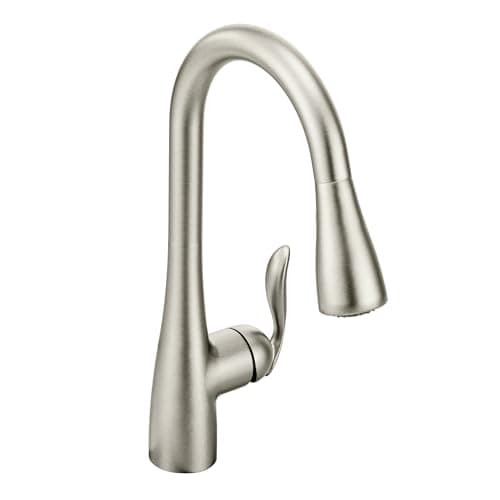
Moen Arbor 7594
Moen · Best for deep pots and hard-water kitchens
The pull-down to buy if you want the taller arc and a finish that hides water spots. Its 8-1/4" spout height is about half an inch more clearance than the Leland, which is the difference between washing a stock pot and fighting one. The tradeoff is reach: 7-7/8" against 9-3/16", so it works closer to the back of the bowl.
Published specifications
What works
- The 8-1/4" spout height is genuine pot clearance, not decorative arc
- Power Boost concentrates the stream for filling and rinsing without raising the rated flow
- Spot Resist Stainless is the single most useful finish choice in a hard-water house
- Reflex docking has been in Moen's line long enough that replacement wands are easy to find
What does not
- Reach is 7-7/8", over an inch shorter than the Leland — on a wide double bowl you will notice
- Moen publishes no independent noise or durability measurement, and neither do we
- The spot-resist coating is a finish, not armor; abrasive cleaners still dull it
Skip it if
Skip it if you have a wide double-bowl sink and want one faucet to reach both drains comfortably — buy reach instead of height.
#ad Affiliate link · Price as of October 17, 2026
Raw specifications: Moen’s own page for the Moen Arbor 7594.
Product photograph supplied by Amazon for this listing, used under the Associates program.
2. Best at 1.8 gpm
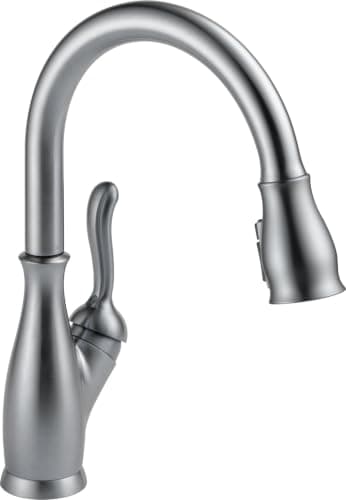
Delta Leland 9178-AR-DST
Delta · Best for most kitchens, one or three holes
The pull-down we would fit in most kitchens, because the two parts that usually fail first on a pull-down are the two Delta engineered around: the docking mechanism and the valve. MagnaTite pulls the wand back into the spout with a magnet instead of relying on a friction collar, and Diamond Seal keeps water off the valve. It ships with a deck plate, so it covers a three-hole sink or mounts through one.
Published specifications
- Flow rate
- 1.8 gpm source
- Spout height
- 7-7/8" deck to outlet source
- Spout reach
- 9-3/16" source
- Overall height
- 14-7/8" source
- Mounting
- Single hole; deck plate included for three-hole sinks source
- Supply lines
- Integrated InnoFlex PEX, pre-attached at the valve source
- Connection
- 3/8" compression source
- Warranty
- Delta limited lifetime source
- Lead compliance
- Meets NSF/ANSI 61 source
What works
- MagnaTite docking is a magnet, not a friction fit — a wand that stops seating is the most common pull-down complaint, and a magnet does not wear the way a plastic collar does
- Spout reach of 9-3/16" clears the far side of a standard 22-inch front-to-back sink
- Diamond Seal keeps water off the valve, which is what the lifetime warranty is really protecting
- Deck plate in the box, so a three-hole sink needs no extra part
What does not
- 1.8 gpm is higher than the 1.5 gpm most competitors now ship, which matters if your area caps flow rate
- Zinc body rather than brass — normal at this price, but this is not a forever faucet
- No independent lab publishes durability figures for this model, so we cannot tell you how the finish looks at year five
Skip it if
Skip it if your sink is a shallow bar sink: at 14-7/8" overall the arc will splash in a basin under about seven inches deep.
Raw specifications: Delta’s own page for the Delta Leland 9178-AR-DST.
Product photograph supplied by Amazon for this listing, used under the Associates program.
3. Best published figure
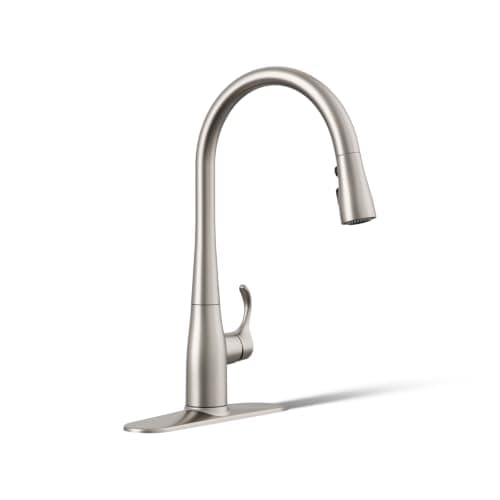
Kohler Simplice K-596
Kohler · Best for wide bowls and long reach
The value pick with the longest reach of the three mainstream pull-downs, and the only one whose third spray function is genuinely useful rather than a novelty: Boost raises flow by 30% while you hold it, then drops back to 1.5 gpm. If your sink is wide, this is the one that reaches.
Published specifications
What works
- 9" reach, matching the longest in this roundup
- Boost is a real feature: 30% more flow on demand, then back to 1.5 gpm
- Sweep spray is a blade rather than a cone, which is better at pushing debris toward a drain
- Kohler publishes a full dimensional spec sheet, which makes hole and cabinet planning easy
What does not
- A three-function head has more moving parts than a two-function one, which is more to go wrong
- The gooseneck shape sets the handle further back than some people like on a shallow deck
- No published independent test data on this model, from anyone
Skip it if
Skip it if you want the simplest possible faucet — a two-function wand is one less thing to break.
#ad Affiliate link · Price as of October 17, 2026
Raw specifications: Kohler’s own page for the Kohler Simplice K-596.
Product photograph supplied by Amazon for this listing, used under the Associates program.
4. Where flow drops most
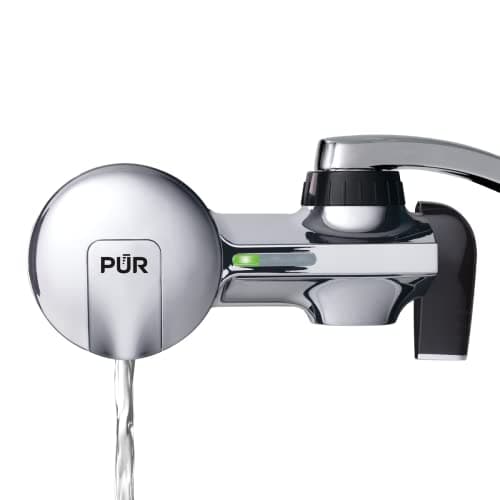
PUR PLUS faucet mount filtration system
PUR · Best for standard non-wand faucets
The cheapest honest answer to filtered water at the kitchen sink, with one hard limitation to know before buying: it clamps to the spout of a standard faucet and will not fit a pull-down or pull-out wand. If your faucet has a wand, an under-sink system or a dedicated filtered-water faucet is the only route.
Published specifications
What works
- Certified lead reduction for roughly the cost of two months of bottled water
- Installs in minutes with no tools and no plumbing
- Filter change is a twist, and the housing tells you when it is due
- Reversible: it comes back off and leaves the faucet as it was
What does not
- Does not fit pull-down or pull-out faucets — the most common kitchen faucet type sold today
- It hangs off the end of the spout, which is visually obvious
- 100 gallons is roughly three months for a small household and much less for a large one
Skip it if
Skip it if your kitchen faucet has a pull-down wand. It will not fit, and no adapter makes it fit.
#ad Affiliate link · Price as of October 17, 2026
What reduces flow after you install it
- A clogged aerator. The commonest cause by a wide margin, and a five-minute fix: unscrew, rinse, descale, refit. In hard water this is routine maintenance, not a fault.
- A partly closed shutoff valve. Easy to leave half-turned after an installation, and it throttles everything downstream.
- A kinked or undersized supply line. What size are kitchen faucet supply lines covers the connections and the common mismatch.
- A faucet-mount filter. This one is by design: the PUR PLUS faucet-mount system passes water through a filter cartridge, which necessarily restricts it. That is the trade for filtration at the tap.
- Scale inside the cartridge. Less common, and the point at which the cartridge rather than the aerator is the repair. How to replace a faucet cartridge is the procedure.
Flow rate and filtered water
If you want filtered water in the kitchen, the honest flow-rate answer is that any filter you put in the water's path takes flow out of it. A faucet-mount unit like the PUR PLUS is the cheapest route and the one you feel most. An under-sink system with its own dedicated tap keeps your main faucet at full flow and puts the restriction on a tap you only use for drinking water.
That is why we generally prefer the dedicated-tap route. Best filtered water kitchen faucets sets out both options and what each one costs you in flow.
What to take away
- 1.5 to 1.8 gpm covers almost every kitchen faucet sold; 1.5 sits at the WaterSense specification.
- Flow rate is a maximum under test conditions, not a promise about your kitchen.
- A figure stated at 60 psi and a figure stated as "max" are not directly comparable.
- Some states cap kitchen faucet flow below 1.8 gpm - check before shortlisting a higher-flow model.
- Aerator design and your supply pressure decide how a tap feels far more than the rating does.
- If flow has dropped on a faucet that used to be fine, check the aerator first - it is nearly always that.
How we sourced this page
Every figure on this page came from one of the following. Where a manufacturer or an independent lab does not publish a number, we say so rather than estimate it.
- US EPA WaterSense — bathroom and kitchen faucet flow-rate standards
- Moen Arbor 7594 product page (published specifications)
- Kohler Simplice K-596 specification sheet (PDF)
- Kohler Sensate K-72218 specification sheet (PDF)
- Delta Leland 9178-AR-DST product page (published specifications)
- Kraus Bolden KPF-1610 product page (published specifications)
- WEWE A1001L kitchen faucet — manufacturer product listing
- PUR PLUS faucet mount filtration system PFM400H — manufacturer listing
Common questions
- Is 1.8 gpm good for a kitchen faucet?
- It is the higher-flow end of what is sold and it is fine, with two caveats: some states cap kitchen faucet flow below 1.8, so check your local rule, and in a house with healthy pressure you will not notice the difference from 1.5. Where it genuinely helps is weak supply pressure.
- Is 1.5 gpm enough for a kitchen faucet?
- Yes, for almost every kitchen. 1.5 gpm sits at the EPA's WaterSense specification and is what most new faucets ship at. A well-designed aerator at 1.5 rinses and fills about as well as a poor one at 1.8, because stream quality is a design matter rather than a flow-rate matter.
- Does a higher gpm mean better water pressure?
- No. Pressure is supplied by your plumbing; flow rate is the ceiling the faucet's aerator imposes on it. A higher-rated faucet restricts less, which helps if your pressure is already weak, but it cannot add pressure that is not there.
- Can you remove the flow restrictor from a kitchen faucet?
- The restriction is part of the aerator on most modern faucets, and removing or modifying it can breach local water-efficiency rules and the faucet's own certification. If flow feels wrong, clean the aerator, open the shutoff valves fully and check the supply lines first - those fix it far more often.
More in Guides
Organized by task, not by date, because a faucet install guide does not go stale and should not get buried under a blog feed. Every guide includes the honest point at which to call a plumber.
Read next
Best faucet for low water pressure
Best faucets for low pressure
Four faucets compared on rated flow, boost functions and how easily the aerator comes out — plus the three causes a new faucet will not fix.
Troubleshooting
Faucet low water pressure
Five checks in order of likelihood, starting with the two parts that unscrew and cost nothing to clean.
Best filtered water setup
Best filtered water faucets
Three routes to filtered water at the sink, in cost order — and the fitment problem that catches most pull-down owners out.
Guide
How to choose a faucet
The six decisions a kitchen faucet needs, in the order that stops you falling in love with something that will not fit your sink.
Best high arc faucet
Best high arc faucets
Four high-arc faucets compared on published spout height, reach and overall height, plus the splash problem a high arc creates in a shallow sink.
How to
Replace a faucet cartridge
Identify the cartridge, get the water off properly, and swap it — for single-handle and two-handle faucets.
Found something out of date, or a figure you can source better than we did? Tell us — corrections get read first. Our methodology explains how picks are made, and contact is one click away.