Kitchen Sinks
The best 30-inch kitchen sinks
Start with the figure nobody puts on the box: every 30-inch sink here needs a 33-inch cabinet. Measure the cabinet, not the sink.

Disclosure: we earn a commission if you buy through the Amazon links on this page, at no extra cost to you. Commission never decides a verdict or a ranking position — read our editorial policy and affiliate disclosure.
How we assessed these: we rank only on figures the maker publishes for the named model number, read from each maker's own product page or spec sheet and linked at every figure. We have not installed these sinks and we do not own them. No independent laboratory publishes comparable flex, noise or durability testing for kitchen sinks, so no such number appears anywhere on this page.
Short answer
The best 30-inch kitchen sink is the Kraus Kore KWU110-30: a published 30 by 19 inch footprint with a 28 by 16 inch bowl 10 inches deep, 16-gauge steel, NoiseDefend pads over 80 percent of the basin, a rear-offset 3-1/2 inch drain, and the grid, mat, board and strainer in the box. The budget pick is the Kraus Quarza KGD-412B, the cheapest sink here, which is dual mount so it drops in or undermounts. Before any of that, note the figure that decides the purchase: all three publish a 33-inch minimum cabinet, so a 30-inch sink does not go in a 30-inch cabinet.
That is the single most useful thing on this page, so it is worth being exact about why. A base cabinet is described by its outside width. Inside it there is a face frame, two side panels and then the clearance a sink needs for its rim, its clips and your hands during installation. A 30-inch cabinet leaves roughly 27 to 28 inches of usable opening, which is less than a 30-inch sink. Kraus publishes a 33-inch minimum cabinet for the Kore and for the Quarza KGD-412B, and BOCCHI publishes 33 inches for the Classico 30 - three different makers, three different materials, the same answer. Sink sizes and cabinet fit sets out the full arithmetic.
Quick picks
Tap any row to jump to the full write-up. There are no scores here because we run no test lab — how picks are chosen is published in full on our methodology page.
| # | Product | Best for | Our read | Price |
|---|---|---|---|---|
| 1 | 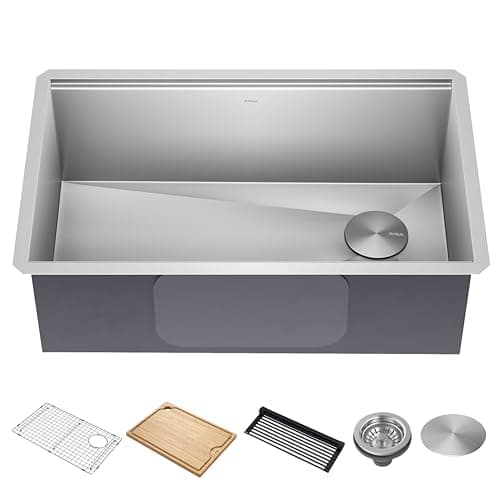 Kraus Kore KWU110-30 workstation sink Best overall | Small kitchens that need counter space | Published 30 x 19", 10-inch bowl, ledge gear included | $469.95 · View on Amazon #ad Affiliate link · Price as of November 28, 2026 |
| 2 | 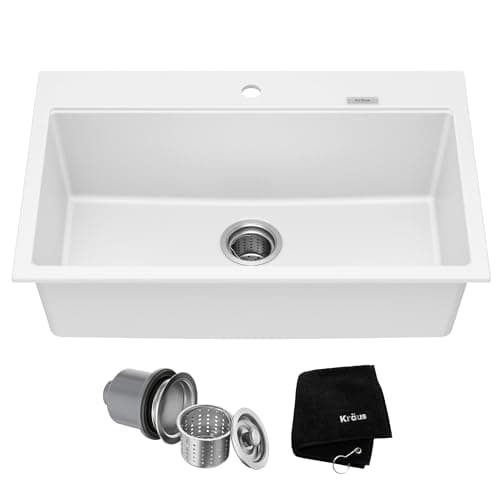 Kraus Quarza KGD-412B composite sink Budget pick | A 33-inch cabinet, either mounting | Cheapest here, dual mount, hides water marks | |
| 3 | 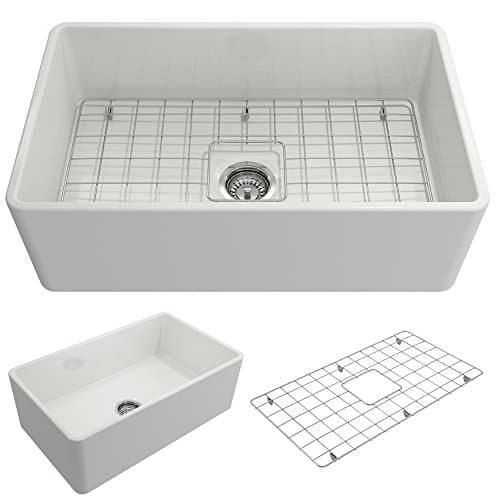 BOCCHI Classico 30-inch fireclay farmhouse sink Best farmhouse | Farmhouse style, lighter than cast iron | Fireclay apron with a grid and strainer in the box | $466.54 · View on Amazon #ad Affiliate link · Price as of November 28, 2026 |
Why buy a 30-inch sink at all
Two good reasons and one bad one. The good reasons: it leaves counter on both sides of the bowl, which is the difference between a working kitchen and a sink with nowhere to put a drying pan, and it fits a 33-inch cabinet comfortably rather than exactly - useful if the cabinet is old, slightly out of square, or sitting under a counter you do not want to cut to the millimeter. The bad reason is thinking it will fit a smaller cabinet. It will not.
What you give up against a 33-inch sink is bowl width, and on a single bowl that is real: the Kore's bowl is 28 inches wide against the 31 inches of the 33-inch Kraus KHT300-33. A full-size baking sheet is 26 by 18 inches, so both take one flat, but the 30-inch sink takes it with nothing to spare. If your cabinet is 36 inches and you are choosing on preference rather than on fit, the best 33-inch kitchen sinks is the wider field.
| Model | Material | Overall size | Bowl | Mounting | Min. cabinet |
|---|---|---|---|---|---|
| Kraus Kore KWU110-30 | 16-gauge stainless | 30" x 19" | 28" x 16" x 10" deep | Undermount workstation | 33" wide x 24" front to back |
| Kraus Quarza KGD-412B | Quartz composite | 30-3/4" x 20-1/8" x 9-3/8" | 28-3/8" x 14-1/2" x 8-5/8" deep | Dual - drop-in or undermount | 33" |
| BOCCHI Classico 30 | Fireclay | Not published for this model | Not published | Apron front | 33" |
Read from each model's own maker page, linked below. BOCCHI sells the Classico 30 by its nominal 30-inch size but does not publish overall or bowl dimensions on the page we read, so this table says so rather than filling the gap. All three publish a 33-inch minimum cabinet.
Product photograph supplied by Amazon for this listing, used under the Associates program.
1. Best overall
Kraus Kore KWU110-30 workstation sink
Kraus · Best for small kitchens that need counter space
The workstation sink we would buy, and the clearest case for 16-gauge steel anywhere in this category: a ledge sink is the one configuration where basin flex is genuinely audible, because accessories rest on the rim and transmit it. Ten inches deep, rear-offset drain, and the grid, mat, board and strainer are in the box rather than a $200 upsell.
Published specifications
- Overall size
- 30" x 19" source
- Bowl size
- 28" x 16" source
- Bowl depth
- 10" source
- Gauge
- 16-gauge stainless steel source
- Minimum cabinet
- 33" left to right, 24" front to back source
- Drain
- Rear offset, 3-1/2" opening source
- Sound damping
- NoiseDefend pads covering over 80% of the basin, plus undercoating source
- Warranty
- Kraus limited lifetime source
What works
- The integrated ledge turns a 30-inch sink into prep counter, the best single trade available in a small kitchen
- Rear-offset drain leaves usable cabinet space under the front of the sink
- Genuine 16-gauge with pads over 80% of the basin — gauge and damping do different jobs, and this sink has both
- A 3-1/2" drain opening takes a standard disposal flange with no adapter
What does not
- Needs a 33-inch cabinet for a 30-inch sink — measure before ordering
- A 10-inch deep bowl is a long reach for a shorter person
- The accessories are the reason to buy it and also the reason it costs more than a plain undermount
Skip it if
Skip it if your run of counter is already generous — you would be paying for prep space you do not need, and a plain 18-gauge undermount will serve.
#ad Affiliate link · Price as of November 28, 2026
Raw specifications: Kraus’s own page for the Kraus Kore KWU110-30 workstation sink.
Product photograph supplied by Amazon for this listing, used under the Associates program.
2. Budget pick
Kraus Quarza KGD-412B composite sink
Kraus · Best for a 33-inch cabinet, either mounting
The composite sink to fit when the cabinet is the problem. At 30-3/4 inches wide it drops into a 33-inch cabinet where most composite sinks ask for 36, and it is dual mount, so it sits on the counter you already have and can be undermounted later. The bowl is 8-5/8 inches deep rather than the 9-1/2 or 10 you get further up, which is the honest cost of the smaller footprint.
Published specifications
- Overall size
- 30-3/4" L x 20-1/8" W x 9-3/8" D source
- Bowl size
- 28-3/8" L x 14-1/2" W x 8-5/8" deep source
- Material
- Natural quartz and premium acrylic resin - Kraus does not publish the percentage split source
- Mounting
- Dual mount - drop-in or undermount source
- Minimum cabinet
- 33" source
- Faucet holes
- One pre-drilled, plus four scored knockouts for accessories source
- Heat
- Kraus states heat safe to 500°F on this model's page source
- Certification
- cUPC to CSA B45.8 / IAPMO Z403, MASS source
- Included
- Drain assembly with removable basket strainer, mounting hardware, cut-out template source
- Warranty
- Kraus limited lifetime source
What works
- A 33-inch minimum cabinet, where the rest of this category starts at 36 — the single most useful number on the page if your run is tight
- Dual mount, so one sink covers a laminate counter now and a stone counter later
- Four scored knockouts mean a soap dispenser or air switch needs no drilling into composite
- Kraus publishes bowl dimensions separately from overall dimensions, which is what you actually need to compare
What does not
- 8-5/8 inches is the shallowest bowl of the composite sinks here, and it will not take a sheet pan laid flat
- Kraus does not publish the quartz-to-resin percentage for the Quarza line, so you cannot compare the mix against Blanco's or Ruvati's published figures
- Kraus's own page states 500°F for this model while the 33-inch Quarza page states 600°F — same material line, two numbers, so treat either as indicative rather than a specification
- Kraus's own store listed the Black Onyx colorway as out of stock when we checked; the live Amazon listing is the white colorway
Skip it if
Skip it if you have a 36-inch cabinet and no constraint, because the deeper bowls further up this page cost about the same.
Raw specifications: Kraus’s own page for the Kraus Quarza KGD-412B composite sink.
Product photograph supplied by Amazon for this listing, used under the Associates program.
3. Best farmhouse
BOCCHI Classico 30-inch fireclay farmhouse sink
BOCCHI · Best for farmhouse style, lighter than cast iron
Fireclay's argument against cast iron is the surface: the glaze is fired onto clay at very high temperature and is non-porous, rather than an enamel layer bonded to metal. This one ships with the bottom grid and strainer, and needs no flange extension for a disposal — a small detail that saves a trip to the store on install day.
Published specifications
What works
- Non-porous glaze, so staining is a cleaning problem rather than a permanent one
- Lighter than an equivalent enameled cast-iron sink, which simplifies cabinet support
- Grid and strainer in the box — the grid is what protects the glaze from dropped cast iron
- Takes a standard disposal flange without an extension kit
What does not
- Fireclay is a ceramic: a hard impact chips it, and a chip is not repairable the way a scratch in stainless is
- Hand-made dimensions vary slightly batch to batch, so cut the cabinet to the sink you received
- No independent lab publishes chip-resistance testing for fireclay sinks, so the material claims here are the manufacturer's
Skip it if
Skip it if your household is hard on a sink — dropped pots and ceramic do not mix. Choose 16-gauge stainless instead.
#ad Affiliate link · Price as of November 28, 2026
What separates the three
The Kore is a workstation sink, which means a ledge machined into the basin that accessories slide along. Kraus publishes pads over 80 percent of the basin plus an undercoating, which matters more on a ledge sink than anywhere else: accessories rest on the rim and transmit flex straight into the counter. It is also the only sink here publishing a 3-1/2 inch drain opening, so if a garbage disposal is going underneath it is the safest of the three - see the best kitchen sinks for a garbage disposal. The con is that a 10-inch bowl in a 19-inch-deep sink wants a reasonably generous cabinet in both directions.
The Quarza KGD-412B is the value answer and the most flexible to install, because dual mount keeps drop-in and undermount both open until the counter is decided. Kraus publishes natural quartz in acrylic resin, heat safe to 500 degrees Fahrenheit, and a drain assembly with a removable basket strainer in the box. The cons are honest ones: Kraus does not publish the quartz-to-resin percentage split, and its 8-5/8 inch bowl is the shallowest of the three.
The Classico 30 is the apron-front option, and fireclay is the reason to choose it over enameled cast iron - the same look, considerably less weight to support. BOCCHI publishes a non-porous glaze that resists stains, scratches and thermal shock, a stainless bottom grid and chrome strainer in the box, and - usefully - that no flange extension is needed for a disposal, which is the one fitting problem thick-decked sinks usually create. The con is that an apron sink is a cabinet modification, not a counter swap: the face of the cabinet has to be cut away for the apron to sit proud.
If none of the three fits
Two directions out. If the cabinet is smaller than 33 inches, the honest answer is a smaller sink than anything on this page, and in this registry the shallow-bowl drop-ins are the ones that tolerate a tight opening best - the best drop-in kitchen sinks covers those. If the cabinet is 36 inches and you landed here by habit, the 32-inch Ruvati epiGranite RVG2080 and the 33-inch Kraus sinks open up, and the extra bowl width is worth having. Either way, the measurement comes first and the shortlist second.
What to take away
- A 30-inch sink does not fit a 30-inch cabinet: all three here publish a 33-inch minimum.
- Measure the clear opening inside the face frame at the top of the cabinet, not the nominal cabinet width.
- Measure front to back too - the Kore publishes a 24-inch front-to-back minimum.
- The reason to buy 30 inches is counter space either side of the bowl, not a smaller cabinet.
- Against a 33-inch sink you lose about three inches of bowl width, which a full baking sheet notices.
- An apron-front sink is a cabinet modification as well as a counter decision.
How we sourced this page
Every figure on this page came from one of the following. Where a manufacturer or an independent lab does not publish a number, we say so rather than estimate it.
- Kraus Kore KWU110-30 specification sheet (PDF)
- Kraus Kore KWU110-30 product page (published specifications)
- Kraus Quarza KGD-412B 31-inch granite composite sink product page (published specifications)
- BOCCHI Classico 30-inch fireclay farmhouse sink — manufacturer listing
- Kraus KHT300-33 drop-in / undermount single-bowl sink product page (published specifications)
- Ruvati epiGranite RVG2080 undermount granite composite sink product page (published specifications)
Common questions
- What is the best 30-inch kitchen sink?
- The Kraus Kore KWU110-30: a published 30 by 19 inch footprint, a 28 by 16 inch bowl 10 inches deep, 16-gauge steel, NoiseDefend pads over 80 percent of the basin, a rear-offset 3-1/2 inch drain, and the grid, mat, board and strainer included rather than sold separately.
- Will a 30-inch sink fit in a 30-inch cabinet?
- No. A 30-inch base cabinet leaves roughly 27 to 28 inches of usable opening once the face frame and side panels are accounted for. All three sinks on this page publish a 33-inch minimum cabinet, and that is the figure to shop on.
- What size cabinet do you need for a 30-inch sink?
- At least 33 inches wide, which is what Kraus publishes for the Kore KWU110-30 and the Quarza KGD-412B and what BOCCHI publishes for the Classico 30. Check front to back as well: the Kore also publishes a 24-inch front-to-back minimum.
- Is a 30-inch sink big enough?
- For most kitchens, yes. A 28-inch bowl takes a full-size 26 by 18 inch baking sheet laid flat, though with nothing to spare. The trade against a 33-inch sink is about three inches of bowl width in exchange for more usable counter on either side.
More in Kitchen Sinks
Three specifications settle almost every kitchen sink question: how thick the steel is, how it meets the counter, and what it is made of. Get those right and brand barely matters.
Read next
Guide
Sink sizes and cabinet fit
The cabinet-to-sink arithmetic, the four measurements to take, and how a disposal changes the numbers.
Best 33 inch sink
Best 33 inch sinks
Five 33-inch sinks compared on bowl size, depth, mounting and what comes in the box - starting with the cabinet width each one actually requires.
Best workstation sink
Best workstation sinks
Ledge sinks reviewed on gauge, accessory quality and drain position, including the 33-inch and farmhouse-ledge options.
Best drop-in sink
Best drop-in sinks
Four top-mount sinks chosen on gauge, bowl depth and cutout — plus the measurement that decides whether a new one drops into your existing hole.
Best matched pair
Best sink and faucet combos
Three sink-and-faucet pairings matched on published reach, bowl depth and hole count, with the clearance arithmetic set out in full.
Guide
How to choose a sink
The six decisions in the order that actually works, each with the measurement that settles it — and what to do when two of them conflict.
Found something out of date, or a figure you can source better than we did? Tell us — corrections get read first. Our methodology explains how picks are made, and contact is one click away.