Garbage Disposals
How long do garbage disposals last?
The useful answer is not an average. It is what the makers warrant, what actually fails, and which failures are worth repairing.

Disclosure: we earn a commission if you buy through the Amazon links on this page, at no extra cost to you. Commission never decides a verdict or a ranking position — read our editorial policy and affiliate disclosure.
How we assessed these: we compared published manufacturer specifications for the named model numbers, read from each maker's own product page or specification sheet and linked at every figure. We have not tested these disposals and we do not own them. No manufacturer publishes a comparable decibel rating for a domestic disposal and no independent laboratory measures them, so no noise figure appears anywhere on this page.
Short answer
Expect roughly 8 to 15 years from a garbage disposal in a normal household, with the cheap single-stage units at the bottom of that range and well-made stainless-component units at the top. The honest way to read it is through the published warranties, because those are the makers' own statements about expected service life: InSinkErator publishes five years in-home on the Badger 5, nine on the 3/4 HP Evolution, seven on the Evolution 1HP, and Waste King publishes 20 years on the Legend L-8000.
Nobody publishes a measured mean service life for domestic garbage disposals. There is no independent laboratory doing accelerated-life testing on them and no manufacturer states a figure, so any precise number you read online is somebody's estimate. What is checkable is the warranty, the grind component material, and what people actually replace them for — and those three together are more useful than an average anyway.
What the warranties tell you
A warranty is a company betting its own money on how long something lasts, which makes it the most honest lifespan signal available. Note that InSinkErator's warranties are "We Come to You" in-home service rather than ship-it-back, which is a meaningfully different promise from a parts-only warranty of the same length.
| Model | Warranty | Grind components | Motor |
|---|---|---|---|
| InSinkErator Badger 5 | 5-year We Come to You in-home | Galvanized steel with stainless swivel lugs | 1/2 HP, 1725 rpm |
| InSinkErator Evolution .75HP | 9-year We Come to You in-home | Stainless steel | 3/4 HP Dura-Drive induction |
| InSinkErator Evolution 1HP | 7-year parts and in-home service | Stainless steel | 1.0 HP, 1725 rpm |
| InSinkErator Evolution Cover Control | 9-year in-home repair or replacement | Stainless steel | 3/4 HP Dura-Drive induction |
| Waste King Legend L-8000 | 20-year limited | Stainless steel with stainless swivel impellers | 1 HP permanent magnet, 2800 rpm |
Warranty terms and component materials are read from each maker's own product page or specification sheet, listed in the sources below. A warranty is not a service-life measurement and we do not present it as one - read it as the maker's own statement of confidence, and check the current terms before relying on them.
What actually wears out
- The grind components. Galvanized steel corrodes where stainless does not, which is the single clearest difference between a builder-grade unit and a premium one. Corroded lugs and a worn grind ring mean the unit grinds worse every year.
- The motor bearings. The commonest end-of-life failure: a unit that hums without turning, or turns with a new grinding-metal noise. Rarely worth repairing.
- The shaft seal. When it goes, water gets into the motor housing, and a disposal leaking from the body rather than from a connection is finished.
- The reset mechanism. A thermal overload that trips more and more often is usually telling you the motor is struggling, not that the switch is faulty.
Notice that only one of those is repairable. Disposals are sealed appliances, and almost all of the service work on them is around the unit rather than inside it: the mounting assembly, the splash guard, the dishwasher inlet, the discharge tube, the trap.
The signs it is going
- It hums but does not turn, repeatedly. Once is a jam and the wrench slot fixes it. Every week is a failing motor or a worn grind ring. Garbage disposal humming and not grinding is the diagnosis.
- It leaks from the body. Leaks at the sink flange, the dishwasher inlet or the discharge are repairable. A leak from the seam of the housing is not. Garbage disposal leaking diagnosis tells the two apart.
- Output has got coarser. Worn grind components stop reducing waste properly, which shows up as slow drains and smells rather than as a noise.
- Resets are getting frequent. How to reset a garbage disposal is the procedure, and the frequency is the signal.
- New metal noise. A changed sound usually means something is loose or worn inside the chamber.
Product photograph supplied by Amazon for this listing, used under the Associates program.
1. Longest in-home warranty
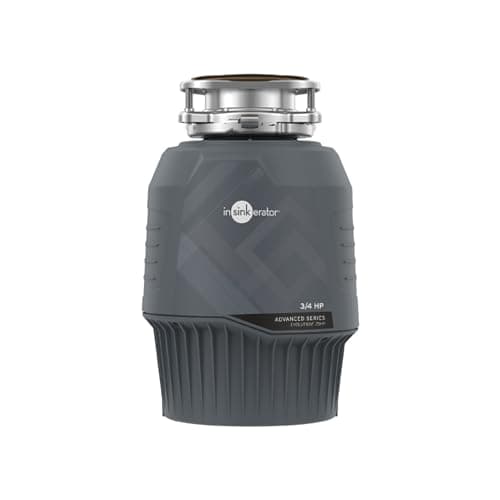
InSinkErator Evolution .75HP
InSinkErator · Best for households of three to five
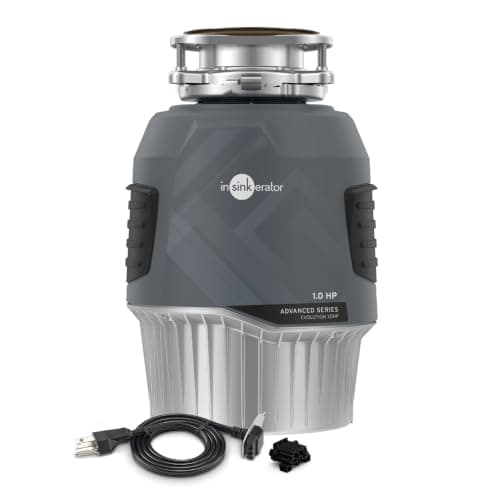
The disposal we would fit in most houses. Three-quarters of a horsepower with three-stage grinding and stainless grind components is the point on the range where fibrous waste stops being a gamble, and SoundSeal makes it noticeably quieter than a Badger. The nine-year in-home warranty is the longest of any InSinkErator continuous-feed unit we checked.
Published specifications
- Motor
- 3/4 HP Dura-Drive induction source
- Grind stages
- Three-stage MultiGrind source
- Grind components
- Stainless steel source
- Overall height
- 12.25" source
- Sound
- SoundSeal — quieter than a standard disposal source
- Septic
- Safe for properly maintained septic tanks source
- Warranty
- 9-year We Come to You limited service warranty source
What works
- Three grind stages and stainless components — the two specs that decide whether fibrous scraps jam
- Only three-quarters of an inch taller than a Badger 5, so it fits most cabinets that took one
- Nine-year in-home warranty, which is a real statement about expected service life
- EZ Connect cord and hardwire adapter in the box, so it suits either wiring situation
What does not
- InSinkErator publishes no decibel figure, and neither do we — SoundSeal is a comparison, not a measurement
- 3/4 HP still stalls on bones and fruit pits; no domestic disposal is a bone grinder
- Chamber capacity is not published for this model
Skip it if
Skip it if you are one or two people who scrape plates and little else — you would be paying for capability you will not use.
#ad Affiliate link · Price as of October 16, 2026
Raw specifications: InSinkErator’s own page for the InSinkErator Evolution .75HP.
Product photograph supplied by Amazon for this listing, used under the Associates program.
2. Longest warranty overall
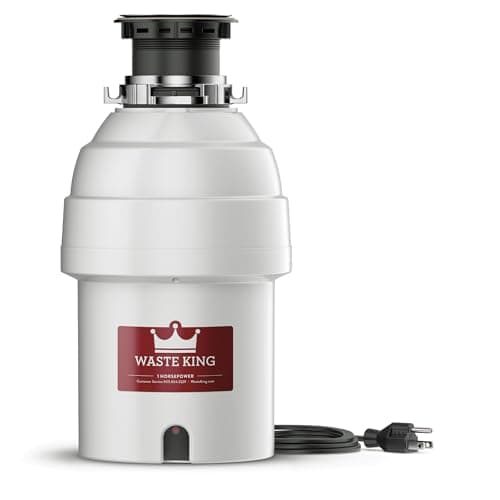
Waste King Legend L-8000
Waste King · Best for value 1 hp with a cord fitted
A different engineering answer to the same problem: a 2800 rpm permanent-magnet motor instead of a slower induction motor with more grind stages. High speed rather than high torque, in a lighter and narrower body, with a 20-year warranty and a factory-fitted power cord. This is the value 1 HP unit.
Published specifications
What works
- 2800 rpm is the highest motor speed here; speed does the work that extra grind stages do on an InSinkErator
- Under 12 lb, which makes a one-person overhead installation genuinely possible
- Power cord pre-attached — no separate cord kit, no wiring
- A 20-year limited warranty at this price is unusual
What does not
- High-speed permanent-magnet motors are louder in character than slow induction motors, and no party publishes a comparable decibel figure
- Single-stage grinding, so output fineness is not comparable to a three-stage MultiGrind
- Waste King's parts network is smaller than InSinkErator's
Skip it if
Skip it if grind fineness matters — on a septic system, for instance, where finer output is the whole point. Three stages beat high rpm there.
Raw specifications: Waste King’s own page for the Waste King Legend L-8000.
Product photograph supplied by Amazon for this listing, used under the Associates program.
3. Shortest warranty here
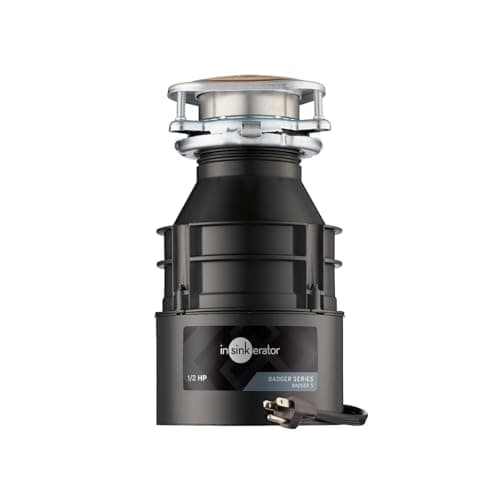
InSinkErator Badger 5
InSinkErator · Best for one or two people, tight cabinets
The baseline every other disposal is measured against, and an honest buy for a small household as long as you know what you are getting: half a horsepower, one grind stage, and galvanized steel grind components rather than stainless. It is short at 11-1/2", which is often the deciding factor in a shallow cabinet.
Published specifications
What works
- Shortest unit here at 11-1/2" — it fits cabinets a 1 HP unit cannot
- Cheapest route to a working disposal from the brand with the best parts availability
- Genuinely adequate for soft scraps: peelings, plate scrapings, coffee grounds
- In-home warranty service rather than ship-it-back
What does not
- Galvanized grind components, not stainless — this is the real difference between Badger and Evolution
- One grind stage, so fibrous waste like celery and corn husks is where it stalls
- No sound insulation of any kind, and the product page makes no noise claim
Skip it if
Skip it if you cook for four or more, or if anything fibrous goes down the drain. Buy 3/4 HP with three stages instead.
#ad Affiliate link · Price as of October 16, 2026
Raw specifications: InSinkErator’s own page for the InSinkErator Badger 5.
Product photograph supplied by Amazon for this listing, used under the Associates program.
4. Best maintenance
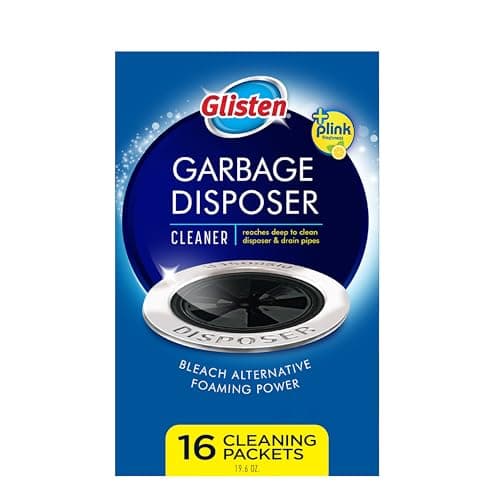
Glisten Disposer Care foaming cleaner
Glisten (Summit Brands) · Best for odor from the chamber walls
The product to reach for when a disposal smells, because the foam is the mechanism: the odor lives in the film on the chamber walls and the underside of the splash guard, where running water never reaches. A foaming cleaner expands into that space. Ice cubes and lemon peel scour the impellers, which are not where the smell is.
Published specifications
What works
- Foam reaches the upper chamber and the baffle underside, where the odor actually is
- Takes two minutes and no disassembly
- Single-use packets, so there is no part-used bottle under the sink
- Safe for the disposal itself, unlike a caustic drain opener
What does not
- It is a cleaner, not a repair: a smell that returns in two days is a trapped-food or trap problem
- Cost per use is high compared with removing the splash guard and scrubbing it
- The manufacturer publishes no independent efficacy testing, and we have measured none
Skip it if
Skip it if the smell comes back within a day or two — that is a blocked trap or food caught above the baffle, and cleaner fixes neither.
#ad Affiliate link · Price as of October 16, 2026
Raw specifications: Glisten (Summit Brands)’s own page for the Glisten Disposer Care foaming cleaner.
What makes one last longer
Most of it is use, not luck. Run cold water while grinding and for a few seconds after, so waste leaves the chamber instead of sitting in it. Feed it steadily rather than packing the chamber and switching on. And keep the things that genuinely damage a disposal out of it — bones, fruit pits, fibrous husks, coffee grounds in quantity, and above all grease, which solidifies downstream of the unit.
What not to put in a garbage disposal is the full list. A monthly clean with a foaming cleaner keeps the chamber walls and the underside of the splash guard from building up a biofilm, which is where the smell lives — garbage disposal smells covers the diagnosis and best disposal cleaners the products.
Repair or replace
The rule of thumb: if the fault is outside the sealed unit, fix it. Mounting rings, splash guards, dishwasher inlet plugs, discharge tubes and traps are all cheap parts and straightforward work. If the fault is inside — bearings, seal, motor, grind ring — replace the whole disposal. There is no economic repair for a sealed motor assembly.
Replacement is also easier than most people expect, especially like-for-like within a brand: the mounting assembly often stays, and the job is a disconnect, a twist and a reconnect. How to replace a garbage disposal is the procedure, and the best garbage disposals is where to start choosing.
What to take away
- Expect roughly 8 to 15 years; no maker or laboratory publishes a measured average, so treat precise figures with suspicion.
- Published warranties are the honest signal: 5 years on a Badger 5, 9 on the 3/4 HP Evolution, 20 on a Waste King L-8000.
- Galvanized grind components corrode where stainless does not - the clearest build-quality difference.
- Bearings, shaft seal and motor are what end a disposal, and none of them is economically repairable.
- Faults outside the sealed unit - flange, splash guard, dishwasher inlet, discharge, trap - are all worth fixing.
- Cold water while grinding, steady feeding and keeping grease out is most of what extends service life.
How we sourced this page
Every figure on this page came from one of the following. Where a manufacturer or an independent lab does not publish a number, we say so rather than estimate it.
- InSinkErator Badger 5 product page (published specifications)
- InSinkErator Badger 5 job specification sheet (PDF)
- InSinkErator Evolution .75HP product page (published specifications)
- InSinkErator Evolution 1HP specification sheet (published as Evolution Excel, PDF)
- InSinkErator Evolution Cover Control product page (published specifications)
- Waste King Legend L-8000 specification sheet (PDF)
- Glisten Disposer Care garbage disposer cleaner (Summit Brands)
- Consumer Reports — garbage disposal ratings and test program (grind speed, grind fineness, noise)
Common questions
- How long should a garbage disposal last?
- Roughly 8 to 15 years in a normal household. The published warranties bracket it usefully: five years in-home on a builder-grade Badger 5, nine on InSinkErator's 3/4 HP Evolution, and 20 limited years on the Waste King L-8000. No manufacturer publishes a measured service life.
- How do I know if my garbage disposal needs replacing?
- The decisive signs are a hum without rotation that keeps coming back, a leak from the body seam rather than from a connection, and resets that get more frequent. Coarser output and a new metal noise point the same way. Faults at the flange, splash guard or discharge are repairable instead.
- Is it worth repairing a garbage disposal?
- If the problem is outside the sealed unit, yes - mounting rings, splash guards, dishwasher inlets, discharge tubes and traps are cheap and straightforward. If it is the motor, the bearings or the shaft seal, no. A sealed motor assembly has no economic repair.
- Does using a garbage disposal every day shorten its life?
- Daily use is what they are built for, and is not the problem. What shortens life is what goes in and how: grease, bones, pits and fibrous husks, packing the chamber full before switching on, and grinding without cold water running. Normal daily scraps with water running cost it nothing.
More in Garbage Disposals
Horsepower is the number on the box and it is not the number that decides whether your disposal jams. Grind stages and component material do. Here is how the three fit together.
Read next
How to
Replace a garbage disposal
What is reusable, what always gets replaced, and how to handle a size or brand change without re-plumbing.
Troubleshooting
Humming, not grinding
Free the jammed impeller plate with the hex wrench, in the right order, with the breaker off first.
Troubleshooting
Disposal leaking diagnosis
Three leak locations on a disposal, what each one means, and which of them is terminal.
Guide
What not to put in a disposal
Twelve things to keep out, the specific reason for each, and which are jam risks versus slow-building drain risks.
Best garbage disposal
Best garbage disposals
Five disposals compared on the three specs that actually predict performance — and the height measurement that decides fit.
Best disposal cleaner
Best disposal cleaners
Why foaming cleaners work where ice cubes do not, which two to buy, and when the smell means something else entirely.
Found something out of date, or a figure you can source better than we did? Tell us — corrections get read first. Our methodology explains how picks are made, and contact is one click away.