Garbage Disposals
The best garbage disposals for septic systems
On a septic field the question is not horsepower, it is how finely the unit grinds - and only one maker here puts a septic statement in writing.
Disclosure: we earn a commission if you buy through the Amazon links on this page, at no extra cost to you. Commission never decides a verdict or a ranking position — read our editorial policy and affiliate disclosure.
How we assessed these: we rank only on figures the maker publishes for the named model number, read from each maker's own product page or spec sheet and linked at every figure. We have not installed these disposals and we do not own them. No independent laboratory publishes comparable decibel or grind-fineness testing for domestic garbage disposals, so no such number appears anywhere on this page.
Short answer
The best garbage disposal for a septic system is the InSinkErator Evolution .75HP: it is the only unit in this registry whose maker publishes a septic statement - "safe for properly maintained septic tanks" - and it grinds in three stages with stainless components, which is what produces the fine output a septic field can handle. The budget pick is the InSinkErator Badger 5, the cheapest way in, with the honest caveat that it has one grind stage and galvanized grind components, so it suits a small household that scrapes plates rather than one that puts real food waste down the drain.
The reason this is a real question and not a marketing one: a septic tank works by letting solids settle and bacteria digest them. Anything that arrives as coarse fragments settles as sludge, and sludge is what fills a tank between pump-outs. So the figure that matters is not horsepower - it is grind fineness, and the published proxy for grind fineness is the number of grind stages. A three-stage unit passes the waste through successive reductions; a single-stage unit cuts once and sends it on. Garbage disposals and septic systems covers the tank side of the question in full.
Quick picks
Tap any row to jump to the full write-up. There are no scores here because we run no test lab — how picks are chosen is published in full on our methodology page.
| # | Product | Best for | Our read | Price |
|---|---|---|---|---|
| 1 | 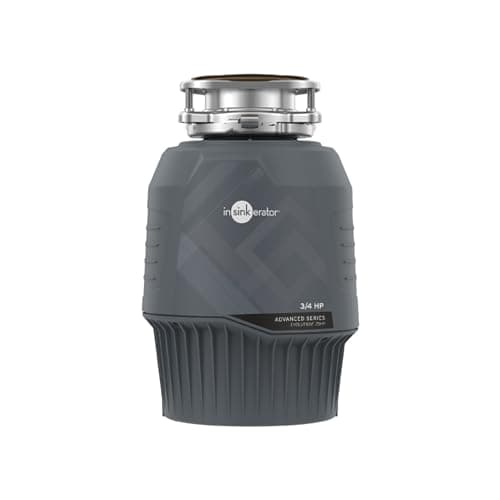 InSinkErator Evolution .75HP Best overall | Households of three to five | The only published septic statement, plus three grind stages | $289.95 · View on Amazon #ad Affiliate link · Price as of November 28, 2026 |
| 2 | 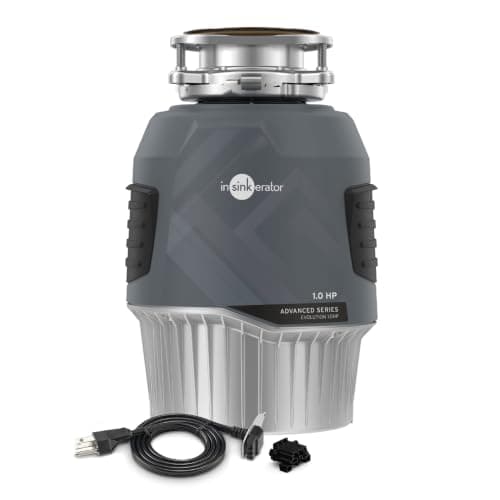 InSinkErator Evolution 1HP Best for a large household | Large households, frequent jams | 1 HP with three stages and a jam-breaking circuit | |
| 3 | 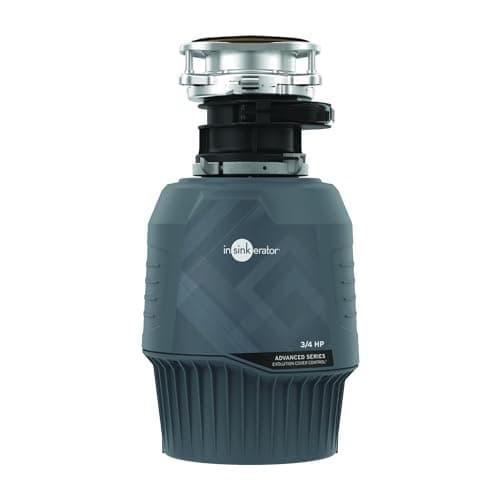 InSinkErator Evolution Cover Control Best batch feed | Households with small children | Three stages, and it cannot run with the drain open | $321.98 · View on Amazon #ad Affiliate link · Price as of November 28, 2026 |
| 4 | 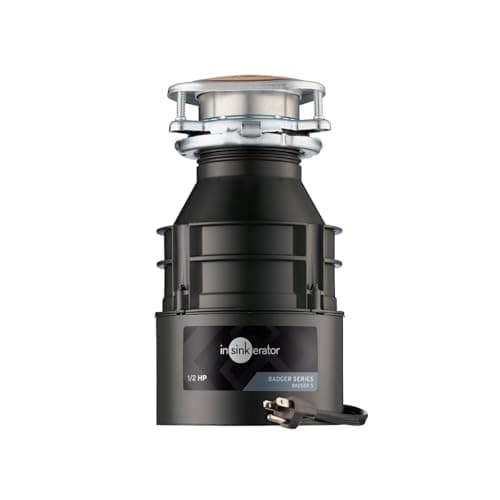 InSinkErator Badger 5 Budget pick | One or two people, tight cabinets | Cheapest route in, with a single-stage caveat |
Stages beat horsepower here
This is the one page on this site where we would steer you away from the highest-horsepower-per-dollar unit. The two Waste King units in this registry reach 3/4 and 1 HP with a fast permanent-magnet motor and a single grind stage - speed rather than repetition - and that produces a coarser output than a slower three-stage InSinkErator at the same nominal power. On a municipal sewer that difference is academic. On a septic field it is the whole question, which is why neither Waste King unit is a pick here despite both being cheaper than everything on the list.
The same logic rules out the Badger 5XP: it is a genuine 3/4 HP upgrade with stainless grind components, but InSinkErator publishes one grind stage for it. More power through one stage is not finer output. Three-quarter vs 1 HP garbage disposals and half HP vs three-quarter HP set the horsepower question out properly for kitchens that are not on septic.
| Model | Motor | Grind stages | Grind components | Septic statement |
|---|---|---|---|---|
| InSinkErator Evolution .75HP | 3/4 HP Dura-Drive induction | Three-stage MultiGrind | Stainless steel | Safe for properly maintained septic tanks |
| InSinkErator Evolution 1HP | 1.0 HP, 1725 rpm | Three-stage MultiGrind | Stainless steel | Not published for this model |
| InSinkErator Evolution Cover Control | 3/4 HP Dura-Drive induction | Three-stage MultiGrind | Rust-resistant stainless steel | Not published for this model |
| InSinkErator Badger 5 | 1/2 HP, 1725 rpm | One | Galvanized steel with stainless swivel lugs | Not published for this model |
Read from each model's own InSinkErator page or spec sheet, linked below. Only the Evolution .75HP publishes a septic statement; for the others we rank on grind stages, which is the published figure closest to output fineness. No maker and no laboratory publishes a particle-size measurement for a domestic disposal, so none appears here.
Product photograph supplied by Amazon for this listing, used under the Associates program.
1. Best overall
InSinkErator Evolution .75HP
InSinkErator · Best for households of three to five
The disposal we would fit in most houses. Three-quarters of a horsepower with three-stage grinding and stainless grind components is the point on the range where fibrous waste stops being a gamble, and SoundSeal makes it noticeably quieter than a Badger. The nine-year in-home warranty is the longest of any InSinkErator continuous-feed unit we checked.
Published specifications
- Motor
- 3/4 HP Dura-Drive induction source
- Grind stages
- Three-stage MultiGrind source
- Grind components
- Stainless steel source
- Overall height
- 12.25" source
- Sound
- SoundSeal — quieter than a standard disposal source
- Septic
- Safe for properly maintained septic tanks source
- Warranty
- 9-year We Come to You limited service warranty source
What works
- Three grind stages and stainless components — the two specs that decide whether fibrous scraps jam
- Only three-quarters of an inch taller than a Badger 5, so it fits most cabinets that took one
- Nine-year in-home warranty, which is a real statement about expected service life
- EZ Connect cord and hardwire adapter in the box, so it suits either wiring situation
What does not
- InSinkErator publishes no decibel figure, and neither do we — SoundSeal is a comparison, not a measurement
- 3/4 HP still stalls on bones and fruit pits; no domestic disposal is a bone grinder
- Chamber capacity is not published for this model
Skip it if
Skip it if you are one or two people who scrape plates and little else — you would be paying for capability you will not use.
#ad Affiliate link · Price as of November 28, 2026
Raw specifications: InSinkErator’s own page for the InSinkErator Evolution .75HP.
Product photograph supplied by Amazon for this listing, used under the Associates program.
2. Best for a large household
InSinkErator Evolution 1HP
InSinkErator · Best for large households, frequent jams
The full-horsepower option, and the only one here with a published jam-breaking mechanism: the Jam-Sensor circuit raises motor torque by 500% to clear a stall instead of tripping the reset. If you have a large household and a history of resetting a disposal weekly, this is what that problem costs to solve.
Published specifications
- Motor
- 1.0 HP, single phase, 120 V, 60 Hz, 1725 rpm source
- Grind stages
- Three-stage MultiGrind, against one on a standard disposal source
- Grind components
- Stainless steel source
- Jam handling
- Jam-Sensor circuit increases motor torque 500% to break jams source
- Sound
- SoundSeal, plus the Quiet Collar sound-reducing baffle source
- Overall height
- 13" source
- Weight
- 23.0 lb shipping weight source
- Warranty
- 7-year parts and in-home service source
What works
- Jam-Sensor is the one published feature that addresses the most common disposal complaint
- The Quiet Collar baffle is included rather than sold separately, and the baffle is most of the perceived noise fix
- 1 HP with three stages handles the fibrous waste that stalls half-horsepower units
- InSinkErator publishes a full spec sheet including amperage and RPM
What does not
- 13 inches tall and 23 lb — the largest unit here, and the most likely to foul a shallow cabinet or a P-trap
- Seven-year warranty is shorter than the 3/4 HP Evolution's nine
- 1 HP does not make it a bone grinder; the failure point just moves
Skip it if
Skip it if your cabinet is shallow or your trap arm sits high — measure the 13-inch height before buying horsepower you cannot fit.
Raw specifications: InSinkErator’s own page for the InSinkErator Evolution 1HP.
Product photograph supplied by Amazon for this listing, used under the Associates program.
3. Best batch feed
InSinkErator Evolution Cover Control
InSinkErator · Best for households with small children
The batch-feed pick, and the only disposal here that cannot run with the drain open. A magnet in the cover starts it, so there is no wall switch and no way for a spoon — or a hand — to be in the chamber while the motor turns. That is the entire argument for batch feed, and in a household with small children it is a good one.
Published specifications
- Motor
- 3/4 HP Dura-Drive induction source
- Feed type
- Batch source
- Grind stages
- Three-stage MultiGrind source
- Grind components
- Rust-resistant stainless steel source
- Activation
- Magnetic CoverStart — runs only when the cover is on source
- Overall height
- 14.95" source
- Warranty
- 9-year limited service warranty with in-home repair or replacement source
What works
- Cannot run uncovered, which removes the one genuine safety failure mode of a continuous-feed disposal
- No wall switch to install, a real saving if there is no switch there now
- Same 3/4 HP three-stage grinding platform as the continuous-feed Evolution
- Nine-year in-home warranty
What does not
- At 14.95 inches it is the tallest unit here, and batch-feed bodies are wide as well as tall
- You cannot feed scraps continuously while rinsing — the workflow is genuinely slower
- The cover is a part that can be lost, and the disposal will not run without it
Skip it if
Skip it if you scrape a sink full of prep waste in one go and want to run water over it as it grinds. Buy continuous feed and an air switch.
#ad Affiliate link · Price as of November 28, 2026
Raw specifications: InSinkErator’s own page for the InSinkErator Evolution Cover Control.
Product photograph supplied by Amazon for this listing, used under the Associates program.
4. Budget pick
InSinkErator Badger 5
InSinkErator · Best for one or two people, tight cabinets
The baseline every other disposal is measured against, and an honest buy for a small household as long as you know what you are getting: half a horsepower, one grind stage, and galvanized steel grind components rather than stainless. It is short at 11-1/2", which is often the deciding factor in a shallow cabinet.
Published specifications
What works
- Shortest unit here at 11-1/2" — it fits cabinets a 1 HP unit cannot
- Cheapest route to a working disposal from the brand with the best parts availability
- Genuinely adequate for soft scraps: peelings, plate scrapings, coffee grounds
- In-home warranty service rather than ship-it-back
What does not
- Galvanized grind components, not stainless — this is the real difference between Badger and Evolution
- One grind stage, so fibrous waste like celery and corn husks is where it stalls
- No sound insulation of any kind, and the product page makes no noise claim
Skip it if
Skip it if you cook for four or more, or if anything fibrous goes down the drain. Buy 3/4 HP with three stages instead.
Raw specifications: InSinkErator’s own page for the InSinkErator Badger 5.
What else to get right on a septic field
- Run plenty of cold water. Cold water for at least as long as the unit runs, and a few seconds after. Water is what carries the ground waste out to the tank rather than leaving it in the trap arm.
- Keep grease out. Grease is the one input that is worse on septic than anywhere else: it floats, it does not digest, and it is the main reason a field fails early. No disposal changes this.
- Keep fibrous waste out. Celery strings, corn husks and onion skins wrap rather than grind, and a single-stage unit will pass them through nearly intact. What not to put in a garbage disposal is the full list.
- Plan on a shorter pumping interval. Assume more frequent pump-outs than a comparable household without a disposal, and ask whoever services the tank to tell you what they find.
Which one to buy
- Buy the InSinkErator Evolution .75HP if you want one answer. The only published septic statement here, three grind stages, stainless components, a nine-year in-home warranty and a body only three-quarters of an inch taller than a Badger 5.
- Buy the InSinkErator Evolution 1HP for a large household: the same three-stage grinding at 1 HP, plus a published Jam-Sensor circuit that raises torque 500 percent to clear a stall - useful where more waste means more jams.
- Buy the InSinkErator Evolution Cover Control if you want batch feed. Three-stage grinding on the same platform, and it will not run unless the cover is on, which is the right answer in a house with small children.
- Buy the InSinkErator Badger 5 as the budget pick, with the caveat stated plainly: one grind stage and galvanized grind components. It is the cheapest way to have a disposal on a septic system, not the right one if real food waste goes down the drain.
What to take away
- On septic the figure that matters is grind fineness, and grind stages are the published proxy for it.
- Only the Evolution .75HP publishes a septic statement in this registry; everything else is ranked on stages.
- High horsepower through a single stage is coarser than lower horsepower through three - which is why the cheapest high-HP units are not picks here.
- A disposal increases the solids load on a tank, so expect a shorter pumping interval.
- Grease and fibrous waste are worse on septic than anywhere else, and no disposal fixes either.
- Cold water while the unit runs, and for a few seconds after, is what carries the output to the tank.
How we sourced this page
Every figure on this page came from one of the following. Where a manufacturer or an independent lab does not publish a number, we say so rather than estimate it.
- InSinkErator Evolution .75HP product page (published specifications)
- InSinkErator Evolution 1HP specification sheet (published as Evolution Excel, PDF)
- InSinkErator Evolution 1HP product page (published specifications)
- InSinkErator Evolution Cover Control product page (published specifications)
- InSinkErator Badger 5 product page (published specifications)
- InSinkErator Badger 5 job specification sheet (PDF)
- InSinkErator Badger 5XP product page (published specifications)
- US EPA — How to care for your septic system
Common questions
- What is the best garbage disposal for a septic system?
- The InSinkErator Evolution .75HP. It is the only unit in this registry whose maker publishes a septic statement - safe for properly maintained septic tanks - and it grinds in three stages with stainless components, which is what produces the fine output a septic field can process.
- Can you use a garbage disposal with a septic tank?
- Yes, with two conditions. The output needs to be fine, which means a multi-stage unit rather than a single-stage one, and the tank needs pumping more often than it would without a disposal. The EPA's own septic guidance is explicit that a disposal increases the solids load on the system.
- Does a garbage disposal fill a septic tank faster?
- Yes. Everything you grind still arrives at the tank; grinding only changes the particle size. Finer particles are easier for bacteria to digest, which is the point of a multi-stage unit, but the mass is unchanged - so plan on a shorter pumping interval than a comparable household without one.
- Is horsepower or grind stages more important on septic?
- Grind stages. Horsepower decides whether the unit stalls; stages decide how fine the output is, and fineness is what a septic field cares about. A fast single-stage 1 HP unit produces coarser output than a slower three-stage 3/4 HP one, which is the opposite of what you want on a tank.
More in Garbage Disposals
Horsepower is the number on the box and it is not the number that decides whether your disposal jams. Grind stages and component material do. Here is how the three fit together.
Read next
Best for septic systems
Disposals and septic systems
What septic-safe actually means, why grind fineness matters more than a badge, and how it changes your pumping interval.
Best garbage disposal
Best garbage disposals
Five disposals compared on the three specs that actually predict performance — and the height measurement that decides fit.
Head to head
3/4 HP vs 1 HP
What the step from 3/4 to 1 HP actually changes, where it does not, and why the two 1 HP units here solve the same problem in opposite ways.
Guide
What not to put in a disposal
Twelve things to keep out, the specific reason for each, and which are jam risks versus slow-building drain risks.
Best InSinkErator
Best InSinkErator models
Five InSinkErator models compared on motor, grind stages, grind material, height and warranty, with the one specification that separates the two families.
Best warranty
Best warranties
Five disposals ranked on published warranty term and service type - in-home repair against ship-it-back replacement.
Found something out of date, or a figure you can source better than we did? Tell us — corrections get read first. Our methodology explains how picks are made, and contact is one click away.