Guides
Pull-down faucet will not retract
The wand hangs an inch proud, or does not come back at all. It is nearly always the hose or the weight, and nearly never the faucet.
Disclosure: we earn a commission if you buy through the Amazon links on this page, at no extra cost to you. Commission never decides a verdict or a ranking position — read our editorial policy and affiliate disclosure.
How we assessed these: this is a diagnostic sequence, not a repair timing or a cost. Product specifications are linked to each manufacturer's own page. No manufacturer or laboratory publishes docking failure rates, so this page explains mechanisms rather than quoting statistics.
Short answer
Four causes, in order of likelihood: the counterweight has slipped or was clipped in the wrong place on the hose, the hose is snagged on something in the cabinet, the hose has kinked or stiffened, or the docking mechanism itself has worn. Start by opening the cabinet and watching the hose while someone pulls the wand out and lets it go — the fault almost always shows itself in the first ten seconds.
A wand that stops seating is the single most commonly reported complaint about pull-down and pull-out faucets, and it is also the most commonly misdiagnosed. People conclude the faucet is finished and buy another one. In most cases the faucet is fine and something below the sink is preventing a system that relies on gravity from doing what gravity does.
How retraction actually works
On a pull-down faucet, the hose runs from the wand down through the spout and the faucet body into the cabinet, where it connects to the valve. A weight clipped to that hose pulls the slack back down when you let go, which draws the wand up into the spout. The last part of the journey is the docking mechanism holding the wand in place once it arrives.
So there are two distinct failures hiding behind one symptom. If the wand comes most of the way home but sits proud or droops out again, that is docking. If the wand does not come back at all, or has to be pushed, that is the hose or the weight. Telling those apart is the first thing to do and it takes seconds.
Cause one: the counterweight
By a wide margin the commonest cause. The weight is a metal block or barbell clipped to the hose, and where it sits on the hose is not arbitrary — it has to be at the lowest point of the hose's travel so that gravity has the longest pull. If it has slid up the hose, been clipped on at the wrong point during installation, or come off entirely, retraction weakens or stops.
- Open the cabinet and find the weight on the hose.
- Have someone pull the wand fully out at the sink and then release it, while you watch what the weight does.
- If the weight does not travel smoothly down, or barely moves, reposition it — generally lower on the hose, at the bottom of the loop.
- Check it is actually clamped. A weight that slips under load does nothing.
- Make sure the weight hangs clear of the cabinet floor, the trap, the disposal and anything stored underneath.
Manufacturers publish the correct weight position in their installation instructions for the specific model, and that is the authority — positions differ between a pull-down with a short hose and a pull-out with a 59 or 68-inch one. If you still have the paperwork, use it.
Cause two: the hose is snagged
The second commonest, and the most satisfying to fix. Everything stored under a kitchen sink lives exactly where the hose needs to travel. Bottles, bins, a shelf, the disposal body, the trap, a water filter, the dishwasher hose — any of them can catch the loop or the weight and stop it falling.
Empty the cabinet, operate the faucet, and watch. If the problem vanishes with an empty cabinet, it was storage, and the fix is to keep that corridor clear rather than to buy anything. A disposal is a frequent culprit because it occupies the space the hose wants — garbage disposal sizing and fit covers the clearances involved.

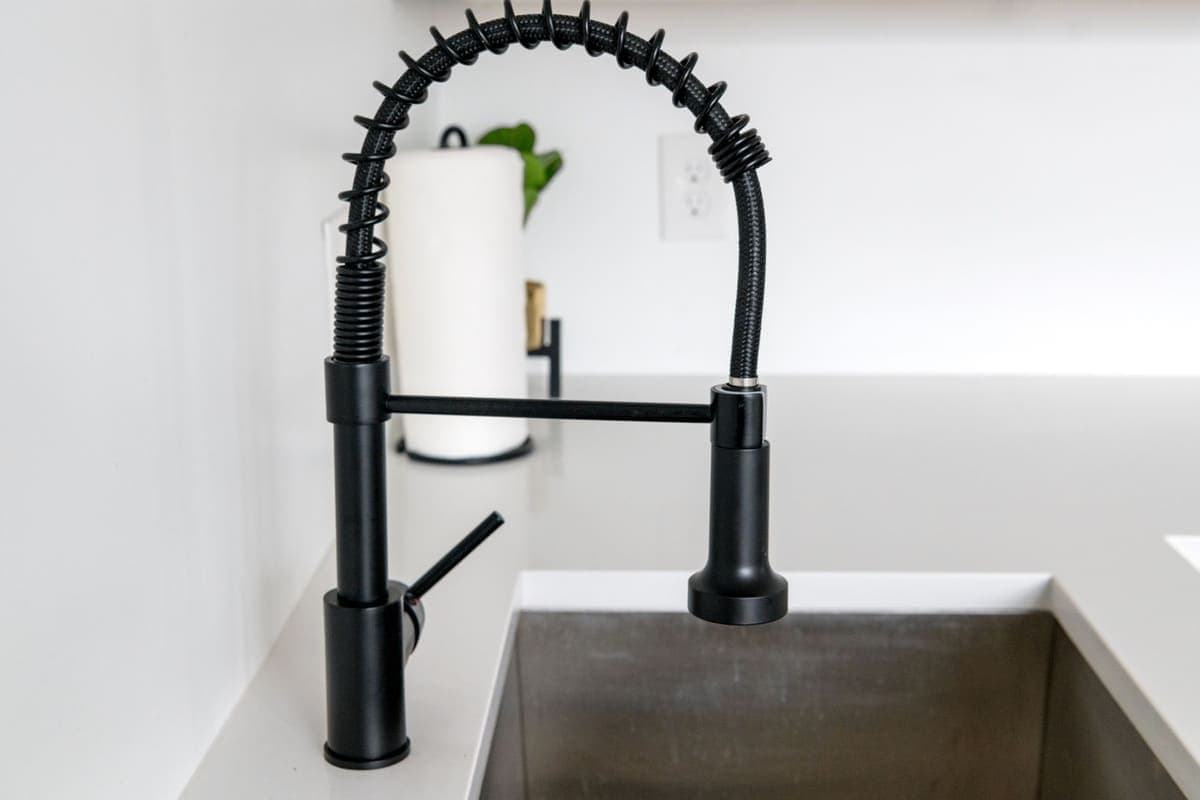
Photograph shows the product category, not this specific unit. We do not republish manufacturer product photography.
1. Best docking mechanism
Delta Leland 9178-AR-DST
Delta · Best for most kitchens, one or three holes
The pull-down we would fit in most kitchens, because the two parts that usually fail first on a pull-down are the two Delta engineered around: the docking mechanism and the valve. MagnaTite pulls the wand back into the spout with a magnet instead of relying on a friction collar, and Diamond Seal keeps water off the valve. It ships with a deck plate, so it covers a three-hole sink or mounts through one.
Published specifications
- Flow rate
- 1.8 gpm source
- Spout height
- 7-7/8" deck to outlet source
- Spout reach
- 9-3/16" source
- Overall height
- 14-7/8" source
- Mounting
- Single hole; deck plate included for three-hole sinks source
- Supply lines
- Integrated InnoFlex PEX, pre-attached at the valve source
- Connection
- 3/8" compression source
- Warranty
- Delta limited lifetime source
- Lead compliance
- Meets NSF/ANSI 61 source
What works
- MagnaTite docking is a magnet, not a friction fit — a wand that stops seating is the most common pull-down complaint, and a magnet does not wear the way a plastic collar does
- Spout reach of 9-3/16" clears the far side of a standard 22-inch front-to-back sink
- Diamond Seal keeps water off the valve, which is what the lifetime warranty is really protecting
- Deck plate in the box, so a three-hole sink needs no extra part
What does not
- 1.8 gpm is higher than the 1.5 gpm most competitors now ship, which matters if your area caps flow rate
- Zinc body rather than brass — normal at this price, but this is not a forever faucet
- No independent lab publishes durability figures for this model, so we cannot tell you how the finish looks at year five
Skip it if
Skip it if your sink is a shallow bar sink: at 14-7/8" overall the arc will splash in a basin under about seven inches deep.
#ad Affiliate link · We publish no price; Amazon shows the current one
Raw specifications: Delta’s own page for the Delta Leland 9178-AR-DST.
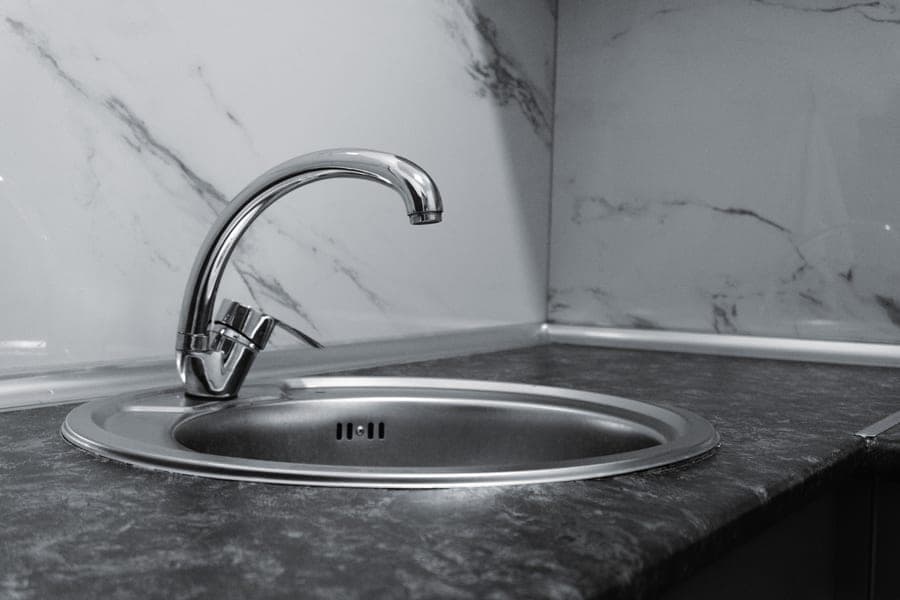
Photograph shows the product category, not this specific unit. We do not republish manufacturer product photography.
2. Best magnetic alternative
Kohler Simplice K-596
Kohler · Best for wide bowls and long reach
The value pick with the longest reach of the three mainstream pull-downs, and the only one whose third spray function is genuinely useful rather than a novelty: Boost raises flow by 30% while you hold it, then drops back to 1.5 gpm. If your sink is wide, this is the one that reaches.
Published specifications
What works
- 9" reach, matching the longest in this roundup
- Boost is a real feature: 30% more flow on demand, then back to 1.5 gpm
- Sweep spray is a blade rather than a cone, which is better at pushing debris toward a drain
- Kohler publishes a full dimensional spec sheet, which makes hole and cabinet planning easy
What does not
- A three-function head has more moving parts than a two-function one, which is more to go wrong
- The gooseneck shape sets the handle further back than some people like on a shallow deck
- No published independent test data on this model, from anyone
Skip it if
Skip it if you want the simplest possible faucet — a two-function wand is one less thing to break.
#ad Affiliate link · We publish no price; Amazon shows the current one
Raw specifications: Kohler’s own page for the Kohler Simplice K-596.
Photograph shows the product category, not this specific unit. We do not republish manufacturer product photography.
3. Best parts availability
Moen Arbor 7594
Moen · Best for deep pots and hard-water kitchens
The pull-down to buy if you want the taller arc and a finish that hides water spots. Its 8-1/4" spout height is about half an inch more clearance than the Leland, which is the difference between washing a stock pot and fighting one. The tradeoff is reach: 7-7/8" against 9-3/16", so it works closer to the back of the bowl.
Published specifications
What works
- The 8-1/4" spout height is genuine pot clearance, not decorative arc
- Power Boost concentrates the stream for filling and rinsing without raising the rated flow
- Spot Resist Stainless is the single most useful finish choice in a hard-water house
- Reflex docking has been in Moen's line long enough that replacement wands are easy to find
What does not
- Reach is 7-7/8", over an inch shorter than the Leland — on a wide double bowl you will notice
- Moen publishes no independent noise or durability measurement, and neither do we
- The spot-resist coating is a finish, not armor; abrasive cleaners still dull it
Skip it if
Skip it if you have a wide double-bowl sink and want one faucet to reach both drains comfortably — buy reach instead of height.
#ad Affiliate link · We publish no price; Amazon shows the current one
Raw specifications: Moen’s own page for the Moen Arbor 7594.
Cause three: the hose itself
Hoses kink, stiffen and take a set over years of being pulled and released. A hose with a permanent bend in it resists traveling through the faucet body, and no amount of weight overcomes a kink. Run the hose through your fingers along its whole length looking for a flattened section or a sharp bend that does not relax.
If the hose is the problem, replacement is the fix, and whether that is easy depends entirely on what the maker sells. Moen publishes Duralock quick connect on the Arbor and the Method, which makes the hose a push-fit part, and Moen's parts channel stocks hoses for models it stopped selling years ago. Delta ships integrated InnoFlex lines on the Leland. A budget faucet with a proprietary molded hose assembly may have no replacement available at all — which is the whole argument in how long do kitchen faucets last.
Cause four: the docking mechanism
If the wand arrives home and will not stay, the hose and weight are doing their job and the docking is not. What that means depends on which mechanism the faucet uses. Delta's MagnaTite and Kohler's DockNetik are magnetic: a magnet in the spout and a steel plate in the wand, with no contact surface. Moen's Reflex uses a counterweight and a shaped seat, holding the wand by fit.
On a magnetic faucet, check for anything between the magnet and the plate — limescale, grease, a dislodged spray face. Clean both surfaces. A permanent magnet does weaken, but extremely slowly, and in practice reported failures are hose and weight problems rather than dead magnets. On a seat mechanism, check the seat for scale and the wand for a deformed collar.
When to replace the faucet instead
Replace the faucet if the hose is unavailable, if the spout outlet is physically damaged, or if the body has a crack or a stripped thread. Everything else on this page is a cheap part or a free adjustment. A faucet that cannot be bought a hose for is finished whatever condition the rest of it is in, and that is a parts-channel judgment rather than a quality one.
If you are replacing, the specification to shop on is the docking mechanism, because it is the one that addresses this exact failure. Best kitchen faucets with magnetic docking collects the faucets with a magnet, and best pull-down kitchen faucets is the broader roundup. When the new one arrives, how to install a kitchen faucet is the procedure.
What to take away
- Watch the hose from inside the cabinet while someone works the wand. The fault usually shows itself immediately.
- A wand that will not come back at all is a hose or weight problem; one that comes back and droops is docking.
- The counterweight is the commonest cause: wrong position, slipped, or fouling something in the cabinet.
- Everything stored under the sink lives exactly where the hose needs to travel. Empty it and retest.
- Descale the wand and spout outlet before concluding the docking has failed. Scale is the quiet cause.
- Replace the faucet only when the hose is unavailable or the body is damaged — everything else is a cheap fix.
How we sourced this page
Every figure on this page came from one of the following. Where a manufacturer or an independent lab does not publish a number, we say so rather than estimate it.
Common questions
- Why will my pull-down faucet not retract?
- Usually the counterweight on the hose under the sink: it has slipped, was clipped in the wrong place, or is fouling something stored in the cabinet. After that, a snagged or kinked hose, and only then the docking mechanism itself. Open the cabinet and watch the hose while someone works the wand.
- Where should the counterweight go on a pull-down faucet hose?
- At the lowest point of the hose's travel, so gravity has the longest pull, and hanging clear of the cabinet floor, trap, disposal and anything stored underneath. The exact position differs by model and the manufacturer's installation instructions are the authority — a pull-out with a 59-inch hose is not the same as a short-hose pull-down.
- How do you fix a kitchen faucet sprayer that will not stay up?
- If it comes home and then droops, the docking is the issue rather than the hose. Clean the wand's docking face and the spout outlet, since limescale and grease build up there. On a magnetic faucet check nothing is between the magnet and the plate; on a seat mechanism check the seat and the wand collar for scale or deformation.
- Can you replace the hose on a pull-down kitchen faucet?
- On a major brand, usually yes, and on some faucets it is a push-fit part — Moen publishes Duralock quick connect on the Arbor and Method, and stocks parts for models long out of production. On a budget faucet with a proprietary molded hose assembly there may be no replacement available, which effectively ends the faucet.
- Does a magnetic docking faucet solve a wand that will not retract?
- It solves the half of the problem that happens at the top of the spout, because a magnet has no contact surface to wear. It does nothing about a counterweight in the wrong place or a snagged hose, which are the more common causes — so fix those first, whatever faucet you have.
More in Guides
Organized by task, not by date, because a faucet install guide does not go stale and should not get buried under a blog feed. Every guide includes the honest point at which to call a plumber.
Read next

Best pull-down faucet
Best pull-down faucets
Three mainstream pull-downs compared on reach, arc height and docking mechanism — the specs that decide how one ages.

Best magnetic docking faucet
Best magnetic docking faucets
The four registry faucets that publish magnetic docking by name, compared on reach, valve and what the magnet is actually doing.
How to
Replace a sprayer hose
The replacement procedure for quick-connect and threaded hoses, how to identify the part you need, and when the hose ends the faucet.
Troubleshooting
Faucet leaking diagnosis
Four leak locations, four different causes, ranked by how common each one actually is.
Head to head
Pull-down vs pull-out
The hose, the arc and the clearance above your sink decide this one. A table of real differences plus a pick per side.
Guide
How long do faucets last?
What wears out on a kitchen faucet and in what order — and why parts availability decides the real lifespan, not build quality.
Found something out of date, or a figure you can source better than we did? Tell us — corrections get read first. Our methodology explains how picks are made, and contact is one click away.